Maryland Court of Appeals Upholds Krawatsky Verdict

Following a jury verdict finding Krawatsky liable in the sexual abuse of two boys at Camp Shoresh, Krawatsky filed an appeal to try and overturn the results. While it’s uncommon for jury verdicts to be overturned on appeal, Krawatsky was no doubt encouraged to appeal anyway by the same people who had already sunk $2.5 Million into defending him against the accusations in the first place and suing the parents of the victims for defamation. In losing the appeal, not only did Krawatsky cost them a fortune to try, but also put him on the hook for the appellees’ costs.

Krawatsky’s central arguments addressed by the court were the following:

The judged erred in trying the question of whether Krawatsky had sexually abused his victims before trying his defamation claim

The judge erred in dismissing the Jewish Week and Hannah Dreyfus from the case shortly before trial in summary judgment after finding that Krawatsky was a limited purpose public figure where the sexual abuse allegations were concerned

The judge was biased against Krawatsky

The judge improperly excluded expert testimony from Dr. Barbara Ziv about the children’s credibility

The judge gave an improper jury instruction

The judge shouldn’t have allowed punitive damages to be assessed after the jury had awarded compensatory damages of $1

The court case was initiated by Krawatsky when he filed a defamation case against the parents, the Jewish Week, Hannah Dreyfus, and Chaim Levin. The parents for discussing the allegations that he contended were false, Levin for publishing an article on his blog accusing Krawatsky of sexually abusing children, and Dreyfus and the Jewish Week for their series of articles on the topic. The parents counter-sued Krawatsky for sexually abusing their children.

Before jury selection in the trial the judge informed the parties that he would be trying the case in the following order:

The parent’s claims against Krawatsky to determine as a matter of fact whether the abuse happened > If the jury found Krawatsky liable the jury would move on to the damages phases to determine how much Krawatsky owed them > After a determination was made about whether the central allegations were true the jury would address whether Krawatsky was defamed > If Krawatsky was defamed, what damages are owed to him

What actually ended up happening was that Krawatsky was found liable for the sexual abuse of two of the three boys, ordered to pay $1 for each in compensatory damages, and $8,000 each in punitive damages.

Krawatsky argued on appeal that the judge’s decision to order the trial as he did disadvantages Krawatsky because his lawyers had prepared to argue as a plaintiff not a defendant, that there wasn’t enough notice given before the change was sprung on them, and also generally waaaaaaah no faaaaaaaair we called it first! The appellate court found that the judge had not erred in ordering the trial as he had because obviously if you have two competing claims – one alleging that a thing happened and the other arguing that it didn’t and claiming in public that it did was defamatory – the first issue to settle is whether or not the thing actually happened. Truth is generally an absolute defense to defamation in the United States, and it was therefore crucial to this cluster**** of a case to first determine whether or not Krawatsky had sexually abused those boys before determining whether everyone else had defamed him by accusing him of molesting them.

At trial Krawatsky brought Dr. Barbara Ziv as an expert witness hoping to use her to call the kids liars. Ziv had been paid about $250,000 for a very extensive report on the case and its various parties. Ahead of trial the judge issued a ruling severely limiting what she could discuss on the stand. In other words, he limited her to testifying generally about the issue of sexual abuse, and behaviors that are commonly recognized as reactions to being sexually abused. She was barred from testifying about whether or not the victims were sexually abused. At trial she was allowed to testify about the issue generally, what grooming typically looks like, the typical effects on victims, and common behaviors of pedophiles in general. She was not allowed to testify to specifics about the accusations against Krawatsky or the credibility of the victims.

Krawatsky’s lawyers believed that was unfair likely because so much money had been spent and they were looking forward to using her to call the victims liars and claim that Krawatsky didn’t fit the profile. In fact, Krawatsky’s attorneys repeatedly tried to elicit testimony from her specifically about the victims’ credibility and objection after objection was sustained to prevent that. At one point it got so bad that the judge excused the jury and directly addressed Dr. Ziv and Krawatsky’s lawyers telling them to knock it off.

The appellate court correctly affirmed that the judge had been correct in limiting Ziv’s testimony as it had. The question of whether Krawatsky abused those children, and therefore the question of whether or not the victims’ testimony was credible, was the sole domain of the jury. The role of a jury in a trial is to be the finders of fact in any given case. If there’s a question of whether or not something happened, evidence is presented to the jury and then they’re asked to decide, based on the evidence before them, if the thing happened or not. It’s inappropriate for an expert witness to testify to the credibility of another witness and by extension try to be the arbiter of whether or not something did happen. They are allowed to educate the jury to ensure that they understand the issue and are equipped to apply that understanding to the question of whether or not something happened. Although it’s understandable that the defense was annoyed. A quarter-million dollars is a lot of money to waste.

In a rather arcane argument in the minutiae of the specifics of the civil tort for assault, Krawatsky’s lawyers argued that when the judge gave the jury instructions on how to evaluate one of the victim’s causes of actions for assault he incorrectly instructed them with the instructions for criminal assault rather than the accepted instruction for civil assault. The argument hinged on, first, the differences in Maryland law between civil and criminal assault and whether it was required for the victim of the assault to be in fear of the impending assault for a defendant to be found liable for civil assault, and, second, whether the judge had failed to give instruction to the jury that included that element.

The appellate court broke down the issue into two parts: Does civil assault actually require that the victim be in fear of the impending assault, and did the judge give the right instruction. To the first point they analyzed the different potential elements of civil assault. According to Maryland law, civil assault can either be threatening to commit a battery against someone and causing them to fear the threatened battery, or actually attempting to batter someone in which case the victim is only required to be placed “in reasonable apprehension” of the impending battery. In this case the victim was claiming the latter type of assault – that Krawatsky had actually attempted to batter that victim. The question then was whether the victim was placed “in reasonable apprehension,” and whether or not the judge had given the jury that instruction before asking them to determine if Krawatsky had in fact assaulted that victim.

The appellate court concluded that the jury instruction was actually lacking that element and then turned to the question of whether that should matter – in other words, if that was enough to have prejudiced the jury and made them return an incorrect verdict. That question hinged on whether or not, had the jury received the correct instruction, they would have returned a different verdict for that victim. In reviewing testimony and evidence presented at trial the appellate court determined that enough evidence had been presented to demonstrate that the victim had clearly been fearful of what Krawatsky was doing.

Had the court given the correct jury instruction, the appellate court concluded, the only way the jury could have returned a different verdict on that victim with the correct jury instruction was somehow if they believed every single other element of the testimony but for some odd reason chose not to believe the testimony regarding that victim’s fear and apprehension. Since it was clear that they did believe the witnesses about every other element it was unreasonable to assume that they would have disbelieved that specific element if given a jury instruction asking them about the victim’s apprehension.

Krawatsky raised the issue of punitive damages being awarded after the jury awarded only nominal $1 damages for each victim. The appellate court first noted that as a technical matter the issue wasn’t properly preserved for appeal at the time. In other words, when the judge instructed the jury on finding punitive damages Krawatsky’s lawyers failed to object on the grounds that they had only awarded nominal damages, and was therefore barred from raising the issue on appeal. In a footnote they addressed the actual argument saying that there was a difference between different kinds of nominal damages a jury could award in a trial. The first is nominal damages awarded where a party is found liable for a clearly compensable injury but the jury, for whatever reason, is unable to figure out the amount of damages to award. Then there’s nominal “technical invasion” damages which is a way for a jury to recognize that a law was broken even though no actual damage was caused. Given that this case was clearly the former, it was appropriate for the jury to award punitive damages after awarding nominal compensatory damages.

When the trial seemed not to be going their way, Krawatsky’s lawyers put on an impressive show for everyone assembled in the courtroom of accusing the judge of bias, citing eye-rolling and other faces made by the judge in response to things said by Krawatsky’s lawyers. It should be noted that Krawatsky’s lawyers had blatantly and repeatedly tried to get around rulings by the judge, especially during Ziv’s testimony, overall acted like bullies toward opposing parties and witnesses, and generally acted belligerently over the course of the trial. Despite this, the judge had handed down rulings even-handedly, at times ruling for one side and at times for the other. This culminated in a 10-minute or so tirade by Krawatsky’s lawyers during which they berated the judge and accused him of bias while he sat calmly and listened.

The appellate court in considering this issue first noted that they had failed to preserve timely objections for appeal when they allege the biased rulings happened. According to Maryland law if they were going to make an argument of bias on appeal they would have had to place the objection on the record when the biased rulings happened. Because they didn’t the appellate court wouldn’t consider those issues. The one issue of alleged bias they did address was the judge making faces. In addressing that the court pointed to the fact that the face-making and eye-rolling was disputed by everyone in the courtroom, with Krawatsky’s lawyers claiming that it was happening, and the judge and plaintiff’s lawyers all disagreeing. Absent any other proof, and in examining the actual trial transcript and record of rulings for each side, the court could find no indication of bias.

Finally, the issue of the summary judgment dismissal of the Jewish Week and Hannah Dreyfus from the case before trial was addressed. The defamation defendants had claimed that for the purpose of this controversy Krawatsky was a public figure because by the time the Jewish Week had started publishing articles about the alleged abuse the public discussion about it had been going on for years, and Krawatsky had inserted himself into the public controversy by hiring a PR firm to suppress Google Results about the allegations against him.

Public figures are treated differently in defamation cases. Defamation against private citizens requires that the person making the statements was negligent in determining whether or not they were true. Defamation against a public figure requires that the person making the statements have shown “actual malice” in making them. In other words, that they either knew the statements weren’t true and said them anyway, or showed a reckless disregard for whether or not they were true. In order to be considered a public figure, or a limited purpose public figure, the court must determine whether there was a public controversy about the subject of the statements, and whether the plaintiff participated in the public controversy to a sufficient extent to make them a public figure in the context of that controversy.

In Krawatsky’s case the controversy had been public for a number of years before the Jewish Week published anything about it, and Krawatsky inserted himself into that controversy by hiring a PR firm to suppress Google results negative to his reputation. Because Krawatsky was found to be a public figure for the purpose of this public controversy, and because the court determined that it couldn’t be argued that Dreyfus and the Jewish Week had acted with actual malice, they were dismissed from the defamation case in summary judgment.

In addressing whether the court had correctly dismissed the Jewish Week and Hannah Dreyfus, the appellate court noted that given the outcome of the trial – that Krawatsky was found to have abused two of the boys – the issue was rendered moot, but noted in a footnote that even if it were not moot the court had ruled correctly in dismissing the Jewish Week and Hannah Dreyfus.

Whether Krawatsky will blow any more of his wife’s brother-in-law’s money on appealing to the Supreme Court of Maryland is anyone’s guess, but after this ruling his chances are looking slim.

Link to full decision: https://www.courts.state.md.us/sites/default/files/unreported-opinions/0091s24.pdf

Standard

Stop Writing Letters For Pedophiles

People often assume that I’m the founder of ZA’AKAH because since assuming its directorship in December of 2016 I’ve become such a public face for it, but the truth is that when ZA’AKAH first started I didn’t support its aims. ZA’AKAH was started by 5 Footsteps members who were use that name to organize a protest the Internet Asifah in 2012, an event planned by a wide array of Charedi community leaders for the purpose of declaring the internet banned. The event was planned for May in Citi Field, where the Mets play baseball, and was going to include many speeches by Gedoilim, many of whom would be in attendance both from the Chassidish and Litvish worlds.

The ZA’AKAH organizers felt that if the community was going to spend so many millions of dollars on something as asinine as banning the internet, they could and should devote at least some of that to helping survivors of sexual abuse access justice and resources to help them heal. The Orthodox community is notorious for denying that the community is suffering an epidemic of sexual abuse, and equally notorious for retaliating against community members who dare to report fellow community members for sexual abuse. To be clear, sexual abuse is not a uniquely Orthodox problem, but the manner in which the community goes about silencing survivors and punishing those who speak out is unparalleled in the broader Jewish community.

 It is still the stated policy of many in the Charedi community to require permission from a rabbi before reporting sexual abuse to secular authorities, and even when such permission is granted survivors still face the threat of backlash for reporting. Survivors regularly lose access to jobs, schools, marriage prospects, and community standing for speaking out publicly, and risk other severe consequences. Resources for survivors are almost nonexistent, and most survivors find that their abusers have ready access to full-throated public support from rabbis and community leaders than they do.

Against this backdrop, the ZA’AKAH organizers sought to point out the hypocrisy of the community in declaring all-out war on the internet while doing nothing about the issue of sexual violence. For my part I was skeptical about the comparison. I was still very much part of the community, Charedi in my outlook and observance, and I didn’t see why a community couldn’t hold two values simultaneously: That the internet was a pernicious spiritual threat, and that sexual violence was a scourge that must be dealt with properly. Contrasting the two made no sense to me. I commended the organizers for organizing, but urged them to do something more productive with their time. Being that I was a 20 year old pisher who knew nothing about the real world at the time, they humored me and carried on.

A month or so before the Asifa I walked out of my office in Boro Park and saw a sign on a lamppost advertising a fundraiser for Nechemya Weberman, a former unlicensed therapist in Satmar Williamsburg who had been arrested (and was since convicted) for repeatedly raping a 12 year old client of his. Incensed at this brazen and disgusting public display of support for a pedophile I called one of the ZA’AKAH founders and suggested that if they wanted to do something actually productive they should organize a protest outside the fundraiser.

Despite that call taking place the day before the fundraiser, they managed to organize a very successful protest outside which called national attention to what was happening in the case. They then continued with the Asifa protest as planned. That protest was much smaller than the Weberman protest, but it got good press coverage nonetheless, and continued ZA’AKAH’s momentum. Not believing in the logic behind the Asifa protest I didn’t attend. I now regret that decision.

As I got older and more involved in advocacy on behalf of survivors of sexual violence in the Jewish community, eventually assuming the directorship of ZA’AKAH, I began to better understand the thought behind the Asifa protest. As the years went by, I saw how some of the worst people in the community were publicly supported without question. I saw rapist after rapist, pedophile after pedophile, provided with the best lawyers money could buy while their survivors drank, drugged, binged, purged, starved, hurt, and killed themselves to make the pain go away. I spent countless hours on the phone with survivors who were losing their homes, jobs, families, communities, marriages, children, sanity, health, and futures while the people who caused their suffering were honored at dinners, defended by rabbis, and supported by fellow community members.

My heart broke over and over again as I told survivor after survivor that I couldn’t help pay for their therapy, even though I didn’t know if they’d be alive long enough for treatment to be expensive, that I couldn’t provide them with access to justice because the rabbis they grew up revering were fighting and paying to make sure that never happened. I had no answer when survivors asked me why no resources were available for them when heaven and earth moved whenever a crook or abuser in their community asked it to.

And then I started reading letters written by rabbis on behalf of convicted pedophiles, rapists, and abusers, rabbis I knew in many cases had had a personal hand in either covering up the abuse in that case or in other cases. That’s when I understood what animated the original ZA’AKAH organizers to protest the Internet Asifa: Is it possible for a community to hold two priorities at once? Sure. But a community whose priorities are so focused on minute stupidities would never be able to focus on the real problems. A community spending millions to ban the internet would never take the issue of sexual violence seriously because they were spending so much time focusing on such a stupid problem.

If the internet was to them such a big problem that it was worth spending millions, and millions of dollars, and who knows how many man-hours gathering together every Charedi community within a 100-mile radius to hear speeches about how evil it was, then they would never care about sexual abuse. They were demonstrating their priorities clearly and emphatically, telling anyone who would listen to them, that they didn’t see anything else as worthy of attention.

That’s what writing a letter on behalf of a pedophile, rapist, or sexual abuser says to the community: That you just don’t care about the issue. Is it possible to care about the wellbeing of people convicted of crimes and facing incarceration as well as the wellbeing of those who suffer sexual violence? In theory. In practice, however, when no expense is spared to help the abusers, and no resources are available to help the victims, the message to survivors is very clear: You are an inconvenience at best, a blemish at worst, and we would much prefer if you left, died, or stayed silent forever.

It’s so rare for rabbis to publicly support survivors that if such instances exist, they can be counted on one hand. It’s so common for rabbis to publicly support abusers that it’s impossible to recall all the examples.

Consistently, abusers can count on the best representation in court, whether civil or criminal, including appeals, support for their families in the rare instances they incur judgments or are sentenced to prison, rabbis telling their communities not to talk about it because it’s lashon hara to discuss abuse cases, and the presumption of innocence or teshuva, even post-conviction, even if there’s no evidence of either. Survivors, on the other hand, can expect nothing but vitriol or callous indifference.

So sure, when we have a community where rabbis truly understand the experiences of survivors, speak out publicly against abusers, write public letters of support on behalf of survivors being mistreated by their communities, publicly raise funds for the mental health, legal, and material needs of survivors, create safe communities oriented around best-practices based abuse prevention and response policies designed to keep children in the community safe and protected, when survivors can assume that they’ll be believed, protected, supported, and healed, when abusers legitimately fear punishment for their crimes – then we can talk about whether or not it’s ok for rabbis to write letters for pedophiles, rapists, and abusers. Something tells me that once we’ve accomplished all that, whichever rabbis are left will think better of it if asked.  

Standard

Zev Steen Sentenced to 23 Years in Fort Dix, Registry, & Lifetime Supervised Release Following Prison

The courtroom was filled with people there to witness the sentencing, mostly family and friends of Zev Steen, with about 5 or 6 people from the community present to observe but not support. Steen himself seemed unperturbed by the whole thing not displaying much emotion, and having a light conversation with is lawyers.

The hearing started with a discussion about the redacted sentencing letters included in the defense’s sentencing memo. The defense had initially petitioned the court to file their sentencing memo under seal, but had been denied. They had been ordered to minimally redact their document redacting only what was necessary to protect the identities of minors and other similarly sensitive information. Instead they had redacted every bit of identifying information about the authors of the letters and the nature of their relationships to Steen.

The morning of the hearing ZA’AKAH submitted a follow-up letter to the judge asking her to order the defense to refile their memo with fewer redactions. At the start of the hearing the judge showed the letter to the defense and asked them for their position. Steen’s lawyer argued, as he had in the letter, that case law showed that there was precedent for protecting the identities of letter writers and that ZA’AKAH’s intentions were to expose the letter writers rather than just shed light on the factors affecting the judge’s sentencing decisions.

The judge remarked that she had seen opposing case law and that it seemed ZA’AKAH was mainly interested in the identities of public figures who had written letters of support and that public figures generally have less of a presumption of privacy. The defense agreed that public figures enjoy less of a presumption of privacy, and the judge said she would find some middle ground that would likely involve less redaction for the letters by public figures. The same, she said, would be true of the video.

Following this discussion the judge inquired of the prosecution whether they had received any requests for restitution from any of the victims of either Steen’s direct abuse and filming or from any of the victims in the materials he’d possessed and distributed. The prosecution said that they’d sent the materials to NCMEC and received no return requests for restitution from any of the victims in the materials.

Then came the sentencing guidelines calculations. In federal court there are specific guidelines that govern what sentencing should be. These guidelines aren’t necessarily binding on judges but they are used as a baseline for determining a sentencing range. It’s a point-based system with all sorts of factors that can add or remove points. There were three groups of conduct being considered in determining Steen’s level for sentencing: Two instances of sexual exploitation of his victim, and the distribution of Child Sexual Abuse Materials (CSAM). Given the crimes he had been accused of and pled guilty to, plus the fact that he exhibited a pattern of behavior, he was considered a dangerous repeat offender. Some points were reduced for having accepted responsibility for what he did and pleading guilty.

At the end of the calculation he was still at the maximum for his offense and the range of sentencing available was up to life imprisonment. In his plea deal, however, he had pled guilty in exchange for a maximum sentence of 28 years. His lawyers requested 15 years in their sentencing memo which is the mandatory minimum for Steen’s crimes.

After the sentencing guidelines calculation is usually when a victim would make an impact statement but no victim was present and interested in making a statement.

The prosecution then made its case for a 28 year sentence. This was not just a case of CSAM, it was a case of direct sexual abuse of the victim. Steen violated the trust of this child repeatedly despite understanding his responsibility to the victim and knowing the damage he was going to cause. Steen’s case was not that unusual in the context of sexual abuse cases in that he had no prior criminal history. The sexual abuse aspect of his crimes is not all that made him dangerous. The possession and distribution of CSAM also makes him a danger to the community because it makes him a danger to girls under the age of 12, which was his preference in CSAM.

It’s undisputed that he is a pedophile attracted to girls under 12 years old and that he has impulse control issues in that area. Despite not abusing any children (that we know of) between the period of his initial disclosure to his wife and his arrest in 2022, the abuse he committed had not just been one instance. It was planned and repeated over years before his wife caught him with CSAM on his computer and confronted him, and only then did he disclose to her. That makes him dangerous.

And he did in fact reoffend by possessing and distributing CSAM even while being watched by his wife who knew he had a problem, trafficking in videos of child rape depicting incest.

The judge interjected to ask if the prosecutor knew how long Steen had been engaged in possession and distribution of CSAM and the prosecutor responded that the only evidence he had began in July of 22 and ended when he was arrested in October of 2022.

The judge then tried to ascertain where Steen worked before he got the job at Bnos Yisroel in 2016 but that wasn’t available on his employment record. It seemed her intention was to determine if he had simply maintained his job there following his disclosure in 2013 or if he had gotten a new job there after that disclosure. The prosecutor and Steen’s lawyer confirmed that he started his job at the school in 2016, three years after his wife caught him and he disclosed his abuse to her.

The prosecutor then continued. Steen was and is a danger. 28 years was needed as a general deterrence to the public to demonstrate that there is a severe penalty for this kind of crime. It promotes respect for the law to have sentences that match the severity of the crime especially since he produced his own CSAM depicting his repeated sexual abuse of a child. 15 – the mandatory minimum – is not enough. The court has the opportunity to send a message that getting away with sexually abusing a child and filming it will be rewarded with a lower sentence.

Some crimes are so severe that they must be punished even if the perpetrator has demonstrated good acts in other areas not relevant to the abuse. Much of the mitigating circumstances were in fact addressed in the plea deal. He already got two years off the 30 years the prosecution could have demanded, and in fact he’s eligible for double what the prosecution was asking for, and other similar offenders have in fact gotten that sentence. He’s already gotten enough of a break on his sentencing without getting only 15 years.

Next the defense presented their case for only a 15 year sentence – the mandatory minimum.

The defense is not asking for a slap on the wrist, and the prosecution’s dismissal of this request for 15 years implies that the mandatory minimum sentence specifically set by congress isn’t good enough. Anything more than 15 years in prison for Steen is tantamount to a life sentence given his age (around 49). He doesn’t have a lot of time outside of his sentence and 15 years is already a tremendous sentence in a difficult prison. Steen’s lawyer pointed out that after 15 years he himself will be dead to underscore how long it was.

The prosecution is treating years like M&Ms but this is actually a long time for him and prison is going to be difficult. This case actually is unique. After his wife found CSAM on his computer, Steen confessed everything to her. Much of what the prosecution knows is only because Steen confessed everything he did to her and asked for help. He was honest and how that honesty is being used against him. He was trying to get better.

(It should be noted that while Steen did disclose what he did to his wife, it was only after he was caught by her with CSAM on his computer, and their way of dealing with it was going to Rabbi Neuberger who covered it up and sent them to an unlicensed therapist for a year for treatment. This could not have worked out better for him. There were essentially no consequences for him following that initial disclosure.)

He is not a danger to people on the street. His problems from 13 years ago didn’t happen again. He is not a danger or menace in person, maybe on a computer when it’s impersonal, engaging with CSAM. Not the kind of danger the prosecution is referring to. There was no new abuse at the school or other victims since 2013. (It should be noted that no evidence of any other victims doesn’t mean they don’t exist. The defense is asserting that there are no victims but no one can know that except Steen.)

Steen isn’t the type of risk people say he is. Sure, he struggles with “keystroke offenses” but nothing since, and nothing was found other than new materials one time during a period of struggling (that took place over at least several months and involved hundreds of pieces of CSAM). The SD card that was found with the CSAM he’d produced as bad as they are were less violent than in normal cases. It’s also usually traded and distributed, and in this case there’s no evidence that he shared the videos he took. It was deleted and never distributed.

When the government found the CSAM Steen produced it was thousands of fragments of a deleted video that had been deleted a long time ago. (Although one has to wonder how in all that time there was so much of the video left on the deleted sections of the SD card almost 10 years after it was produced. Generally an SD card that’s routinely used would have fully overwritten all of the deleted data by that time.)

In the 13 years since his initial disclosure there’s no indication of additional abuse and he has consistently been doing good deeds and helping people in his community. He successfully raised a family with 7 kids, prioritized making sure they got an excellent education, and the only reason he sought a job at the school was not to get access to new victims but to get a discount on tuition he couldn’t otherwise afford to ensure his kids got the best education. In some cases when this kind of crime is exposed hell opens up in the family, but in this case he has a beautiful family that are all very well adjusted. Steen raised them well and his children reflect well on him.

The prosecution in their sentencing memo cited many studies about the effects of sexual abuse but in none of the studies they cited did any of them say that 15 years is less effective a deterrent than 16, or 18, or 20, or 28 years in prison. 15 years in hell is plenty of deterrence. After 15 years he will come back to probation and lifelong supervision where he will be monitored, be given treatment, be subject to regular polygraph testing, and spot checks. They will do a very good job controlling him. The prosecution can’t argue that that’s not sufficient.

While he was in state custody after his arrest he did homework on the phone with his kids every night, and even called his kids’ principal out of concern for his children. He helped fellow inmates giving them books on religion and positive things. He could have sat and done nothing but instead he spent his time helping people. His jail chaplain, Rabbi Sholom Reindorp, even wrote a compelling letter describing how Steen helped his fellow inmates. It speaks to his character that he’s concerned with helping others during the worst time of his life. We want everyone to act the way Steen is acting during their incarceration.

The judge then asked if anyone was present to speak on Steen’s behalf. His wife’s brother spoke about how Steen had taken him in when he was a kid going through a difficult time and supported and helped him. He described dealing with dyslexia as a kid and the time and patience Steen dedicated to helping him prepare for his bar mitzvah. He described Steen as exhibiting intuitive kindness. He described the lengths Steen went to in securing him a scholarship to a Boy Scout camp which he enjoyed greatly. He also described Steen providing him a safe place when his mother was dying, and later helped him buy a ring when he got married.

Next Steen’s brother spoke describing their upbringing and how Steen was always a support for him as they moved from place to place, helping him integrate easily into their new environment. He also discussed a business the two of them started which was struggling and how Steen had wished him the best when he said he’d be leaving for a better opportunity. He then described how Steen had spent time helping someone with terminal cancer finish a book he had been writing ensuring that it got published before he died.

Steen’s mother then spoke asking the judge to take her son’s good deeds into account and saying that she and her husband ask themselves every day how this happened when they tried to raise good children and give them a good life. She said that she goes over every day what mistakes they may have made and feel such guilt over what happened.

Steen’s son also spoke talking about how loving and caring his father was and describing how Steen helped him when he was struggling. He also talked about his own struggles following the arrest and his uncertainty over the future. He described going with Steen to a local grocery to help bring the food nearing expiry to a local food pantry.

Steen’s wife then spoke describing how her husband disclosed to her (after being caught) and asked for help getting treatment. In addressing her decision to stay with him she said that she decided to walk through hell and face it together with him for the health and benefit of the whole family. She said that contrary to the way the prosecution characterized Bergman they actually had top people helping them with extensive treatment in all areas of life which Steen himself spearheaded. She said that in a sense her husband was a better parent than she was because he didn’t raise the kids like a herd but spent time cultivating their specific individual interests and hobbies.

She said that she understood the anger and vitriol of certain groups and a wish for punishment, but that Judaism believes in Teshuva – which is repentance, but deeper – that demands that you look inwards at yourself, reflect, confess, and resolve for the future, which is what Steen did. In prison, she said, he brought a group of men together to elevate themselves and inspired teshuva in his fellow inmates.

Steen himself was asked if he had anything to say, and he used his time to address his family saying that he was so sorry for what he did, that he loved them, and that where he was he would still be with them and be in touch to help with their challenges.

The judge then laid out the factors she considered in rendering her sentence:

  • He had an easy upbringing with no trauma
  • Married 23 years with 7 kids
  • Steady employment
  • No criminal history
  • Letters from friends and family attesting to him being a good member of the community
  • The extremely serious nature of the offenses over so many years
  • The fact that he possessed and distributed hundreds of pieces of CSAM (in light of his previous abuse) causing serious damage and revictimization to the kids depicted on those materials and perpetuated the demand for CSAM
  • The seriousness of his crimes and the need to promote respect for the law
  • General deterrence and specific deterrence for Steen
  • Need to protect the public given the nature of the conduct
  • The sentencing guidelines

The judge then remarked that it was a very sad case with a traumatic effect on the victim, his family, and his community. She pointed out that there wasn’t just one victim but many including the victims of the CSAM he possessed and distributed. Regarding his employment at the school the judge remarked that had his disclosure been handled properly (in other words had anyone who heard it reported it) he would never have been in a position to have gotten that job at the school. Despite there being no evidence of further abuse after that disclosure, he wasn’t cured after one year of therapy.

The judge also remarked that bad conduct doesn’t mean a person is a bad person and Steen clearly has done a lot of good deeds and has a lot of support. Remarking on the collateral damage to his family the judge said that she doesn’t take it lightly but its not relevant given the statutory guidelines.

Given all of these factors, his presentence rehabilitation, good deeds in jail and with his family, and the fact that he accepted responsibility, she sentenced him to 23 years in prison at Fort Dix with lifetime supervised release afterward. She said she hoped he would use this time to help his family and get treatment.  

There were a number of fines he was technically eligible for that he wasn’t sentenced to pay because he was considered indigent, which is noteworthy considering how expensive his lawyers were. They confirmed during the hearing that Steen himself wasn’t paying them. It’s anybody’s guess who was.

Standard

Baltimore Rabbinical Leadership & CHANA Clinical Coordinator, Covered For Steen for 10 Years: Prosecutor

In December of 2023 Zev Steen, a former teacher at Bnos Yisroel in Baltimore, and former head of TAG Baltimore, an internet filtering nonprofit, pled guilty to one count of sexual exploitation for repeatedly raping a child, filming it, and distributing it along with numerous other images and videos of children being sexually abused to a network of pedophiles online. The abuse and filming of his victim occurred in his own house. Steen was found with some of the footage on his person on an SD card at the time of his arrest.

After his initial arrest Steen was granted release on bail, but shortly afterwards was rearrested on more serious charges when the repeated sexual abuse and filming of his victim was discovered in the course of the investigation. After he was remanded to jail for the duration of his case Steen filed a habeas corpus motion to petition the court for bail. In support of his petition Rabbi Shraga Neuberger, a bigwig at Ner Israel and head of an important leading family in Baltimore, wrote a letter attesting to Steen’s character, referring to him as “honest and dependable.”

Some community members, outraged at Neuberger’s public support of Steen, began a petition meant for the court to ask the judge to deny Steen pretrial release. The petition received 364 signatures. It’s unclear whether that factored into the judge’s decision, but Steen’s petition was denied.

In early September of 2024, a former student of Ner Israel reached out to Neuberger to ask him about the letter he’d written in support of Steen. In emails leaked from the conversation Neuberger expresses sympathy for Steen, implying that there’s more to the story, mitigating circumstances unknown to the former student, and the possibility that Steen is not as guilty as he was being made to seem (in other words, what he’d pleaded guilty to).

Ahead of Steen’s sentencing on September 30th his attorneys filed a motion asking the court to allow them to file his sentencing memorandum under seal to protect sensitive information about the case and victim from being made public. The motion mentioned letters of support that had been written on behalf of Steen by his family and members of the community who no doubt wanted their letters to be filed under seal to prevent them from facing scrutiny for their public support of a pedophile. Thankfully the judge denied the motion and ordered that redactions be restricted to “redacting only identities of minors and other similarly sensitive information while otherwise preserving public access to court filings.”

On September 25th the prosecution filed its sentencing memo. Contained within it are additional horrific details about the abuse, as well as sickening details about what Baltimore community leadership knew about Steen’s abuse, when they knew it, and the measures they took to cover it up. Baltimore has outdone itself with this case. When people say that Baltimore is a uniquely dangerous place for children, this case is a perfect example of why.

The sentencing memo begins by detailing what Steen did. Zev Steen sexually abused the victim in this case from when she was 2 years old until she was 8 years old. He videoed his sexual abuse of her at least twice, once in a video depicting the two of them naked in bed where Steen had her sit on top of him so their genitals were touching until he ejaculated. He continued to abuse her repeatedly over the next 6 years.

In another video Steen is shown in bed with the victim, both naked, with her sitting on his torso, her anus and genitals shown, and Steen’s penis in between her legs in contact with her genitals. In some of the images he is shown holding his penis on her buttocks which are covered in his semen. The victim was 5 years old in this video.

Steen was also in possession of numerous images and videos of child sexual abuse materials which he downloaded and uploaded on a peer-to-peer network. The play history on his VLC player showed that he had been watching videos of a 10 year old being sexually abused, a little girl performing oral sex on a man while wearing a collar, a young girl sitting on a toilet being ejaculated on by an adult who makes her lick it off herself, and a video of a young girl being urinated on in a bathtub, among many other disturbing images and videos.

While Steen’s sentencing memo has not yet been filed publicly, the prosecution’s memo includes descriptions of some of the materials which were filed when the motion to seal was filed. Along with his motion he submitted multiple letters of support from family and members of the community along with a video compilation of some of his family and two rabbis in support of lenient sentencing.

One of the big questions surrounding any case like this is why a serial pedophile’s wife would stay with him after she knows that he’s sexually abusing children. This sentencing memo offers some insight in this case as to why Steen’s wife stays with him. The memo states that in 2013 Steen and his wife came to Rabbi Shragi Neuberger and disclosed Steen’s conduct. Neuberger then sent the two of them to a “counselor who had experience in this area.” Neuberger then describes on the video how he supported Mrs. Steen’s decision to remain in the marriage.

How much of that is actually an informed decision and how much of that was pressure from Neuberger is anyone’s guess, but it’s not unreasonable to assume that being told by a very prominent and influential rav in the community that you should stay with your pedophile husband may have had something to do with it. One might also assume from this that Neuberger sent them to a licensed therapist who specializes in the area of sexual abuse of children to perform some kind of official assessment.

As an aside, such an assessment still wouldn’t be grounds to advise a woman to stay married to a pedophile especially when she has children with him, but at least one could understand the rationale. No, the “therapist” Neuberger sent them to was Yehuda Bergman, an unlicensed “drama therapist.” He has no professional specialty in sexual abuse or trauma counseling and does not treat minors.

In May of 2023 Bergman testified before a grand jury about the “therapy” he provided the Steens. He said that he had treated them for a year after Neuberger sent them to him. He also said that Steen had admitted to him that he’d sexually abused his victim over a period of years and stated that the last instance of abuse was “a little bit earlier.” Despite having a duty to report the abuse, Bergman and Neuberger decided not to report the abuse because the consequences would be too difficult for the victim. Right, because being sexually abused and filmed for 5 years wasn’t difficult.

Following this disclosure the victim was sent to a therapist for a year who said that there were no sexual indications at all during her treatment of the victim. The therapist, Laura Greer, an LCSW who serves as clinical coordinator for CHANA, a support organization for victims of abuse, said that she was informed generally that there had been some kind of sexual abuse but was given no further information. She also said that the nature and extent of the abuse was never described to her. She said that she never received a direct disclosure, and never asked. She seems to have adopted a don’t-ask-don’t-tell policy regarding the repeated sexual abuse of a child. No report was ever made by her.

Notably in the emails referenced earlier between the former NIRC student and Neuberger, Neuberger makes the claim, by way of trying to minimize what Steen did, that CPS had investigated Steen for sexual abuse in 2013 and that no disclosure had been made to them by his victim. He failed to mention that Steen had disclosed repeatedly sexually abusing her.

Rabbi Mordechai Shuchatowitz, Av Beis Din of the Baltimore Beis din, implied in his video on behalf of Steen that Steen has an “addiction” because of something unhappy in his life. He then opines that Steen did not produce, collect, and distribute CSAM because he wanted to see inappropriate material, but because something was gnawing at or bothering him.

This addiction trope is one that pops up again, and again, and again in sexual abuse cases. Rabbis love characterizing pedophilia and sexual abuse as a “sex addiction” rather than what it is: The criminal urge to rape children. An addiction is something that can be treated or cured. Pedophilia cannot be cured or effectively treated. It’s also an insult to sex addicts to be lumped in the same group as pedophiles. Sex addiction is a real but specific phenomenon where someone is compulsively engaging in consensual sex that is harmful to their lives or relationships. Sexual abuse is another thing entirely.

The frum community tends to use the term sex addiction to describe any kind of sexual activity it doesn’t approve of. This includes watching porn, even if not excessive, masturbation, homosexual intercourse, sex out of wedlock, pedophilia, and sexual assault. An unfortunately popular web forum, Guard Your Eyes, a frum organization that claims to exist for the purpose of helping people with sex addiction, frequently uses the language of addiction for all of those categories – despite them all being radically different from each other.

Shuchatowitz’s rationalization of Steen’s pedophilia also rings disturbingly similar to the excuse Gershom Selinger gave for his sexual abuse of a number of children in his infamous interview with Mendy Pellin. In that video Selinger blames his pedophilia on his wife for not having enough sex with him. To be clear, there is no amount of sex an adult woman can have with a pedophile that will make him no longer a pedophile. Abusers love placing blame on everyone except themselves for their predations, simultaneously offloading blame for the crimes while also forcing their partners to stay with them out of a distorted sense of responsibility to keep them from preying on children. It’s disgusting, and Shuchatowitz is clearly playing into that here.

Later in the video Shuchatowitz says that Steen had admitted to him that he “struggled with a problem” that he had not overcome and that he had slipped “back into certain things.” The level of understanding, limmud zechus, and advocacy someone can get from the Av Beis Din of the Baltimore Beis Din is incredible if they only admit to being a serial sexual abuser of children. And yet, if you’re a victim in Baltimore and you ask your rav if you should report the abuse, chances are you’ll be instructed not to. If you go ahead anyway and report, you can forget about ever getting any help from any of them. Shuchatowitz has never publicly advocated for victims and never will. Yet here he is advocating for a convicted pedophile and blaming it on Steen’s wife.

Later in the video, Neuberger states, in asking the court for leniency, that having Steen separate from his family for a long time is a death sentence to the emotional health of the family, which is a family and can continue as a family the sooner Steen could be in a state of being protected not to hurt anybody else. This from a man who knew for ten years that Steen was an active pedophile and did nothing but cover it up and guilt Steen’s wife into staying with him. “They’ve already gone through hell through all of this,” Neuberger said, “Whatever considerations can be given with balance, I think, is well worth considering.”

Neuberger is the reason that Steen was able to continue procuring and sharing CSAM with his online network of pedophiles, including the videos he had made of himself repeatedly sexually abusing a girl between the ages of 2 and 8. He’s also the one who pushed Steen’s wife to stay with him all those years despite them knowing what he’d done and was doing. And yet, he has the chutzpah to talk about tearing apart a family, as if freeing Steen’s family from him wouldn’t have been the greatest service he could have done for them.

The memo states two things that taken together are heartbreaking. The prosecution writes that the victim herself submitted a sentencing recommendation letter on Steen’s behalf, and also that to date she has never disclosed the abuse directly and has never received any treatment for it.

It’s notable that Steen decided to produce a video to submit in his defense. After all, he was, as we know, an amateur video producer whose videos enjoyed wide distribution. What’s incredible also is the fact that these rabbis continue to submit sentencing recommendation letters even though to date I have yet to ever see a judge indicate that these letters do anything but make them loathe the communities that write them. Over and over again, in case after case, judges have noted with bewilderment the fact that prominent communal leaders write letters on behalf of these abusers while never acknowledging the crimes they committed or expressing any concern for the victims. If anything these letters count against the perpetrator at sentencing, and yet they keep being written.

These people should all be deeply, deeply ashamed of themselves. How Neuberger, Bergman, Shuchatowitz, and Greer live with themselves all these years without the guilt eating them up is anyone’s guess. One wonders if they even have a conscience left to erode at this point.

Standard

Rabbi Shraga Neuberger’s Letter for a Pedophile

A month after his arrest for rape and possession and distribution of CSAM (child sexual abuse materials), Zev Steen submitted an appeal to the Baltimore circuit court of the judge’s decision to hold him without bail until trial. Steen had initially been arrested for possession and distribution of CSAM and granted bond, but was rearrested and denied bond when police found evidence that he had sexually abused a child and filmed it. As part of his appeal seeking bond pending trial, Steen submitted a letter written by Rabbi Shraga Neuberger, a prominent and well respected rebbi at Ner Israel.

The letter, written on NIRC letterhead, describes Steen as “honest and dependable.” In his request for bond he stated that he would likely be living close to NIRC while out on bond.

Nov 16, 2022: I have known William Zev Steen for twenty five years and have had contact with him for much of that time and found him to be honest and dependable. Thank you, Shraga Neuberger Professor of Talmud Ner Israel College

At the time ZA’AKAH called Neuberger out for writing the letter, but Neuberger issued no statement in response. The letter was unfortunately typical of rabbinical leaders in the Orthodox community who often tend to show much more concern for abusers than they do for survivors. This trend continued recently with RCA head, Rabbi Menachem Penner, writing a letter on behalf of Judah Karkowsky who was convicted of forging a court transcript for the purpose of regaining membership at a shul that had expelled him for allegedly abusing a child on an EMT call. Contrast this with SAR which, under threat of termination, forbade employees from writing letters of support for former principal Jonathan Skolnick who had been convicted for blackmailing students into sending him sexual images and videos.

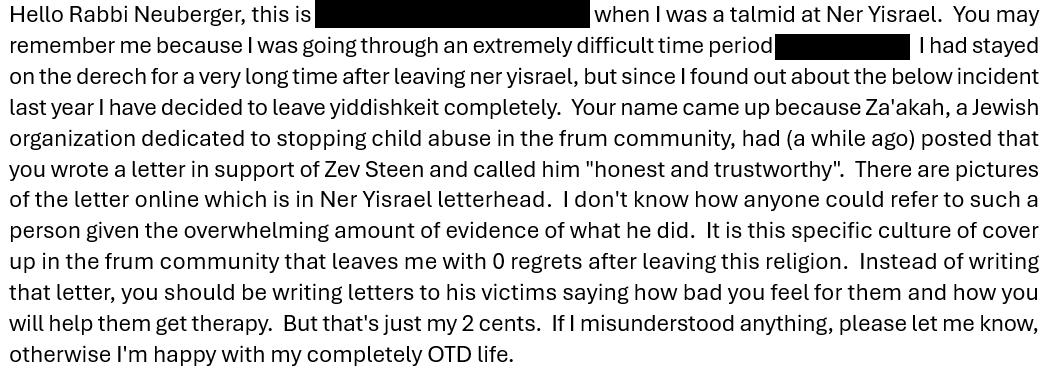
Yesterday a former student of NIRC contacted Rabbi Shraga Neuberger to ask him about the letter he wrote on behalf of Steen. Below is their exchange with commentary.

Neuberger’s Response:

What’s notable about his rationale is his claim that he was unaware if the accusations were true. Later on in the email exchange he seems to believe that the extent of the charges are related to CSAM possession and distribution, and claims that CSAM possession and distribution only directly harms the perpetrator, a dangerous misconception that leads many to minimize the actual damage it causes its victims. David Pelcovitz made the same error when he wrote a letter on behalf of Evan Zauder. In later statements addressing his writing of that letter, Pelcovitz claimed he didn’t know about the charges added against Zauder in a superseding indictment of trying to lure children to sexually abuse.

The problem is twofold: Either he actually didn’t know about the new charges, in which case he was grossly negligent when writing such a serious letter on behalf of a person accused of such serious crimes, or he knew and didn’t care and is only now claiming he didn’t know. Either way his rationale is a serious problem.

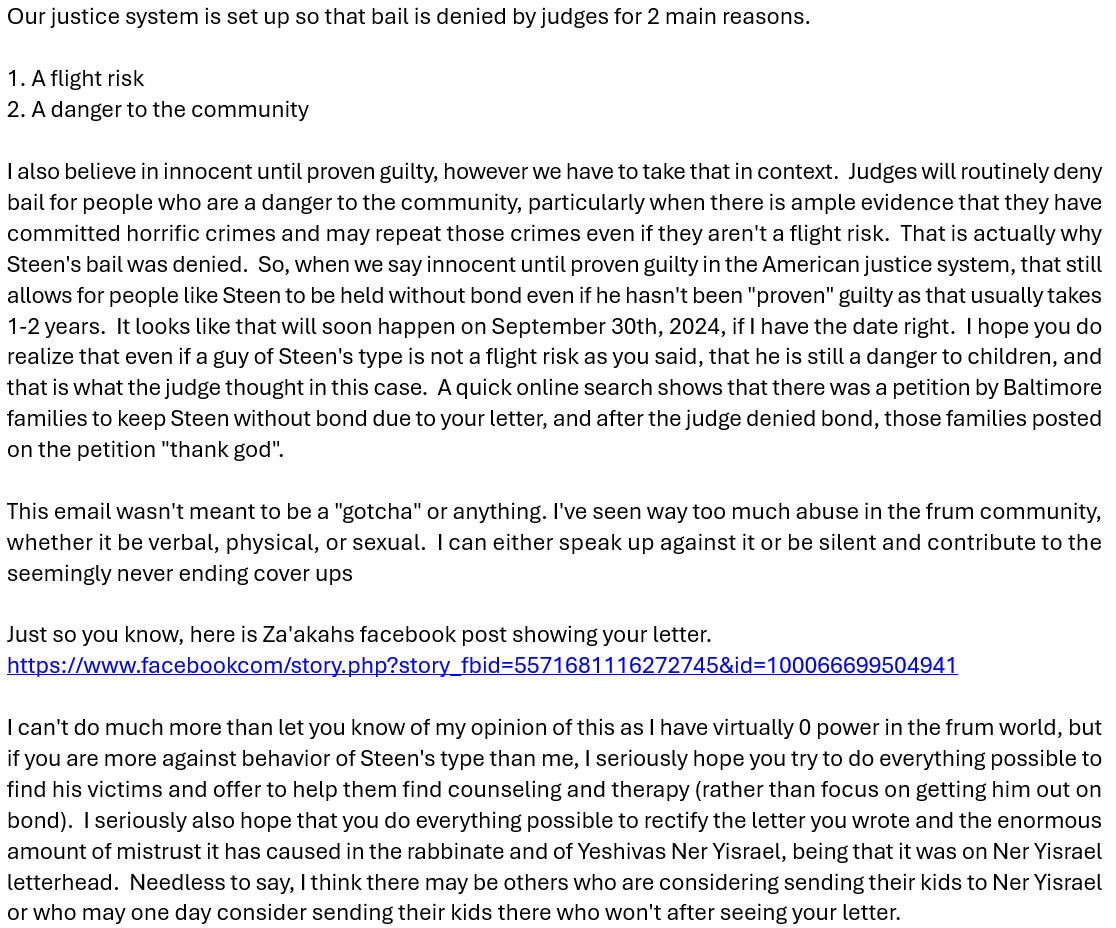
Furthermore, innocent until proven guilty is a copout. It’s a legal standard that exists to protect people from having their civil liberties violated by the government without due process, it is not meant to force us to pretend like we aren’t aware of the allegations or the evidence presented with them. A man who shoots another person in the face in broad daylight is also entitled to a legal presumption of innocence even as he stands there with the smoking gun in his hand. That doesn’t require that the bystanders help him reload.

The former student then responds:

Neuberger’s response:

In this response Neuberger, in Trumpian fashion, tries to turn the accusation around by claiming that he in fact cares more about abuse than the former student does and cites his connection to Shimon Russell, a well known therapist in the community who trusts him to consult on sexual abuse cases. He probably doesn’t realize that what he’s saying reflects very poorly on Russell who should not be consulting rabbis on sexual abuse cases, let alone rabbis like Neuberger who clearly don’t get it. Incidentally, Russel is director of training and development at Kesher Nafshi, an organization providing support to at-risk youth and their parents which has had Rav Mota Frank as a speaker several times despite his staunch and public support for convicted serial rapist, Rav Eliezer Berland. Birds of a feather.

Also notable is this allusion to inside information that he claims to have about a prior CPS interview of Steen’s children. The relevance of a CPS investigation that’s over a decade old is anyone’s guess.

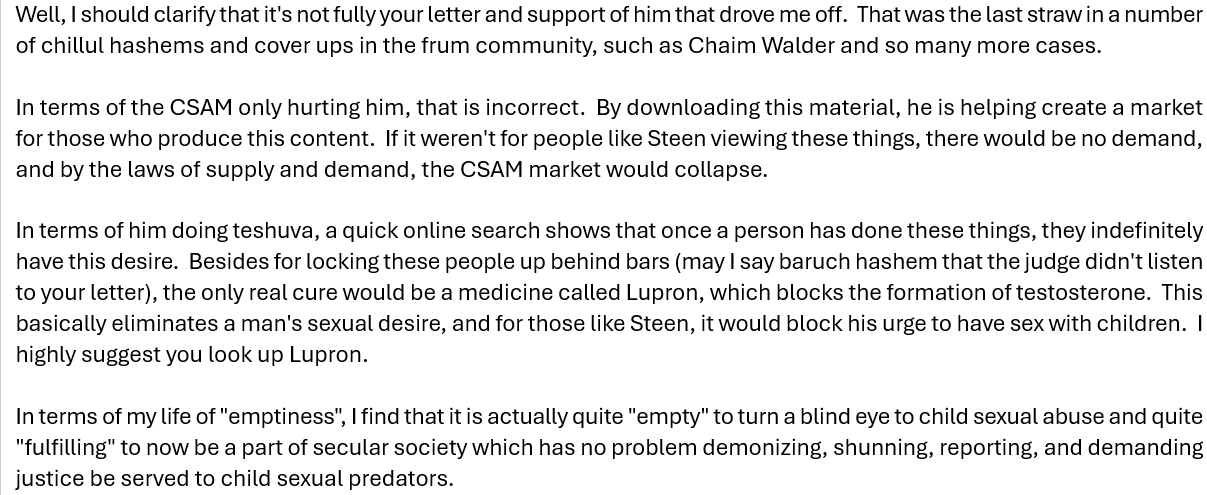
The former student then asks:

Neuberger’s response:

Typos aside, there’s a lot to unpack in this response. At the beginning of his response he claims that the only damage done in this case was to Steen himself, and that he has been going for help for years, whatever that means. This is a common tactic taken by abusers and their enablers who try to minimize the effects of CSAM on their victims. Victims of CSAM are directly damaged by the possession and distribution of the images of their abuse.

They live with the constant knowledge that an immeasurable number of people have seen their abuser and derived sexual satisfaction from it. They live in constant doubt about whether the people looking at them are just looking at them or are recognizing them from the images of their abuse. They can never fully heal because their abuse is never fully over. Every time it’s shared their abuse intensifies. Every time they are recognized by law enforcement in another collection discovered in an investigation and are notified that their images have been found their abuse continues. CSAM is the opposite of a victimless crime.

Another common tactic used by abusers and their enablers is claiming that the abuse they engaged in is no longer relevant or reflective of their character because they went to therapy. There are no treatments that can reliably remove the risk a pedophile poses to children, and pretending otherwise simply puts children in the community at risk. Enablers like Neuberger will do anything but center the victims in their calculus, instead feeling sadness for the abuser and expressing concern for their wellbeing.

The rest of the response is addressing the former student’s leaving of Orthodoxy. The juxtaposition of Neuberger’s expression of concern for Steen and his attacking the former student’s life away from Orthodoxy as empty and meaningless is jarring and disturbing. If the meaning Neuberger finds in frumkeit leads him to side with abusers and minimize the effects of sexual abuse then what is any of it worth?

Neuberger’s response:

In other words, you’re too stupid and misguided to understand the complexities of this case, so I’m done engaging.

The former student tries again:

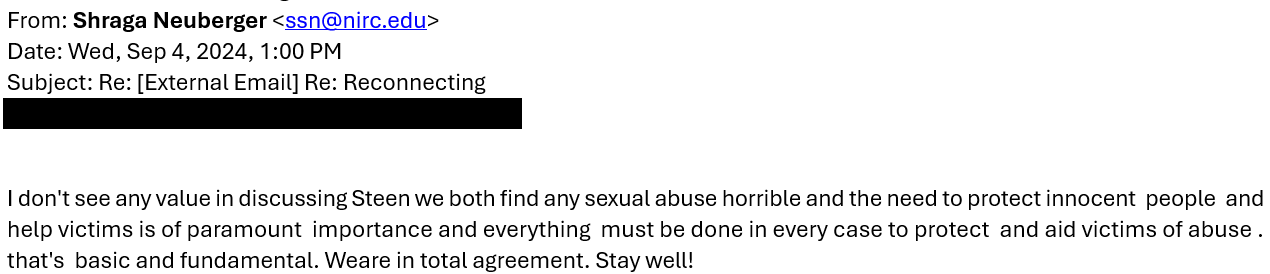
Neuberger’s response:

Here we see that after being informed (perhaps for the first time although that’s unlikely) that Steen actually was accused of directly sexually abusing a child, recording, and distributing it, Neuberger again engages in deflection. He doesn’t see value in discussing it because the only move left for him in this conversation is to acknowledge either his ignorance or his indifference, and that’s off the table for him. Instead he pretends that he cares about sexual abuse victims equally if not more than the former student does when all he’s done in this exchange has been center the abuser and defend and advocate for him. They are very clearly not in agreement, but Neuberger has nothing further to say for himself.

And of course, as with all of these rabbis and community leaders who defend and support abusers, there will be no consequences for his involvement in this case. No one will make him sit down and be educated. None of his peers and colleagues will tell him he’s wrong and explain why. Nothing will change.

Below is a screenshot from Steen’s plea agreement that Neuberger was sent by the former student. He has yet to respond to it.

Standard

Jury Awards Krawatsky Victims Compensatory & Punitive Damages

On Thursday the jury in the Steven Shmuel Krawatsky trial awarded two of the victims of Shmuel Krawatsky $1 each in compensatory damages, and $8000 each in punitive damages.

It’s a very strange ruling: Finding him liable for the sexual abuse of two boys, then awarding $1 each in compensatory damages, but $8000 each in punitive damages. I can’t say for sure, but I do have a theory that I believe explains what happened.

Generally when a jury finds someone liable but only awards $1 in compensatory damages it’s meant to send a message that the jury felt forced to rule against the losing party, and to essentially nullify the effect of their verdict they award only $1. But that’s not where the story ended here.

The burden of proof in a civil case is to preponderance of the evidence, which means that the evidence presented makes the facts alleged more likely to have happened than not. It’s essentially 50.1% likely to have happened. That’s what you need to prove to establish liability and compensatory damages in a civil case.

In order to additionally find punitive damages in a civil case the jury needs to find that there was clear and convincing evidence of malice by the defendant. Clear and convincing is more than preponderance. It’s not just that the facts alleged are more likely to have happened than not, it’s that the evidence presented makes you believe that it did actually happen. It’s not quite beyond reasonable doubt, but it’s a lot more than just more likely than not.

This jury found based on the preponderance standard that Krawatsky was liable for the sexual abuse of two boys, and that he owed them $1 each for that in compensatory damages, and then under the clear and convincing standard found that there was malice in his actions and awarded the boys $8000 each in punitive damages.

Very strange.

Having been in the courtroom for most of the trial overall and all of the damages phase of the trial, this is what I think happened. This case was a strangely structured case. Krawatsky sued the parents for defamation for accusing him publicly of sexual abuse. They they countersued him for abuse of their children. While the parents were party in Krawatsky’s case against them, they were not party to their case against him because they were merely acting on behalf of their minor children.

Their minor children had never incurred any expense in their own treatment because they weren’t the ones paying the bills. Their lawyer therefore couldn’t ask the doctors that testified about the amounts spent on their treatment because it wasn’t relevant to them. The boys themselves didn’t testify in the damages phase as to their own pain and suffering because their families didn’t want them to have to be cross-examined again after having given multiple depositions and having been cross examined by an asshole during the liability phase of the trial.

So there was no direct testimony given as to their pain and suffering in the damages phase, no direct testimony given about the actual expenses involved in their treatment. What was presented, by one of the boys’ therapists and an expert witness was the nature of their diagnosis, their prognosis, and the likely treatment plan they’d need in the future, but none of that came with a dollar amount attached.

The jury was then instructed to render a verdict on compensatory damages that adequately compensated the boys for their pain and suffering and noneconomic damages incurred (noneconomic damages meaning damages that didn’t have a direct financial cost to them), but part of the instruction said that they shouldn’t base the number they come up with on guesswork – that it should be based on the evidence provided.

They were also instructed that they were allowed to give nominal damages awards of $1. That instruction was specifically for assault, which was only relevant to the second victim, but the jury aren’t lawyers and that wasn’t spelled out. The families’ lawyers allowed that instruction because they thought it would make Krawatsky’s lawyers look like assholes arguing for it.

My explanation for what happened is this. The jury felt that based on the evidence presented during the damages phase they didn’t have a frame of reference or starting point for how to award compensatory damages so they just decided to punt the decision of how much to award the families to the punitive damages phase. At one point they sent out a question asking who gets the punitive damages, so they were clearly thinking about that and concerned with making sure the children would receive them.

What they didn’t know at the time they likely made that decision was that they would be instructed not to give a financially ruinous judgment of punitive damages. There was no such instruction given on the compensatory damages – if you do a ruinous amount of damages to someone it’s your own fault if you owe a ruinous amount of money to them, but punitive damages in Maryland can’t be financially ruinous.

Compensatory damages and punitive damages weren’t ruled on at the same time. The jury was first instructed on how to calculate compensatory damages, told to deliberate on those, and come back with a verdict. The verdict included the amount of compensatory damages, and a yes/no question about whether they believed he was liable for punitive damages. After they returned with a compensatory damages verdict, they were then given evidence on punitive damages in the form of Krawatsky testifying to his finances. Then they were instructed further and sent again to deliberate on the amount of punitive damages.

After the families’ lawyer ran through the extent of Krawatsky’s finances, he tried getting admitted all the money paid by other people on behalf of Krawatsky to his legal team, which totaled $2.5M billed directly to a third party who paid, and the various funds disbursed to him by the Israel Charity Fund set up specifically to funnel money to him, according to evidence presented by the families in various filings, but the judge ruled it inadmissible because the presence of third party money previously doesn’t mean he’d have access to it going forward especially if none of the third parties had any legal obligation to pay him.

Considering that the Israel Charity Fund was likely illegal in the first place, there certainly were no legal obligations for it to pay him at all.

Given that, and having heard his finances in excruciating details, without all the third party money he seemed like an average middle class guy living paycheck to paycheck with a small amount saved. Based on that, and the instructions they were given not to financially ruin him, they awarded each victim $8000.

To me that reads as a miscalculation by the jury, not a repudiation of their verdict. In cases where a jury repudiates their verdict by awarding nominal damages of $1 they never award punitive damages, which require a higher burden of proof.

Standard

The Trial of Steven Shmuel Krawatsky: Day Four – Krawatsky’s (Unsuccessful) Defense

Please note: Krawatsky has since been found liable for abusing two of the three alleged victims. We’re continuing to summarize the day-to-day of the complete trial to keep a public record.

On Friday, 2/9/2024, the Krawatsky’s began their defense against the allegations of sexual abuse. As mentioned in previous posts, while the Krawatskys had initially filed a defamation suit against the families and had then been countersued for the alleged abuse, the families were allowed to present their case on the abuse first since the question of whether or not the abuse happened was central to every other claim.

To start their case off the Krawatsky’s lawyer, Chris Rolle, called Detective Mike Davies, the officer assigned to investigate the sexual abuse allegations against Krawatsky.

He started by saying that he currently works at the Maryland highway safety office as a manager for community engagement, and previously worked at the Frederick County Sheriff from 2003 to 2023. He said that while at the Sheriff’s office he had started in patrol, then served as a community deputy, and then worked in criminal investigations specializing in crimes against persons, including sexual abuse. He said he had investigated likely over 100 cases of sexual abuse.

He said he had gotten numerous trainings for investigating sexual abuse, and that one of the most important for child sexual abuse was the Finding Words protocol, which was a protocol for interviewing children. He said it was a weeklong training that he took in 2009 which gave them methods for interviewing children including rapport building, identification of touch, inquiring about abuse scenarios, and how to question a child, including not asking leading questions, asking open ended questions, and avoiding yes/no questions.

He said that at the time interviews were not recorded because they were done at the Child Advocacy Center with a social worker or forensic interviewer, and police would watch the interviews on a CCTV in a separate room. He said he didn’t interview the kids in the Krawatsky investigations, but that Shannon Pulsipher and Brenda Lohman had done them.

Regarding the Krawatsky case he said the complaint came in on 8/19/15, and Pulsipher interviewed the first alleged victim at the CAC on 8/19/15 for about an hour. For the sake of the children being interviewed, he said, they try to limit the time of the interview to an hour or so, but not hours and hours. He said that after the CPS interview he met with the father of the first alleged victim.

Next, he said, he interviewed Krawatsky at his school. He said Krawatsky was not notified before the interview. He said that Pulsipher had scheduled the interview with Krawatsky and he knew she was coming, but not that Davies was coming. He said that up until that point there was nothing atypical about the case. He said Krawatsky was interviewed for 30-60 minutes.

Next, he said, he decided to see if the first alleged victim could take them all to where the abuse had happened to get a clearer picture of the layout of the facility. He said that the first alleged victim said it was a changing room or locker room and that Krawatsky – but was cut off by a sustained objection.

After meeting with Rabbi Dave at the camp, he said, he, Pulsipher, and the first alleged victim went into the locker room, leaving the father and Rabbi Dave at the doorway outside. He said that he and Pulsipher asked him questions about whether it looked familiar, and details of the abuse. He said that the first alleged victim confirmed the details, and then Davies went to see the layout of the pool area. He said there were other rooms on the backside of the locker room, on the pool side.

He described the locker room saying that when you walk in there’s boys on the left, girls on the right, then an exit to the pool at the end of the hallway. He said there’s only two ways in or out, one at either side of the hallway, and that the pool can’t be accessed from anywhere else but through the locker room.

He said that after they were done, Rabbi Dave and the father were brought into the locker room. He said that all 5 of them exited the other end of the locker room to the pool deck, then they walked to the lifeguard stand and the pump room. He said that he asked the first alleged victim if he had been to the lifeguard stand or pump room, and he said no. He said he took pictures of the pump room.

He said that they then all entered the locker room from the pool door and left through the locker room. He said that he, Pulsipher, and Rabbi Dave met to discuss the allegations, and the first alleged victim and his father left.

He said that he and Pulsipher were with the first alleged victim the entire time when Rabbi Dave and the father were outside, and that Rabbi Dave never came in. He said that he was never alone with Rabbi Dave and the first alleged victim. He said that he never unholstered his weapon, or made threats to the first alleged victim to withdraw his statement, and that he would never do such a thing.

After that meeting was over, he said, he had numerous meetings at the CAC with different teams. He started explaining all the people involved in such investigation and was stopped by a sidebar.

He said after meeting with the CAC group he interviewed the second alleged victim and another child who Rabbi Dave had mistakenly identified to him as being involved. He said that he interviewed the second alleged victim at his home with his father because his father requested that it be at home rather than at the CAC, which they accommodate when requested. He said that the second alleged victim didn’t disclose after Pulsipher interviewed him. He said the second alleged victim was asked questions about what the first alleged victim had said and he said that it didn’t happen. He said that the second alleged victim said he hadn’t been abused by anyone.

He said that to resolve the contradiction he reviewed the case with the state’s attorney’s office. He said that in the meantime he had received communications from the first alleged victim’s parents but didn’t recall what they were. He said that he reinterviewed the second alleged victim in December of 2015 at the request of Pulsipher regarding the playdate at the therapist. He said that that interview also wasn’t at the CAC.

At the second interview, he said, the second alleged victim said that something had happened, that he had been solicited with $100 to touch rabbi Krawatsky’s penis area one time.

He said he didn’t take any further steps in that investigation.

Davies said he testified at the CPS appeal hearing for Krawatsky on 1/13/2016. After that, he said, another case opened with Brenda Lohman at CPS. He said that he and Lohman met with the third alleged victim and his mother a the Child Advocacy Center. He said that he learned in that interview that the mother of the first alleged victim and the third alleged victim had spoken. The two are aunt and nephew. He said that the mother of the first alleged victim had told the third alleged victim about the importance of not lying and what could happen if he did.

Davies repeatedly referenced his notes during the direct examination.

He said that the mother of the first alleged victim told the third alleged victim that people who lied would blow up inside, according to the child’s mother. After talking to the mother of the third alleged victim, he said, Lohman talked to the third alleged victim. He said that he watched from an adjoining room at the CAC. He said that Lohman asked the third alleged victim how many times it happened, and he said it had happened several times.

He said that the third alleged victim told Lohman that other kids were in the locker room at the time the abuse happened, but didn’t identify any of them. He said that the third alleged victim had said he’d discussed with his mother what he’d say at CPS. He said he doesn’t recall what the third alleged victim’s mother said before the CAC interview.

After that, he said, Krawatsky was interviewed again at the CPS office. He said he then reviewed the third alleged victim’s case with the state’s attorney’s office and took no further steps. For this investigation, he said, he had interviewed 3 junior counselors as well who worked in the same age group as the alleged victims.

On 1/5/2017, he said, he was notified by CPS to meet with Lohman at the CAC to interview the third alleged victim regarding new allegations. He said he went to the CAC, and this time they had a dedicated forensic interviewer, Kirsten Dunn, do the interview, and he and Lohman watched from a CCTV feed. He said that the third alleged victim made additional allegations that Krawatsky had touched his penis and butt, and put his penis in his butt, and that Krawatsky had him put his own penis in Krawatsky’s butt, and that there was oral sex both ways numerous times over three different summers in the locker room and changing room areas. He said that the third alleged victim identified himself as being the only child present during these incidents.

He said he then reviewed with the state’s attorney and took no further steps. He said that he is not friends with Rabbi Dave, and that prior to these allegations the two had never met or had any prior communications. He said that he is not aware of any other allegations against Krawatsky, and that his investigations were not compromised in any way.

He said that he had never requested any search warrants for anything in this case including for Krawatsky’s phone.

Direct examination ended and Annie Alonso cross examined.

She asked him if during the first investigation into the first and second victims’ allegations he was aware that the allegations had only been reported 84 hours after they were reported to Rabbi Dave, and he said that he had found out later in the investigation. She asked him if he was assigned with Pulsipher on the first two cases and he said yes.

She asked him to confirm the following details: That he said he was assigned with Pulsipher on the first two cases; That the first step was to interview the child; That he watched Pulsipher interview them; that he didn’t leave during the interviews; That the interviews were not recorded; That the first alleged victim never alleged he was abused in the pump room; That the boy incorrectly identified by Dave said he didn’t see anything, and that the victim said the boy who had walked in had come in at the very end of the abuse anyway; that the first alleged victim claimed that Krawatsky was naked; That Davies next spoke to the father of the first alleged victim and never met with his mother; That he next went to the house of the second alleged victim with Pulsipher, while armed; That the second alleged victim’s father was there, and that he spoke to the second alleged victim about the allegations while Shannon and the father were in the house.

She then asked him if the second alleged victim actually said he denied it at one point and then kept saying he didn’t remember, and Davies said he didn’t describe that, and that maybe Pulsipher’s interview had that detail. She asked him if after the second alleged victim’s interview he spoke to Rabbi Dave, and he said that he had but not on the same day. She asked him if he had asked Rabbi Dave to email him if he had any more information and if he knew that Rabbi Dave was the director of the camp, and he said yes.

Regarding his interview with Krawatsky at his school on 9/2/2015 She asked him if he hadn’t asked Krawatsky to come to the police station or CAC and hadn’t recorded it, and he said yes. She asked him if he had Krawatsky if he had ever gone into the locker room, and he said that he hadn’t because he assumed Krawatsky had to go in there for work.

She asked him if he could have issued any search warrants in this case, and he said that he could if he had felt there was probable cause for one. She asked him if he had asked for any, and he said that he hadn’t, including for Krawatsky’s phone, computer, and house. She asked him if he had ever verified that Krawatsky had actually changed in a utility closet (implying not with the boys) and he said no, other than later with some junior counselors.

Regarding the trip to Shoresh on 9/8/2015 with the first alleged victim, he confirmed that it was with him, Rabbi Dave, Pulsipher, the first alleged victim, and his father, and asked him if they had all gone into the locker room, and he said yes. She asked him if there were no video cameras there at the time in 2015, and he confirmed.

She asked him if he had Rabbi Dave, Shannon, and the first alleged victim walk through, and he said that Rabbi Dave wasn’t a part of the walkthrough. She asked him if he remembered testifying at the CPS hearing on 1/13/2016, and he said yes but he didn’t remember what was said. She read a part of his testimony from that hearing which was that Rabbi Dave took them all to the the locker room and unlocked the door, camp wasn’t in session at the time, and Rabbi Dave walked them through the locker room to show them where the incident occurred.

She asked him if at that point he was aware that the first alleged victim was 7 years old, and he said he would have known at the time. She asked him if he had his gun that visit, and he said yes. She asked him if he remembered if the first alleged victim was about waist height, and he said that he remembered him being average height for a 7 year old. She asked him if he and Pulsipher spoke to him about what happened there, and he said yes. She asked him if the first alleged victim had made any disclosures about what had happened, and he first seemed to not remember, but then said that the first alleged victim had made the allegation about being offered $100 to touch Krawatsky’s penis.

She asked him if he thought it might be traumatic to bring a child victim to the location of his abuse, and he said that it could go either way which is why they reviewed the idea internally, and had CPS ask the parents for permission. She asked him if it’s usual to gather evidence with victims, and he said sometimes.

Regarding the follow-up visit with the second alleged victim on 12/22/2015 (at his therapist’s office) she asked him if before that visit, on 12/8/2015, he had closed both the first and second cases, and he said yes. She asked him if anyone had needed his approval to have the two boys meet, and he said no. She asked if it was because it was case closed and there was no further evidence gathering, and he said yes. She asked him if when he arrived the parents of the first alleged victim were there, and he said no.

She asked him if he and Pulsipher decided to speak to the second alleged victim and he said yes. She asked him about his demeanor and he said he didn’t remember. She followed up asking if the second alleged victim had been scared or shy, he said could be.

She asked him if when he met with the second alleged victim that second time he had disclosed that Krawatsky had done something mean, and he said yes. She asked if he recorded it, and he said no. She asked if he spoke to the second alleged victim’s parents, and he said yes but that he didn’t record that either. She asked if he learned there was a recording by the mother of her son’s disclosure, and he said yes, but he didn’t remember getting the recorded. She confirmed to him that it had never been provided to him.

Regarding the investigation of the third alleged victim’s allegations she asked if he had gotten that on 2/9/2016 and was assigned to partner with Brenda Lohman, and he said yes. She asked him about CPS scheduling the interview and if he had spoken to the third alleged victim’s mother about her son’s disclosure, and he said yes. She asked if the mother had said she’d seen some odd behaviors from her son including self-hating talk and smearing poop on the bathroom walls, and he said yes. She asked him if Lohman had conducted the interview while he watched, and he said yes.

She asked him if the third alleged victim had had a stuffed animal with him at the time, and he said he didn’t. She showed him a copy of his report to refresh his memory, and he said that the third alleged victim had had a stuffed animal but didn’t remember what it was. (When the third alleged victim had testified in court he had been clutching a small stuffed rhinoceros.)

She asked him if after that interview he had decided to talk to Krawatsky, and he said yes. She asked if he had set that interview up with Krawatsky and his lawyer, and he said that Lohman had. She asked if he had gone along and he said that he had gone unannounced to the meeting at the CPS main building, and that the meeting wasn’t recorded.

She asked him if at that interview he found out that Krawatsky had learned about the allegations from Rabbi Dave (before the surprise interview), and he said yes. She asked him if Krawatsky had said he had never disciplined the third alleged victim in the locker room, and he said yes. She asked him if Krawatsky had said he’d been in the locker room with the third alleged victim, and he said yes, but only as a group. She asked if Krawatsky had denied being alone with the third alleged victim in the locker room and he said yes.

She asked him if Krawatsky had said that counselors change in the locker room, and he said yes. She asked if any of these interviews had been recorded, and he said no.

She asked him if he’d spoken to some counselors given to him by Rabbi Dave, and he said yes. She asked if he’d asked the counselors if they’d spoken to Rabbi Dave (about the case) and he said no. She asked if that was the end of the investigation, and he said yes.

She asked him if he was once again assigned to the third alleged victim’s case with Lohman in January of 2017, and he said yes. She asked if the third alleged victim, at age 9, had come to the CAC nervous, and he said yes. She asked if it was not recorded, and he said yes, but that he and Lohman had watched the interview on CCTV. She asked if there was a disclosure and he said that there was. She asked if after that disclosure he had scheduled another interview with Rabbi K, and he said no. She asked if he had closed the case on 2/20/2017, and he said yes.

Going back to the second alleged victim, she asked him if he remembered when he went to the house to interview the child and his father, and he said yes. She asked him if he remembered that the second alleged victim had had an MRI and had been under sedation, and he said he didn’t believe so.

Cross examination ended and Chris Rolle redirected.

Rolle asked Davies if he was asked (just a few minutes before) if the second alleged victim had said that Krawatsky had said something mean, and he said yes. Rolle asked if Pulsipher had followed up on that and he said that she had in the second interview. Rolle asked if he remembered what was said, and he said he’d have to go back. Rolle let him review his notes, and then he said that initially the second alleged victim had said no, but had then said yes.

Regarding the meeting at the camp in September of 2015 Rolle asked if he had testified upon cross that Rabbi Dave unlocked the doors of the locker room, and he said yes. Rolle asked if he had a chance to review the locks during the investigation, and he said yes, there were no internal locks inside the room, and it was only lockable from the outside. Rolle asked him if someone could lock it from the inside, and he said no.

Rolle asked him to describe the locks from the outside and he said there was a latch on a shed or outside garage door, a lock and a padlock, and on the inside was just a door handle.

Redirect ended and Davies was excused.

Next was another De Bene Esse deposition video showing testimony from Adam Lombardo, counselor to the first and second alleged victims, and self-described mentee of Shmuel Krawatsky. An attorney for Camp Shoresh, which was a party to the case at the time, questioned Lombardo. Adam is originally from Silver Spring but now lives in Jerusalem. His highest education is high school, and he’s in Yeshiva now in Jerusalem. He wants to be a community leader and help develop communities.

Adam said he was employed by Shoresh between 2014 and 2017 when he was between 15 and 18 years old. He said that before beginning his work at Shoresh he had to complete a background check, had to be fingerprinted, and had to attend a mandatory orientation for all staff led by Drew Fidler, a social worker and child protection policy expert. He said that Fidler spoke to them and showed a PowerPoint about crucial parts of camp, including rules about no lap sitting, no touching of campers, no being alone with campers at any point in camp.

He said he remembers the reporting policy being to report “up and out,” which he explained means that if you see something concerning about a child you report up and out to a head counselor and that counselor reports to Rabbi Dave or Phran Edelman and then you were relieved of the matter. (Maryland law, as of at least 2014, requires that all persons who are aware of child abuse or neglect report it directly to the relevant authorities.)

He was shown a 19 page slide and questioned about their contents.

He said he recalled receiving a presentation regarding a slide that said “Protect camp” and remembered Fidler giving a presentation about the bullet points on that slide. He said he remembered the slide about how to discover abuse and how to respond if you hear or suspect abuse. He said he remembered a slide with a flowchart of specific examples of what abuse includes. He said he remembered learning about “up and out” reporting.

He said that he received a staff handbook when working as a counselor. He said he had reviewed the handbook prior to the deposition. He was asked to look over the section called “Staff with Campers” and the sub-heading “Relationships and Inappropriate Intimate Behavior.” He reviewed the sections on verbal and physical contact. He said that while working at Shoresh he never saw a staff member inappropriately touching, kissing, back rubbing, massaging, slapping, or spanking any camper.

He reviewed the section on physical punishment never being appropriate, and said he had never seen a staff member strike a camper.

Regarding the section on child abuse prevention and reporting he reviewed the first bullet point saying that all staff must be fingerprinted and background checked with CPS, and said he had to do that before working at Shoresh. Regarding the bulletpoint about suspected child abuse he said he recalled the reporting policy of the camp to be be reporting “Up and Out.”

In explaining “Up and Out” he said that meant he would report to Rabbi Dave if he was there, and if not he would go to a head staff member. He said his direct supervisor would have been Rabbi Krawatsky.

Regarding the section describing the job description of a counselor and general responsibilities, he read the second bullet point which said to stay aware, keep an eye on all campers, and make sure everyone is safe.

(The general gist of this part of his testimony is to demonstrate that the camp had policies and mandatory training of those policies required for all staff.)

He said that he had a concern for one of his campers, the second alleged victim, because he would at times, when things didn’t go his way, have a tantrum and start being violent, like pushing, shouting, screaming, losing control, which Adam said made him concerned. He said he remembered some of this violence being directed at the first alleged victim who was in the same bunk.

Regarding the handbook saying that counselors must be in the pool with kids unless they were a designated watcher, he said that designated watcher meant sitting in a chair by the pool watching the kids who were sitting on pool chairs, lounging around, playing sports next door, making sure they were there, or that if a camper needed a restroom that their counselors were aware of it.

Regarding the missing persons section of the handbook he was asked if there was a time when he was a counselor in 2015 when any of his campers went missing, and he said that the second alleged victim had at some point gone missing while doing an activity. He said that something had not gone the first alleged victim’s way and he had a tantrum and fit and lost his cool and started running. He said he pursued the second alleged victim who ran to the community center and was found with his mother who was trying to get the situation under control. He said that the second alleged victim’s mom worked at Shoresh, and that other than that one incident he didn’t recall any other missing camper incidents.

He discussed the policy regarding notifying a lifeguard if a camper was missing during buddy check and said he recalled buddy check being running down the numbers every camper was assigned at the beginning of camp to see if everyone was there. Other than the incident when the second alleged victim ran off, he said, there were no other missing campers.

He recalled being assigned to bunk aleph for all 3 summers he was employed at Shoresh. After being shown a camp roster he recalled that first session of 2015 he had 9 campers, and that two of them were the first and second alleged victims. He said that there were two counselors assigned to bunk aleph.

He said that he recalled the first alleged victim as being a sweet, happy kid, very cheery. He said his recollections of the second alleged victim were that he was a sweet, very nice kid aside from when something wouldn’t go his way and he’d go be difficult and go into rages. He said he didn’t remember how frequently these rages happened. Asked to recall two other campers (they believed may have been the boys referenced by the first alleged victim as having walked in at the end of one of the abuse incidents) he said that one was nice, not athletic, and liked to play cards, and the other as a fun, lively, good time kid.

He described the typical schedule for kid in his bunk as everyone getting on buses, coming to Adamstown, where the camp was, getting off the buses, joining their appropriate groups for davening, then going to first activity, which for them was usually swimming, followed by another period, then lunch, learning, then two more periods, then dismissal. He said that lower boys division had 5 bunks.

After being shown a schedule he recalled swim session being 50 minutes. He said that approximately 60 kids in the division would be swimming at the same time, with at least 10 counselors and a few lifeguards present. He said the pool was right in the middle of camp – really center stage – and that the boys locker room was attached to the pool area. He said that while swim was scheduled no campers could be at another activity.

In describing the scene during lower boys’ swim he said that it was controlled chaos because a bunch of kids were running around, and there are kids and counselors in and out of the water, and around doing stuff. He reiterated that the morning started with davening and then went into swim. He described the scene in the locker room prior to swim as kids all over the place, excited, running into bathroom and shower stalls to get changed, with some kids already dressed, and everyone being excited to jump in the pool.

Once swim began, he said, if a camper needed a bathroom one of the counselors that were on the side would escort them to the bathroom. He said that counselors were told to check the bathrooms periodically during swim sessions. He said that if his bunk was assigned to a different activity after swim they would use the bathrooms at the pool primarily, and that if counselors had to use the bathroom they would use the poolhouse bathroom.

He said that he recalled no point during the day when the locker room was closed or locked so boys couldn’t use it. He said that he didn’t remember where counselors would change when getting ready for swim. He said that he didn’t remember where Krawatsky changed but that he doesn’t remember him changing in front of kids in the boys locker room.

He said that while he was a counselor he never observed Krawatsky walking around naked in the boys locker room, or any rabbis or staff doing so, and didn’t recall seeing Krawatsky propositioning any kids in the locker room, sexually assaulting any campers there or anywhere at Shoresh.

He said he was aware of the allegations and remembered being contacted by law enforcement. He said he remembered Davies asking if he had spoken to the first alleged victim’s mother and he said he remembered her being very frantic and expressing to him that if he lied she was going to subpoena him and bring him to court, and that he shouldn’t lie (repeatedly stated).

He said he didn’t remember who contacted whom for that conversation, and didn’t remember asking her questions during that conversation.

He said that he recalled testifying previously on this case and was shown a transcript of that deposition. Using that to refresh his memory he said that he remembered the first alleged victim’s mother asking if he had noticed Krawatsky going behind curtains with either her son or the second alleged victim, and he said he didn’t remember that. He said that he was 17 at the time of that conversation.

During the summer of 2015, he said, the first and second alleged victims never reported to him any issues with Krawatsky. He said he knew Krawatsky since 2015 and never saw anything suspicious about Krawatsky’s interactions with kids at Shoresh.

He said that he became a counselor to share his energy and love for Judaism and make some money. He said he made bonds with the kids and the camp and cared for and took care of the children. He said that with that care and love he would report abuse if he saw it and wouldn’t deny it just because he liked his boss. He said that reporting abuse would be an important goal of his and said he saw no abuse from anyone in ca mp toward any of the kids, and never suspected any of Krawatsky for the entire time he was at Shoresh (2015-2017).

He said he spoke to other counselors as part of the camaraderie and social aspect of camp.

(At this point court ended for the day, but to keep the coverage easy to follow I’m including the rest of Lombardo’s deposition from Monday 2/12/2024)

Adam was then questioned by Jon Little. Jon asked him how he had known there was a transcript of the CPS hearing (which he later mentions testifying at) and he said he was made aware by the camp lawyer. Jon asked him when the last time he spoke to the camp lawyer was, and he said that they’d spoken the day before (the deposition) for about an hour about prepping for the deposition.

Jon asked him when the last time he spoke to Krawatsky was and he said the previous Monday, and that they spoke about Adam getting names of funders in the community to help him raise funds for his studies.

Jon asked him when the last time he spoke to Rabbi Dave was and he said two months prior they had spoken about him coming back to Shoresh as a division head. Jon asked him how often he spoke to Rabbi Dave and he said that he didn’t keep track but not often, but that he wanted to. Jon asked him when was the time before last that he had spoken to Krawatsky and he said that it was about 5 months prior. Jon asked him how often he had spoken to to the camp layer before the previous day and he said that they had corresponded by email but he didn’t remember when or how frequently.

He said he remembered testifying at a CPS hearing when he was 17 and that after that hearing he went back to Shoresh. He said that Rabbi Dave knew he was testifying about that, but didn’t remember if they had discussed his testimony.

He said that Krawatsky was his supervisor in 2015 and that the camp had a policy of not texting. Jon then asked him if Krawatsky was exempt from that policy and he said yes because Krawatsky was a master educator. He said that he learned Krawatsky was exempt when Krawatsky texted him. He said they would have been in contact (by text during the summer).

Jon asked him if he had ever called Krawatsky to help with the second alleged victim’s tantrums, and he said yes, because Krawatsky was his head counselor, but didn’t recall how many times.

Jon asked him if when he had testified for CPS he had said that the first alleged victim had had a problem with a counselor named Jacob Zelaya, and asked him where he’d gotten that information from, and Adam said he didn’t remember. Jon asked if that information had come from Rabbi Dave and he said he didn’t remember.

Referencing the camp schedule he’s been shown Jon asked him if before the pool activity the locker room would have been empty, and he said yes. Jon asked him about his use of the term center stage to describe the pool area and asked him if he had discussed the pool area’s traffic with the camp lawyer before his deposition, and he said yes.

Jon showed him a copy of the CPS transcript and asked him if he’d said that kids could go to the bathroom during swimming, and Adam said yes. Jon asked him if he had testified that there was a head counselor watching them during swimming and if that head counselor was Krawatsky, and he said yes.

Jon asked him if in 2015, after camp, he had reached out to the parents of the first and second alleged victims on a Friday by phone, and he said yes. Jon asked him if those were the inly families he called after camp in 2015 and he said yes. Jon asked him if that was because Rabbi Dave had asked him to, and he said no. Jon asked him why he did it, and he said it was because of his good conscience.

Next he was questioned by David Mulquin, a lawyer for the family of the first alleged victim.

Mulquin asked him when the last time he had seen the orientation presentation before that day, and he said that he’d seen it the day before. Mulquin asked him if when the camp lawyer had asked him in the deposition to rely on his recollection about the presentation from 2015 he had actually seen the document the day before, and he said yes. Mulquin then asked him when the last time he had seen the PowerPoint, and he said the day before. Mulquin asked him if when the camp lawyer had asked him to think back to 2015 about that document he was actually relying on his memory from the day before, and he said that it had jogged his memory as to what he’d seen in 2015.

Regarding buddy check, Mulquin asked him if that was something done at the beginning of an event, and he said yes. Mulquin asked him about his recent contact with Krawatsky asking if Adam had called Krawatsky or the other way around, and he said that he had reached out to Krawatsky looking for help with potential fundraising for his school. Mulquin asked him if during the course of that conversation he had mentioned to Krawatsky that he was doing a deposition, and he said yes.

Regarding Adam’s last conversation with Rabbi Dave, Mulquin asked who had called whom, and he said he had called Rabbi Dave. Mulquin asked him if during the course of that conversation they had discussed him coming back as a division head, and he said yes. Mulquin asked him if rabbi Dave had made an offer, and he said he had asked Rabbi Dave and Rabbi Dave had said he was going to bring it up the following week.

Mulquin asked him regarding his conversation with the mother of the first alleged victim if it was fair to say she had told him not to lie, and he said yes. Mulquin asked him if she had emphasized that it was important that he not lie to her and he said yes. Mulquin asked her if she had told him what to say and he said he didn’t remember. Mulquin asked her if when he was asked earlier about it he had said that she had emphasized that he not lie to her, and he said yes.

Mulquin asked him if after that call with the first alleged victim’s mother he had called Rabbi Krawatsky, and after refreshing his memory he said yes. Mulquin asked him if after his conversation with Krawatsky, Krawatsky had told him to call his lawyer, and he said yes.

Kurtz then asked some questions.

Kurtz asked him if it was standard policy that he couldn’t text campers but that he was allowed to text Krawatsky and he said he was only allowed to text Krawatsky. Kurtz asked him if he remembered anything about there being a policy about having a phone or not, and he said yes. Kurtz asked him if he just remembered Krawatsky being exempt and he said yes.

Kurtz asked him if he would cover or lie to protect a child molester for donations to his school, and he said no.

Kurtz asked him if when the mother of the first alleged victim told him “don’t you lie to me” he had taken that as “hey, please say the truth” or as a threat, and he said he had perceived it as hostile from the tone of her voice.

Kurtz asked him regarding the bathroom policy at the pool if Krawatsky was one of the counselors who would be in a position to take kids to the bathroom, and he said he didn’t recall.

Lombardo’s testimony ended.

Following the first day of the Krawatsky’s defense the judge ruled to dismiss one of the counts against Krawatsky in summary judgment. The count was invasion of privacy which had been alleged mainly against the camp and Rabbi Dave in particular for allegedly leaking private school records from the second alleged victim, but the camp and Rabbi Dave had previously been dismissed from the case in summary judgment. The remaining counts were left intact.

The families’ lawyers tried arguing that the count should be preserved because the allegation made in court about the pictures Krawatsky allegedly took of the boys after abusing them would also be an invasion of privacy if they had been distributed (which couldn’t be established because Krawatsky’s phone just happened to stop working right when he filed the lawsuit), but the judge dismissed it on summary judgment nonetheless.

Standard

The Trial of Steven Shmuel Krawatsky: Day Three Part 2

The next witness was the father of two boys who attended Shoresh. One of his children is nonverbal and has Down Syndrome and had a paraprofessional shadowing him while he was at camp. He will be identified in these notes as Hersch, which is not his real name. His name was spoken in open court and is part of the public record, but it is being hidden here at my discretion to protect the identities of his children.

He said that he didn’t know any of the parents of the three alleged victims in this case. He said that he did know Rabbi Dave from when his children attended Shoresh. One of his sons, he said, attended Shoresh in 2014 and 2015, and his other son – the one who required the shadow – attended in 2015.

He said that his son is special needs, and has Down Syndrome, and at that point used very few words, mainly communicating using a limited number of single words. The first day his nonverbal son attended Shoresh, he said, Rabbi Dave called him and said that he wasn’t adjusting well and suggested that he hire a shadow for his son.

He said he doesn’t remember the shadow’s name, but he was 19, went by a hebrew name, was a big, heavyset guy, most likely in college but didn’t seem very sharp, so he got along well with his son. He said that for a number of years his son had carried a backpack full of Hot Wheels and other small cars that he’d take everywhere, both at home and at camp.

He said that his other son sometimes came home missing his underwear. He said that this was not the first camp he’d sent his kids to, and he’s sent them to many camps since, and nothing like that had ever happened at any other camps he’d sent his kids to before.

Direct examination ended and Chris Rolle cross examined Hersch.

Rolle asked him if the name of the shadow was Meir Samberg, and he said that sounded right.

Cross examination ended and Hersch was excused.

Next Jon Little called the first alleged victim.

Jon asked him what he likes doing for fun, and he said that he likes being outside and collecting rocks, and enjoys playing guitar. He said he is currently in 10th grade. In 2015, he said, he was around 7, and that summer at Shoresh was the his first time at camp. He said that on his first day, like any first day anywhere, he was getting used to what’s what there. His older brother and brother were also there, he said.

He said he occasionally saw his sister there but not much because the boys and girls were segregated. He said he also only occasionally saw his brother who is two years older than him. He remembered meeting Krawatsky, he said, and identified him in the courtroom. He remembers the first time meeting Krawatsky, he said, as being during davening in the morning. He said he remembered encountering Krawatsky in other places too, like the locker room.

His first time in the locker room, he said, he accidentally got water in his eyes in the pool and went into the locker room to get a towel which is when he walked in on Krawatsky with the second alleged victim. The second alleged victim, he said, was standing there nearby facing toward Krawatsky, and Krawatsky looked surprised and taken aback to see him, but smiled and didn’t seem to affected by his presence. He said that Krawatsky bet them $100 that neither of them would touch his penis.

He said that he himself didn’t touch it, but that the second alleged victim hesitantly put his hand on Krawatsky’s penis and moved his hand along it. Both of them, he said, were around 7 years old at the time. Before camp, he said, he hadn’t known either Krawatsky or the second alleged victim. When the second alleged victim moved his hand up and down Krawatsky’s penis, he said, Krawatsky ejaculated onto the second alleged victim’s hand and part of his arm.

Back in 2015, he said, he didn’t know what ejaculation was, and didn’t know what semen was, but he saw a substance go onto the second alleged victim’s arm.

After that, he said, he left the locker room afraid and not really sure what had happened. He said he was freaked out and didn’t know what to do, and before he left he saw Krawatsky grab the second alleged victim’s arm and pull him into a stall. He said he didn’t tell anyone when it happened because he was scared and hadn’t really understood what had happened, he was 7 and didn’t know much of anything and didn’t know if anyone would believe him.

He said he saw Krawatsky again when Krawatsky spoke to him and told him to come into the locker room during swim a few days later. He said he complied because he was freaked out and was afraid Krawatsky would get angry if he didn’t. He said he entered the locker room and saw Krawatsky in there naked, the second alleged victim was there too, and when he entered Krawatsky said hi to him and bet the two boys $20 that neither would touch his penis. He said that he hesitantly touched Krawatsky’s penis at first and then pulled his hands away, but Krawatsky grabbed his hands and forced them onto his penis.

He said that Krawatsky forced him to move his hands up and down his penis until Krawatsky ejaculated onto arm. Again he reiterated that he didn’t know what masturbation or ejaculate was at the time. He said he had been wearing a green paper wristband on his arm, the kind you get as a pass at attractions (according to previous testimony such wristbands were given to kids who were going to swim in the pool). Following that incident, he said, Krawatsky pulled the first alleged victim into a stall, and he left and went into the pool to wash the semen off his arm.

He said he had another encounter in the Shoresh locker room a few days later when Krawatsky told him on the way to the locker room to come on during swim “or else.” He said he complied because he was scared. He said he felt violated and out of control and new he didn’t want that done to him again, but felt afraid and intimidated by Krawatsky since he was small and Krawatsky was bigger and older than him. He said that even now he may be intimidated enough by such a scenario to comply with it.

He said that at the time he was Orthodox and respected rabbis. He went in, he said, and saw Krawatsky standing there naked, and that it looked like the second alleged victim had arrived before him. This time, he said, Krawatsky bet them $150 that neither of them would stick their hands up his butt, but neither boy did it. He said that in response to their defiance Krawatsky said they were the worst kids for not listening, and that he picked up the second alleged victim, pulled off his swimsuit, and raped his anus. He said that the second alleged victim was being held away from Krawatsky with his back to Krawatsky and that Krawatsky had an erect penis and put it in the second alleged victim’s anus.

He said the second alleged victim looked terrified, was crying, and shaking a little, and that Krawatsky went on for a minute or two – he wasn’t counting – and when he was done he put the boy down and said that what he had just done to him was normal and that if either of them told anyone what he’d done they would do the same to them.

He said that Krawatsky told him to come into the locker room the day before the camp Shabbaton. He said he went down to the pool area to try and get his brother’s attention to tell him about what had happened, but his brother was preoccupied with basketball in the pool so he talked himself out of telling his brother because he was afraid.

He said he only attended Shoresh for the first session in 2015.

He said he again encountered Krawatsky that summer the night before the Shabbaton when he came into the locker room as Krawatsky had instructed. He said Krawatsky was there wearing nothing, the second alleged victim was there, and Krawatsky told them that they were terrible for not listening to him. He said that Krawatsky told them they were bad, and picked up the second alleged victim so his back was against Krawatsky, pulled down the boy’s swimsuit, and then put his penis in the boy.

He said that Krawatsky then put the boy down then picked up his phone and took a picture of the boy putting his swimsuit back on. He said the second alleged victim was terrified, whimpering, sad, and afraid. He said Krawatsky then picked him up, pulled down his swimsuit, and raped him while his back was toward Krawatsky. He said Krawatsky penetrated his anus most of the way in. He said he felt really bad, that he was shaking, and scared. He said Krawatsky then out him down, his penis was shaking, and then he took a picture of him trying to put on his swimsuit. He said he didn’t remember that time if Krawatsky ejaculated on or in either them.

He said he remembered feeling physically violated, remembered bleeding onto his swimsuit, and feeling physically disgusted with himself and what happened, and that after that he felt gross and disgusting. He said he went back to the pool feeling shaken up and afraid, not knowing what to do, and that Krawatsky had reiterated his threat that if they told anyone that person would do the same to them as Krawatsky had done.

He said that he never consented to any of it (not that he would have had to, children are incapable of consenting to sexual activity with adults).

After Krawatsky raped him, he said, he tried to find his brother but didn’t succeed in finding him. He said that after all four incidents he told no one. He said he had other interactions with Krawatsky at Shoresh that summer. One day during davening, he said, he was running around and Krawatsky came over to him, grabbed him, told him he was the worst kid ever for not doing as he was told, and shook him. He said that he was Orthodox at the time and prayers were important, and that he had interrupted prayers.

He said he remembered one time on the soccer field, when he got stung by a bee, that Krawatsky came over and said he wanted to take him to the nurse and seemed agitated. He said he didn’t want to go with Krawatsky because Krawatsky had hurt him, and he was scared to go with him. He said another counselor ended up taking him to the nurse.

He said he remembered one other time strongly that when they were ziplining in camp and he was coming off the zipline, he banged his knee on the ground and was in pain. He said that Krawatsky was nearby supervising an activity and tried to take him to the nurse, but he was too scared and refused to go with Krawatsky because he was scared, so eventually he just said he was ok and ran back to the line to go again.

He said he eventually told his mom at first, after he left Shoresh, that he’d dreamed that Krawatsky had peed in front of him. (Its possible that such a dream is how a child’s mind would represent witnessing an adult ejaculating in front of him.) At the time, he said, he didn’t understand what ejaculation was. He said his mother seemed freaked out and asked if he’d ever seen something like that happened. He said he told her about the first incident with Krawatsky where he bet them $100 that neither of them would touch his penis. He said he then had to tell the story again to his father.

He said that after that his father told Rabbi Dave about it at the Rabbi’s house on Shabbos day. He said he remembered that Rabbi Dave reacted not compassionately, and kept asking him about other people who were there. He said he told Rabbi Dave about the second alleged victim, but Rabbi Dave said that Krawatsky was probably joking, and not serious about what he’d done to them.

He said Rabbi Dave didn’t seem aggressive at the time. He said he had to tell his story again to Shannon Pulsipher, the CPS worker, and he told her the same thing he told Rabbi Dave, about the incident where Krawatsky offered them $100 to touch his penis. He said that when he told Pulsipher no one was in the room but the two of them. He said he was introduced to detective Davies outside the room.

He said he had to tell the story again in the Shoresh locker room when he was there with Pulsipher, Davies, and Rabbi Dave. He said he felt terrified coming back to the locker room. He said he had finally gotten some level of parents acknowledging what had happened, but he was scared and hadn’t wanted to go back to where the abuse had happened.

He remembered Davies having a gun. When Shannon Pulsipher left the locker room, he said, and he was left to talk to Davies and Rabbi Dave, Davies pulled his gun out of its holster and pointed it toward the ground. He said that Rabbi Dave said not to repeat anything that happened there and to stop talking about it. He was terrified, he said, a month prior he’d been violated in that room and now he was back being threatened.

Regarding the playdates he said he saw the second alleged victim in the room with him at the therapist’s office, with the therapist present. The first time, he said, he didn’t remember discussing what happened, just playing game. The second time, he said, he said what had happened to him at camp regarding Krawatsky offering them money to touch his penis.

Moving on to his cousin, the third alleged victim, he said that he knew his cousin, and that they had a sleepover together the night before he moved to Atlanta. That night he said he woke up with his pants pilled down in bed, and his cousin was rubbing his erect penis against his butt. He said is cousin hadn’t penetrated him and that he didn’t say anything at the time to anyone because he was scared, but eventually told one of his parents and his therapist.

Since that incident, he said, he hadn’t seen or spoken to his cousin. Regarding the second alleged victim he said that he doesn’t remember seeing or speaking to him since the playdates except for one time when the second alleged victim and his family came to visit them in Atlanta, but not in the last 5 years. He said that his family moved down to Atlanta in 2016 before he had disclosed the rapes. First time he remembered disclosing that, he said, was to his parents, he thinks, in 2018.

He said he told both his last and current therapists about the rapes. He said he had been deposed in both 2019 and 2023.

Regarding his triggers he said he still doesn’t like wearing paper wristbands, at Skyzone or anything like that. It’s something he has to think about, he said, and plan around if he knows he’ll be somewhere that gives him one, how to avoid wearing it on his wrist.

In 2015 after the rape at Shoresh, he said, he was scared of going into public locker rooms in general because of what happened at Shoresh. He said it’s gotten easier with age and time and general exposure to use public restrooms, but still to this day he feels more comfortable using a stall than a urinal. He said it wasn’t like that before the abuse.

Regarding his testimony he said he was testifying not because anyone made him, and not to please his mother, but for no other reason than to tell the truth.

Direct examination ended and Benjamin Kurtz cross examined the first alleged victim.

Kurtz began by asking him if his disclosure to his mother came, to the best of his recollection, after his friend, the second alleged victim, had been expelled from camp and he said he didn’t remember, but acknowledged it was plausible. Kurtz asked him if they were good friends, and he said he was friendly. Kurtz asked for him to describe his level of friendship with the second alleged victim and he said that he wouldn’t describe a 7 year olds who spent one month together as very good friends, but friends.

Kurtz asked him how many days a week was and he said 5. Kurtz then asked if he went every day and he said he didn’t remember which days he missed, but he believed he missed a couple of days. Kurtz asked him if out of 20 days he’d have hung out with his friend for 18 and then asked him if those 18 days were enough to become so worried about him over what happened with Krawatsky that he wanted to help him get through it, and he said yes.

Kurtz asked him if he’d seen his friend be violated multiple times and was concerned and wanted to help his friend get his truth out, and he said yes. Kurtz asked him if he thought he was going to help his friend with the help of his parents, and he said he was scared to tell his parents and didn’t know what to do, so he doesn’t know if it was to help his friend tell his story.

Kurtz asked him if before he went to the playdates the therapist had arranged a cue with him to start talking about what had happened to him with his friend, and he said no but he was told the meeting would partially be about what happened at camp. Kurtz asked him if he remembered being told to ask his friend if he remembered what happened at camp, and he said he remembered being told to tell the truth, and that he had.

Kurtz then asked him if when he said what happened at camp his friend had said it didn’t happen, and he said he didn’t remember his friend’s exact reaction but he seemed surprised that it was brought up. Kurtz asked him to clarify if he meant surprised it came up or surprised at all, and he said the former. Kurtz asked him if his friend responded saying it didn’t happen repeatedly, and he said he didn’t remember his friend’s response exactly as it was 10 years ago.

Kurtz asked him if he would remember if he saw a video of that day, and he said that it likely would. Kurtz asked him if he remembered being taped at the second playdate, and he said he didn’t remember which one was taped, but was on some level aware that the playdates were being taped.

Kurtz then played a video of the meeting with him, his friend, and the therapist. (The audio wasn’t very clear, so I’ll be recounting what I was able to hear.) The video showed him talking about having been offered $100 in the locker room to touch Krawatsky’s penis, and the second alleged victim expresses surprise and says he wouldn’t do that. The second alleged victim is heard on the video denying what the first alleged victim had said, and acting dismissive of it. The second alleged victim is then heard saying that it wasn’t true, and that (Krawatsky) didn’t even have $100.

Kurtz then asked him if he heard his friend’s multiple denials in that video, and he said yes. Kurtz asked him if after that meeting he remembered going elsewhere in the therapist’s office, and he said maybe the waiting room. Kurtz asked him if he remembered his mother talking to his friend, and he said no.

Going back to Shoresh, Kurtz asked him if he agrees that when he first disclosed to his mother it was that Krawatsky had offered him and his friend $100 to touch his penis, and he said he remembered telling her that. Kurtz asked him if he remembered telling his mother about any anal rape, or about his friend being there, and he said not initially, and that he hadn’t told Pulsipher either. Kurtz asked him if this was in 2015, and he said yes.

Kurtz asked him if this was after everything had happened that his friend said nothing happened, and he said yes. Kurtz asked him if he was told by his parents to bring it up, and he said he was told it would be brought up. (In this retelling I’m phrasing it like questions Kurtz is asking, but in reality he was throwing assumptions at the first alleged victim and hoping they would stick. For example, that last question was more like Kurtz making a statement And you were told by your parents to bring it up” implying that the first alleged victim was being used as a set piece with a specific part to play by his mother to elicit a specific response.)

“Going back to your disclosure, or whatever, story,” Kurtz began, and then asked him if when Pulsipher and Davies had taken him to the locker room Rabbi Dave was there too, and he said yes, that Shannon had gone out to his father leaving him inside with Rabbi Dave and Davies.

Kurtz then asked him about a trauma narrative he’d written for his therapist, and he said that he had dictated but his therapist had written it. Kurtz asked him if he had dictated that Davies had taken him to Shoresh to point out where things happened and Davies asked for a moment alone and Shannon left, and he said yes. Kurtz pointed out to him that it didn’t say there that Rabbi Dave was there and asked him if he’d forgotten that detail or if it was new.

He said it was 6-7 years ago and he didn’t remember all the details of himself talking about the events that happened, so he probably just forgot to say at the time because it wasn’t an easy process to go through. He said it had taken a while so if the trauma narrative wasn’t perfect that’s because it was a way to deal with the trauma, and wasn’t meant to be a perfect retelling.

Kurtz then asked him some detailed questions about the threats he’d said Davies had made against him, including whether Davies had threatened to kill his parents and his frogs, and he said he didn’t remember exactly how he’d dictated it at the time and that when he was 9 he had a tank of frogs that kept dying so he convinced himself that Davies was killing them because he was freaked out and didn’t know much better. Kurtz asked him if he was looking for answers, and he said sure.

Kurtz asked him if he’d said he was worried Davies would come kill him and he said he believed so, but that he didn’t really believe Davies was going to come to his house and kill him, and if Davies asked other cops to shoot him they’d call the FBI. He said that this was all part of him dealing with his trauma 6 years earlier, and that he didn’t remember exactly.

Regarding the rapes of him and his friend, Kurtz asked him if the date of disclosure being November 9, 2017 sounded right, and he responded with an uncertain “sure?” Kurtz then asked him if the day he made those allegations was the same day his mom had confronted him about searching for porn, and he said yes.

Kurtz asked him if he had admitted to searching for porn because he said he was looking for pictures Krawatsky had taken of him, and he said that he had, but when he saw the actual porn he was horrified by what he saw and clicked away. Kurtz then essentially asked him if he had made up the whole thing about rapes to avoid getting in trouble for looking up porn, and he said it wasn’t because he was in trouble, it was because he was scared already and after therapy that day he decided to disclose. Kurtz asked him to confirm it was the same day, and he said yes.

Kurtz then asked him what his mother’s reaction was, if she had showed him love, hugged him, and the like, and he said he didn’t remember her response. Kurtz asked him how much trouble he was in from watching porn, and he said he wasn’t watching it, he was trying to find pictures taken of him. He said his mother hadn’t gotten him in trouble, she was just concerned, and they scheduled a session with this therapist and discussed it. He said she was more concerned and wasn’t looking to punish him but help him.

Kurtz then asked him if when he disclosed after the porn she was concerned about getting him better, and he said that she was concerned about helping him process events he’d talked about before. Kurtz then clarified that he was talking about the rapings (this was the kind of cavalier insensitive way he talked about this when questioning this alleged victim, just casually referring to “rapings”) because the allegations had evolved from $100 offered to touch Krawatsky’s penis to rape, and he said he believed he had already disclosed some of the rape prior to that day and had disclosed other incidents before then, but in addition he had disclosed that Krawatsky had taken pictures.

Kurtz then said he had already asked him if that day was when he disclosed, and asked him if he was now saying he had disclosed earlier, and he said that he had disclosed one incident earlier to his mom or therapist. Kurtz asked him if his mom had called CPS or something, and he said he didn’t know but that he did know he disclosed about Krawatsky raping his friend before then.

Cross examination ended and Jon Little redirected.

Jon asked him if he recalls November of 2017 as being the date when his trauma narrative was written, and he said that the narrative had taken place over a long period of time. Jon then asked him about his former therapist and current therapist who he started seeing after he moved to Atlanta, and then asked him if he remembered around when he started with the new therapist, and he said he didn’t remember the exact year but remembered that it was around 2017 and 2018, maybe later.

Jon then asked him if he had still been worried about his friend because Krawatsky had raped him, and he said he’s been concerned for his friend for the last 9 years. Jon asked him if he remembered first telling his first therapist about his friend being raped, and he said he didn’t remember the exact date. Jon then showed him a copy of his first therapist’s records to refresh his memory, and he said it was the 8th of February, 2017. Jon asked him to confirm that that was 9 months before the trauma narrative was written, and he did.

Jon asked him if he remembered getting into trouble for looking at porn, and he said no. Jon then asked him why he was looking at porn, and he said that he was trying to find the pictures Krawatsky had taken of him and his friend.

Redirect ended and he was excused from the stand.

Next Jon Little called Dr. Drew Barzman. Barzman has an MD in Psychiatry and is certified in psychiatry, forensic psychiatry, and child and adolescent psychiatry. He is Director of Child and Adolescent Forensic Psychiatry Services at Cincinnati Children’s hospital, and Professor of Psychiatry and Behavioral Neuroscience at University of Cincinnati. He has treated child victims of sexual abuse and trama for over 20 years, an estimated 400-800 children a year, and has conducted about 100 or so forensic evaluations a year.

Dr. Barzman also has a research doctorate and publishes about child sexual abuse and trauma.

He was accepted by the court as an expert in general, child, and forensic psychiatry.

He said he had worked on criminal cases, and has worked with a few state prosecutors in Ohio and Indiana, and has also worked on behalf of defendants, and in civil cases on both sides. He said he was being paid $37,000 as an expert in this case, and another $3,200 for a deposition he’d given.

Regarding false reports he said he’d encountered them, although the incidence rates are very rare, and that over the course of his practice he’d only ever dealt with one. Literature in the field, he said, generally says that the false report rate is around 2%-8% of referrals to child advocacy centers.

Jon asked him if he’d ever heard of memory narrowing, and Barzman said he’d never heard the term.

He said that typically disclosures are made a little bit at a time and mostly over time, and that there is no uniform way that kids experience trauma, and the same was true for people in general. He said the same was true about kids remembering trauma.

He said that in his practice it is not common to have kids come in qith physical evidence of sexual abuse, including DNA, blood, semen, and anal tearing.

He said that in his practice the typical pattern for abusers is that there are past allegations of other victims when the abuser is caught, so generally there are other potential victims. He said that in his practice it’s considered best practice to record forensic interviews, and that the same was true in 2015. He said that in the child advocacy centers in Cincinnati it was standard practice to record forensic interviews, and as far as he knew the same was true back in 2015. He said that from 2005 he couldn’t remember a time when cases weren’t recorded.

He said he examined all 3 boys in this case in 2019 in Cincinnati.

He said it was not, in his opinion, appropriate to take a 7 year old back to where he’d been raped.

Jon the asked him if they’d worked together before, and he said yes. Jon asked if Barzman had always given Jon a favorable opinion, and Barzman said no. Jon asked him if he would testify a certain way because he was being paid, and Barzman said no. Barzman said that the opinions he’d given that day were to a reasonable degree of medical certainty.

Direct examination ended and Benjamin Kurtz cross-examined him.

Kurtz asked him if he had had a discussion with Frederick County (where the alleged abuse happened) about their decision not to record, contrary to what he’d said best practices were, and Barzman answered no, that he wasn’t around for that decision on a national level. Kurtz then asked him if someone accused of something would have the ability to tell the interviewer to record it, and he said no.

Barzman was excused.

Annie Alonso then called Shmuel Krawatsky.

Krawatsky said he worked at Shoresh in 2014 and 2015 and was also known as Rabbi K. He said he was lower boys’ division head counselor and was in charge of little boys leaving grades 2-5. He said he was also in charge of the lower male counselors, overseeing them, and if those counselors couldn’t address a kid’s behavior they would come to him.

He said that whe he was a counselor he gave kids prizes many times. Asked to clarify if they were gifts or prizes, he said prizes, that they weren’t bar mitzvah gifts. Asked if Adam Lombardo (one of the boys’ counselors) considered him a mentor, he took it as a statement and said “that’s great.” When told it wasn’t a question he said he didn’t know.

He was reminded of a deposition he gave where he was asked if he considered himself a mentor to Lombardo and had said yes, and he said it made sense he’d said it. He said Lombardo was a counselor at Shoresh.

He said he wore costumes at Shoresh. A photo of Krawatsky in a costume was shown on Parents Day, 2015.

Regarding the cellphone policy at Shoresh, he said he was able to use his personal cell at Shoresh despite the written policy to the contrary because he was head staff and that’s how they all communicated. He said the counselors weren’t allowed to.

He said he was a head counselor and communicated to the parents if he had their contact numbers. He said that in 2015 he had a cell with Tmobile, and that the number he had in 2015 was the same number until February of 2018. His phone records were entered. He said that he had an iPhone on a family plan run by Linda Krawatsky that had stopped working in 2018. To his dismay, he said, it stopped working right after he filed his defamation suit.

He said that he assumed that phone had contained all of his actual SMS and photos until then, but that a lot of it had transferred to his new phone. Annie asked him if he remembered his deposition, and he said yes. She asked him if he remembered at that deposition being asked if when his phone stopped working in 2018 he believed everything had been on that phone, and he said that sounded right.

He was asked about Hersch’s son, the nonverbal kid with Down Syndrome who played with cars, and he said he did. He said that he had a memory of the first alleged victim, but not a vivid recollection. He said that prior to any of the allegations he had spoken to the parents of the first alleged victim. When asked if he ever offered to teach their son social norms, he said no. Annie asked him, no? And he said no.

Again, Annie asked him if he remembered his deposition, and he said yes. She showed him the deposition transcript and asked him if he’d offered to help kids with social norms, and he said he always tries to help kids. She asked him if it’s possible he had a conversation with the parents of the first alleged victim about teaching their son social norms, and he said it could be.

Regarding the parents of the second alleged victim he said he knew the mom from camp. He said that he would like to think their relationship was professionally excellent. He was asked if that’s what he said in his deposition, and he said yes. He said he also knew the second alleged victim from camp, and that he had been in his division in 2015. He said he believed the second alleged victim had high respect for him even though Krawatsky had dismissed him from camp.

He said he had also believed the second alleged victim had behavior issues at camp, including being angry, and violent, and that he had tried to address those problems with him. He said that by addressing those problems he meant he would try to see what was giving the boy angst because he definitely had angst. He then said he picked the second alleged victim up and moved him somewhere else because he was beating up another child. He said he had picked the boy up and brought him to his mother.

He said that he had texted the mother of the second alleged victim and sent her a video of her son by her request. He said that the second alleged victim was dismissed from camp early. When asked if he requested the expulsion, he said that he had given his suggestion. Annie asked him if he hadn’t requested the boy be expelled, and he said he doesn’t have final say, but if she was saying he suggested it then yes, he suggested it. She asked him to confirm that, and he did.

Annie asked him if he remembered his deposition where he was asked about this incident and if it led to any consequences, and he said yes. She asked him what they were, and he said he believed the boy was dismissed from camp. She asked him if he had requested that the boy be expelled, and he said no. She asked him to confirm whether he had requested or suggested he be expelled from camp, and he said he would not clarify that for her.

Regarding the third alleged victim Annie asked him if he only knew the boy by name and not physically, and he said he didn’t remember which of the two twins the third alleged victim was, but he remembers both of them. Annie asked him if he remembered saying at his deposition that he only knew the third alleged victim by his name, and Krawatsky said he meant that he couldn’t tell them apart unless someone told him who was who.

Annie asked him if he denied calling either of the third alleged victim’s parents about him, and he said he probably would call if there was an issue. She asked him if he’d called them about their son playing a game in the pool involving holding kids’ heads underwater, and he said that if such a thing happened he’d probably have called the parents.

She asked him if he didn’t deny disciplining the third alleged victim or talking to him as a result of that, and Krawatsky asked her to explain disciplining. She asked him if he denied disciplining the third alleged victim in the locker room as a result of his activity, and Krawatsky said he didn’t understand discipline (meaning what that meant) and that the answer was no, he’d redirect. She asked him if that meant he didn’t discipline the third alleged victim by the pool, and he said that if she explained what she meant by discipline he’d answer.

She said that when he was asked in his deposition he didn’t ask for clarification so she played that section of the deposition. In the recording she asked him if he had ever disciplined or spoken to the third alleged victim in the pool changing area as a result of his engaging in that activity in the pool (the aforementioned activity), and he said it could be. She then pointed out to him that he hadn’t asked for clarification on what discipline meant there, and he said no.

She then asked him if he recalled calling the third alleged victim’s parents about an incident on the soccer field, and he said he didn’t remember. She asked him if he denied teaching the third alleged victim to control his anger by squeezing his own hand, and he said that he’d shared with the boy that at times when he felt overwhelmed if he squeezed his own hands it would help with some of his anger.

Regarding the allegations, she asked him if he remembered the first time he heard about the allegations against him was on 8/14/2015, and he said he remembered it was a Friday but wasn’t sure of the date. He asked Annie if she had a calendar, and she said she could refer him back to his deposition if that would refresh his recollection. He confirmed that it was on 8/14/2015.

She asked him if he became aware of those allegations because his friend Rabbi Dave called him and asked him to meet in person, and he said he was driving home before shabbos when the call came in. He said he drove over to his own house and met Rabbi Dave in his case, which is when he learned that he was being accused of acting sexually inappropriately with children. After that conversation he said he spoke with Zippy Schorr at Beth Tfiloh, who was his boss at the time, on Saturday night. He said she wasn’t a friend, just a boss.

Annie asked him if after that conversation with his boss he learned that she and Rabbi Dave were going to discuss the allegtions, and he said he didn’t remember. She asked him if that was his answer today, and he said that if he said it (preempting her apparent call to his deposition transcript) at the time it was probably true. She said it was what he’d said in the deposition, and he said it sounded right.

She asked him if over the course of the weekend he spoke to Rabbi Dave more than once, and he said that it could be, it would have been by phone so she could check the records.

Regarding CPS’ investigation into the allegations made by the first two alleged victims he was asked if he was interviewed about those by Davies and Pulsipher, and he said yes. He said he had been aware of the interview before I actually happened. He said that that interview had happened at Beth Tfiloh where he’d taught for 15 years.

He said he was asked about where he changed and said he had changed in a pump room, and then said that in order to get to the pool area you have to walk through the locker room. He said he continued being in touch with Rabbi Dave throughout the investigation. When asked if he emailed Rabbi Dave on 9/22/15 he said he guessed so.

Annie handed him an email, and he confirmed the date. He also confirmed that the email was valid. The email essentially was him asking Rabbi Dave if not that day of course but he would appreciate it if Rabbi Dave could talk to Rabbi Hauer (an influential rabbi in the Baltimore frum community) the same way Rabbi Dave had with Rabbi Marwick (the rabbi of a local, popular synagogue) so that Hauer could be more supportive and not judge Krawatsky in a negative light. The email continued to say that it would mean a lot to Krawatsky and that it was hard to think that a rabbi he loved and respected would be doubting his credibility. The email ended with a G’mar Chasima Tova.

Annie asked him about the rulings in the CPS cases for the first and second alleged victims, about the initial findings of indicated and unsubstantiated for each respectively, and the change on appeal of the indicated finding to unsubstantiated, and asked him to confirm that he had had a settlement with CPS regarding the indicated finding for the first alleged victim but that the unsubstantiated finding for the second alleged victim wasn’t part of any settlement, and he confirmed that.

Regarding the third alleged victim she asked him if he first heard about the allegation by letter or phone call, and he said he thought so. She asked him if this was after the first two CPS investigations and he said yes. She asked him if the first allegation from the third alleged victim was in 2016, and he said yes. She asked him if it had been unsubstantiated by CPS and he said yes.

Regarding the 2017 allegations from the third alleged victim she asked him if he had remembered that the third alleged victim was alleging anal rape and oral sex, and he said that he couldn’t remember. She asked him if that second time CPS indicated him and he said yes. She asked him if he settled with CPS in that case for an unsubstantiated finding and he said yes. She asked him if that came about because he requested that the victim be deposed in that case, and he expressed (what in my opinion was mock) surprise and said he didn’t know.

She asked him to confirm if he had requested that deposition (the implication being that the victim was likely too scared or in pain to want to tell his story in a deposition that Krawatsky and/or his lawyers could attend and therefore capitulated to his appeal), and he said that she was implying the two were related, but all he’d done was asked for each of the kids to be deposed and questioned. She asked him if that was when CPS downgraded their findings in that case and he said yes.

She asked him if prior to the allegations he used to have kids over for Shabbos from his school, and he said occasionally yes. She asked if they’d come for dinner, and he said yes. She asked if they sometimes stayed overnight for all of Shabbos and he said yes, in groups of 4 or 5. He asked him if kids from Shoresh ever stayed over and he said yes. She asked him if in fact he hosted a yearly retreat where the young kids would spend the night in his basement, and he said no, that he’d had 2 or 3 bunks over, but it wasn’t a yearly thing.

(By this point Annie had done such a good job of calling him out using the depositions that everyone in the room knew what the next line was: “Do you remember your deposition?” She paused before saying the line and there were titters across the courtroom from people who heard her say it in their heads before she said it out loud.)

Annie pulled up his deposition and asked him again if he hoisted a yearly retreat at his house where young people spent the night in his basement, and he said that the Shabbaton was in the area and they would put kids up at his house, counselors and campers together.

She read the following questions and answers from the deposition: She asked him if he ever used Twitter in 2015 and he said he didn’t know if he had an account. She asked him if he was saying he didn’t know if he used Twitter, and he said he didn’t know if he ever used Twitter. Annie pulled up his deposition and recalled him being asked in 2015 if he’d ever used Twitter, and he said he recalls opening an account, and recalls that he wasn’t good with Twitter and couldn’t remember the password he’d used to set it up and that he planned to revisit that at some point. She asked him at what point he wanted to revisit it and he said he didn’t remember. She asked him when he interacted with Twitter and he said he didn’t know.

The deposition clip ended and she asked him if he denied frequently interacting with Twitter, and he said yes. She asked him if he denied receiving any Tweets, and he said yes. She asked him if he didn’t use it at all, and he said yes. She asked him if the only social media services he used were WhatsApp and Facebook, and he said yes.

She then showed him pictures of the Shoresh locker room and asked him if he recognized the pictures. He identified them as being pictures of the Shoresh locker room. She showed him a picture of a wall with cubbies and a picture of bathroom stalls and shower stalls, and asked him if that’s what it looked like in 2015, and he said it looked right. She showed him a picture of the locker room hallway from the pool area to the exit and the pump room, and then asked him, re the pump room, if that’s where he changed. He said yes, and that it wasn’t a pretty room.

She asked him if he denied all the allegations and he said 100%.

Direct examination ended and Benjamin Kurtz cross examined.

Kurtz handed Krawatsky a bunch of pictures and asked him what they were. Krawatsky said it was him and a bunch of colleagues from Shoresh wearing costumes. Kurtz asked him why costumes and he said that they sometimes had dress up days, 60s days, silly days, and so on. Kurtz asked him if many people wore dress up, and he said sometimes just head staff and sometimes the entire camp.

Kurtz showed him pictures of Krawatsky in costume with other staff present, and asked him when he started teaching at Beth Tfiloh, and he said he had been there for 15 years. Kurtz asked him how long he worked at Shoresh, and he said 6 years. Kurtz asked him if in all that time during which he interacted with thousands of kids – other than the allegations mentioned in the case – he had ever been accused before or since, and he said no.

Kurtz then asked him what a Shabbaton was and he described it (singing, meals, games, having a fun time all Shabbos for 25 hours).

Kurtz ended cross examination, and Krawatsky was excused.

The families rested their case.

At this point one of the claims from the families, namely the invasion of privacy claim by the second alleged victim against Krawatsky, was dismissed on summary judgment for lack of evidence having been presented. The other claims remained.

The judge moved on to scheduling Krawatsky’s side’s case, and the subject of their expert witness, Barbara Ziv, came up. They said they anticipated her needing two days of testimony, between direct and cross. The judge seemed incredulous that they would need so long on one witness and asked her what she did in this case. They said that she analyzed all of the records and facts, interviewed the kids, and issued a comprehensive opinion.

The judge, kind of snarkily, asked them if they could just skip having the jury decide the case and have her decide, and they insisted that she had done all the work and issued an opinion. The judge said he wasn’t being critical, but was just thinking aloud about what she’d done. They said it’s a 600 page report that cost $250,000.

The judge was incredulous and asked if she had literally charged a quarter million dollars, and asked them who on their side paid her.

Bit of background on this issue. There’s a pending motion in limine about something called the Israel Charity Fund, a charity established by Krawatsky’s wife’s brother in law that claimed to be for the purpose of providing charity to needy families in Israel but in actuality, according to allegations made to the court by the families, was just a way for Krawatsy to solicit tax-deductible donations for his legal defense. The motion was about whether or not that fund and the allegations around it would be allowed at trial. The judge, hearing that so much money had been paid to one expert, started wondering out loud if he had to rule on that motion so the jury could know who paid the expert because they would definitely want to know who paid that much.

Krawatsky’s lawyers tripped over themselves a little bit before settling on telling the judge that the insurance company for Camp Shoresh had paid her when they were still party to the case. They had been dismissed on summary judgment shortly before the trial. The judge told them that he didn’t feel it was relevant to the jury whose insurance company had paid for the expert and said they would have to figure out who, other than the insurance company, had paid Ziv. Jon Little said he would ask her who retained her, she would say Shoresh, and he’d ask how much they paid, and she would say how much.

Krawatsky’s lawyers argued that if they’re allowed to say Shoresh paid for her people are going to think that Krawatsky’s own lawyers paid for it, or the camp paid to get Krawatsky off, not that Shoresh was party to the suit at one point, and while party they hired Ziv, and were then dismissed from the case. They said the jury would think poorly of them.

At some point Kurtz tried arguing that the jury wouldn’t know who Shoresh even was because they weren’t party to the case. The judge laughed at that and said that all they’d been talking about the whole trial was Shoresh. Kurtz argued that Shoresh the camp was mentioned at trial, but Shoresh the entity hadn’t been.

The judge asked if they would agree that Shoresh paid it and that the jury would be allowed to hear that they had been party to the case at the time she was hired but that they were no longer, and that’s why they paid, and they did.

Standard

The Trial of Steven Shmuel Krawatsky: Day Three Part 1

Day three began with Jon Little calling the mother of the first alleged victim. This is the person Krawatsky’s team had pinned their entire defense theory to in claiming that she’s the one who influenced all 3 children to fabricate allegations against him (for some unarticulated reason).

She said that her other children who had attended Shoresh really enjoyed it during their first year, and that her son was looking forward to attending. She said he was happy for he first week but afterwards his behavior changed, like hiding under his blankets, coming home with stomach aches, and running around at night instead of sleeping. She said he stayed home from camp for a few days because of it. She said he was 7 years old at the time in 2015.

She said he started not wanting to eat, even his favorite foods and asking odd questions about his body like asking – she was interrupted by an objection from the other side, but after a sidebar the objection was overruled. She said she was concerned about his questions. She said that as a mom of two other kids, especially in the Orthodox community, the questions weren’t typical because the Orthodox community has a value of tznius and they hadn’t taught their kids about sex education, the proper names for body parts, descriptions of puberty, and never changed in front of their kids.

She said that during the second week of camp her son started seeming like he didn’t want to go to camp. She said she reached out to his counselors, Adam Lombardo and Jacob Zelaya, and a few days later she got a call back from Krawatsky. She said that Krawatsky first said her son was a sweetheart and then asked if he could talk to her son. She said she asked her son if he wanted to talk to Krawatsky and her son ran out of the room.

She was concerned at that, she said, but continued talking to Krawatsky, who offered to provide her son social skills training. She said she refused this offer. Her son went to camp most days during the third week, she said, but was having so many issues with stomach aches and vomiting so he didn’t attend the camp overnight. She also said that another day while they were waiting at the camp bus stop he painted the car seat with nail polish so they took him home to clean it up because they were concerned about him.

She said that when she asked him what was going on he didn’t want to talk about it. She said he didn’t mention interactions with Krawatsky during first camp session.

Regarding her son’s relationship with the second alleged victim she said that her son mentioned the second alleged victim as a friend, that they got along and his mother worked at the camp, and that her son talked about him after camp ended.

She said that she was concerned with her son after camp ended. She said she hadn’t acted on her initial concerns regarding a physical incident she’s heard about where in the course of a disciplinary incident with her son he’d been shaken, but she had at that point decided not to send her kids back. She said her son’s behaviors were continuing even after first session ended, but she didn’t make any other decisions about it at that point. Her son’s vomiting got worse, she said, and he started walking in on his parents changing and refusing to get out of bed. She said he also tried to pick the bathroom when his sister was in the bathroom changing in addition to walking in on her and her husband changing.

Before he went to Shoresh, she said, her son loved reptiles and kept aquatic frogs, was very close with his siblings, loved the book The Trumpet and the Swan, his temperament was easygoing, friendly, and social, and was excited to do new things.

Before Shoresh she said she hadn’t known the family of the second alleged victim, and didn’t know Krawatsky aside from seeing him around in stores and the like and recognizing him as the Shoresh rabbi and saying hi either in fall 2014 or winter 2015. She said she hadn’t known Rabbi Dave really either except from shul and around the neighborhood.

Her son said something else in August of 2015, she said, that caused her concern. She and her husband, she said, decided to consult with a rabbi because in the frum community you seek Daas Torah when you have a major decision to make about something. After her husband consulted with Rabbi Dave, she said, she didn’t go to the police. She said her husband got a call from Pulsipher (CPS). She said she didn’t talk to Pulsipher at that point but that her husband said he had.

She said that CPS investigated and Krawatsky was indicated for sexual abuse, but the finding was downgraded to unsubstantiated after a settlement with CPS.

Regarding the third alleged victim she said that he was her nephew, and that the extent of their relationship was going on hikes by the Potomac with her husband and their kids and then going to her in-laws house once a month with them.

She said she wasn’t close to her nephew, the third alleged victim, that she spoke to her sister in law once a month, but wasn’t close to the kids and wasn’t generally close to her nieces and nephews. She said her sister in law asked her to speak to her son, the third alleged victim, about Shoresh when they were at an ice skating rink after camp in 2015. She said her sister in law had severe concerns about the third alleged victim, and that she mentioned to her sister in law that Krawatsky had been indicated for sexual abuse of her son, the first alleged victim. She said that her sister in law then shared concerns for her own son because he was smearing poop on the walls of the bathroom. She said her sister in law asked her to speak with the third alleged victim.

She said she didn’t initially talk to the third alleged victim, but after a lot of concern and seeing what her sister in law was going through she agreed to talk to the third alleged victim later on at their in-laws’ living room.

She said she spoke to the third alleged victim about The Obsidian Mirror, when you hold a lot within obsidian it makes you feel like things aren’t clear, but when you talk about those things it’s like the obsidian shatters and you can see them clearly. She said she wasn’t yelling but she does have an intense voice. She said she didn’t threaten him or say she would do something to him if he didn’t speak.

She said their conversation lasted a few minutes, and that his parents where there. She said she didn’t speak to him about Shoresh at all. Last time they saw each other, she said, was in 2016, and she isn’t close with him or his brother.

Regarding the second alleged victim she said she first learned who he and his mom were during the first week of camp in 2015, and has since met him around Thanksgiving 2015, and then again in the therapist’s office at the playdate. She described the playdate as coming about because the therapist, the second alleged victim’s father, and her husband had arranged them, and that she was not involved in the planning of them but knew and didn’t object to them.

She said that of the two such sessions she didn’t speak to the second alleged victim during the first one and was not in the room during the playdates. Regarding the efficacy of the playdates she said she felt the therapist thought they were a good idea for the second alleged victim, but her son didn’t really want to go back for the second one. He went back anyway, she said, but it wasn’t easy to come down to Rockville for the second session between the length of the drive and childcare, which made it inconvenient, a sentiment she shared with the parents of the second alleged victim.

She said she had not met the second alleged victim’s father prior to the second playdate, or his mother. She said she first met the mother on January 13th of 2016, when Krawatsky’s CPS appeal hearing took place.

Between August 15th and the CPS hearing, she said, she only spoke to the father of the second alleged victim once by phone, and that while she never spoke to the mother by phone her husband had.

Between the CPS hearing, she said, and Krawatsky filing suit she spoke to the parents once to invite them to her older kid’s bar mitzva, and once at dinner with them, once when they visited the family of the first alleged victim in Georgia after their move.

Regarding the playdates, she said, she didn’t speak to the second alleged victim during the session, but did talk to him after the session in the therapist’s office. Present at the time, she said, were the second alleged victim, his father, the therapist, and her. She said that she told the second alleged victim that if he had something to tell his parents he should tell them because it would make him feel better and because she and her son would not be returning for a third playdate. She said her son was running around the yard and she needed to take him home so her conversation with the second alleged victim only lasted a few minutes. She said she didn’t yell but said that she has an intense voice, especially then since her son was outside unattended.

Regarding Adam Lombardo, her son’s counselor at Shoresh, she said she called him in early September. After Krawatsky was indicated, she said, she had received a call from Adam and had come away from it feeling uncomfortable. After the investigations were over, she said, she wanted answers about her kid and why he wasn’t getting better so she called Lombardo back. During that call, she said, she made no threats to him and didn’t talk to him about testifying at the CPS hearing. She said she never called him about the CPS hearing or to speak to him about CPS, and said she never called him again after that one call.

Regarding her conversation with her nephew, the third alleged victim, she said she only had the one conversation with him about the obsidian mirror, but never spoke with him about details of what happened at Shoresh. With the second alleged victim she said she only spoke about what happened at Shoresh.

She said she had turned down Krawatsky’s offer of social skills training for her son because it seemed inappropriate and made her uncomfortable.

After Shoresh in 2015, she said, she noticed behavioral changes in her son that hadn’t always been there, in particular there were certain songs that triggered him – especially Uptown Funk. She said that they were at breakfast while on vacation in Tampa and the song came on and his face went blank and he tried to bolt out of the room. She said that when he hears it now he immediately pits in Airpods to avoid hearing it. Another example she gave was the green wristband Shoresh used to give kids who could swim, and that when he got one after camp at an event he would get scared and pick at his wrists.

She said that she doesn’t really like kids other than her own, and that’s still true today. She said that her son made his disclosure to her. She began explaining what she understood happened to her son at Shoresh, but was stopped with a sustained objection. She began explaining that she responded to the disclosure in the way she did because she loves her son but was stopped again with a sustained objection.

She said that her decision to talk to her nephew after her own son disclosed was because she saw the concern in her sister in law and knew her son had symptoms and triggers consistent with abuse and that Krawatsky had been indicated, and out of love for her sister in law and her nephew she spoke to him. She said she had spoken to the second alleged victim too because she didn’t want to have a third playdate and because her son was running around outside and because she thought the second alleged victim would feel better if he talked to his parents.

Direct examination ended and Chris Rolle cross examined her.

Rolle started by setting the timeline: Her son, two nephews (third alleged victim and his brother), and the second alleged victim all went to Shoresh at the same time in 2014 and 2015 in different bunks in the same division, and then asked her if they all went to swim at the same time. She said she didn’t know.

He asked her about the timing of the first indication or allegation of abuse from her son and If it was August 11 of 2015 and she said around that time. He said that the dates weren’t so important and asked her to confirm the timeline that camp ended after June and the allegations began in August, and she said yes.

He then set out a timeline and asked her to confirm: That her son had initially spoken to her and not to his father about the allegations, and then her husband called Rabbi Dave, and then Dave called CPS, and then CPS contacted her husband, and then her son went to CPS for an interview, and then he asked her if CPS interviewed the second alleged victim and she said she presumed so.

He asked her when she heard that the second alleged victim had denied being abused and she said she didn’t know. He then asked her if she had heard that before the playdate at the therapist and she said she didn’t remember but she knew the allegations were unsubstantiated by CPS. He asked her to clarify if she had heard that the second alleged victim had said nothing happened and she said she had heard that, and that CPS had found the allegations unsubstantiated, and that she had heard those things prior to the playdate at the therapist.

He asked her if after the playdate she knew or discovered that CPS was going to interview the second alleged victim again and she said she didn’t remember. He then asked her if the next event in the case was Krawatsky’s appeal, and she acknowledged that Krawatsky’s attorney filed the appeal, and he asked her if she testified at that hearing. She said she had on January 13th 2016.

He then asked her if she was aware of the recording the second alleged victim’s mother had made of her son’s disclosure, and she said she no. He then asked her if she testified truthfully at the CPS hearing and she said yes. He then asked If after that hearing her sister in law had asked her to talk to her nephew and she said no. Rolle asked her what happened and she said that just after Thanksgiving in early December her sister in law asked her to speak to her son, but that she didn’t know exactly when he eventually made his disclosure.

Rolle asked her if she knew that her sister in law had the previous day testified that it was the same day as her conversation with him, but there was a sustained objection.

He then asked her if she knew that in February 2016 the first report was made of her nephew’s allegations to CPS and she said she didn’t remember when it was. He asked her if she remembered testifying at the CPS hearing under oath in front of an administrative law judge and talked about the reasons why she went to the playdate meeting at the therapist, and she said yes. Rolle then told her she had said something different then, and there was a sustained objection.

He then asked her about her having said at the CPS hearing that the reason for the playdate was because her son was concerned for about the second alleged victim and she said that her son was concerned about the second alleged victim and had been asking to see him since camp. He said he thought she had said the reason was because the second alleged victim was in pain, and she said that she was concerned for his pain because her son was concerned about him. He asked her how her son knew what was going on, but there was a sustained objection.

He then asked her if she had told her son what was going on with the second alleged victim and that he’d denied being abused, and she said she didn’t remember what she told him but that he’d been concerned for his friend since camp. He asked her what he was concerned about and she said her son had wanted to see his friend since camp and she generally understood that he was concerned but she didn’t remember if she told him anything about the allegations.

He then asked her about having said at the CPS hearing that the second alleged victim wouldn’t feel better until he saw her son and was willing to talk, and she said that her son felt that he wanted to see his friend and the therapist felt that the two should see each other so it would be accurate to say that he would feel better after this meeting.

He asked her about her having said that the reason for the meeting was because the second alleged victim was in pain, and she said she stood by that answer. He challenged her saying that at the CPS hearing she had said it was because the second alleged victim wouldn’t feel better until he saw her son and was willing to talk and she said that that was the impression she was under from her son, and her husband had said the same. He asked her if she agreed with that, and she reiterated that that was the impression she was given at the time. He asked her if that’s what she said at the CPS hearing and she said she didn’t remember but she she agrees with it.

He then played a clip of her saying that she knew the second alleged victim would feel better if he spoke about it, and asked her if nothing came from the first playdate, and she said that her son didn’t like it and didn’t want to go back. He asked her if the objective had been to make the second alleged victim feel better and she said yes, according to his therapist. He asked her if she was worried that the second alleged victim was in pain and she said that her son and the therapist were worried.

He asked her if one of the concerns in setting up the playdates was not to contaminate evidence, and she said that while she knew about the playdates she had no involvement in setting them up. He told her that she had said so at the CPS hearing, and she said that she was probably quoting her husband. He asked her what she meant by that and she repeated that she was quoting what her husband had said.

He then set the stage for his next question by saying that the second playdate was on December 3rd 2015, she was there in the waiting room during the playdate feeling frustrated, and asked her why, and she said that she was frustrated because her son hadn’t wanted to come back for the second one. He asked her if that was because it was a schlep to Rockville and she said that yes, it was an hour drive. He asked her if she had used that term “schlep” before and she said yes. He then asked her if she hadn’t wanted to schlep down again, and she said that her son’s therapist had told her that he was getting nothing out of it.

He then asked her if her reason for not wanting to come back was because of her too (meaning not just that it wasn’t working for her son but that she was annoyed by having to come all that way for nothing) and she said that no, it was because of her son, that he hadn’t wanted to go. She said that she may also have not wanted to go but her concerns were about him not wanting to go.

He then asked her if she had addressed the second alleged victim and told him that he needed to tell what happened to him, and she said no, that she had said he should tell the truth and that if something happened he should say so because it would make him feel better. He asked her if she was upset that he didn’t immediately say what her son had alleged, and she said no, she wasn’t upset.

He asked her if she recalled saying at her deposition that she didn’t want to schlep back, and she said that it was one of her reasons. He asked if she hadn’t said that it was because her son hadn’t wanted to come and she said that the reason she didn’t want to was because her son wasn’t getting anything from but, but that if he had she would have been fine with it.

(The implication of this line of questioning is that she was looking for a specific result – the second alleged victim confirming what her son had alleged by making the same allegation – and out of desperation to avoid having to schlep back down to Rockville she coached the second alleged victim into making an allegation that hadn’t really happened to support the allegations her son was making.)

He asked her why she hadn’t mentioned her son in the deposition if she was saying in court that it was because the playdates weren’t useful for him, and she said that she had both reasons and a lot of the reason she didn’t want to take the time out of her day was because it didn’t help her son. She said that if she thought it was helping she’d have driven very far to take him there and that she drives him to stuff he needs to do all the time, even further than Rockville, and that because this didn’t seem necessary (or helpful) she didn’t want to Schlep, but she would drive 5 hours for her son if it helped him, but would feel that driving 5 minutes was a waste of time if it wasn’t helpful to him.

He asked her if she felt it wasn’t useful because the second alleged victim wasn’t saying what she needed him to say, and she said no, it was because her son didn’t like being there. He asked her about having said during the deposition that she had no idea that the second alleged victim had denied the allegations, and she said she knew he said he didn’t remember (implying not that he’d denied it). He asked her if she had said today that one of the reasons she had said she wanted to leave was because her son was running around the yard, and she said that he was. He then told her she hadn’t said that in her deposition, and she said “ok.” He asked her if that part was new, and she said no, he was in the yard and she hadn’t thought of that but he was there, and her husband was taking a work call in the car, leaving their son alone in the yard.

He then asked her about the objective of her meeting with the third alleged victim, her nephew, and she said that her sister in law approached her after she’d told her sister in law that Krawatsky had been indicated for abusing her son, and told her that she was concerned about her son, the third alleged victim, having changes in behaviors including smearing feces on the bathroom walls and such, and didn’t know what to do, and asked her to talk to him.

He asked her if she had been asked to help by talking to her nephew and she said yes. He asked her how she could help him by talking to him, and she said that she didn’t know but she had been asked. He asked her if she’d talked to her nephew before, and she said that she had a few times but not close conversation. He asked her if she doesn’t like kids, and she said she doesn’t like other people’s small kids. He asked her if when she talked to her nephew she talked about obsidian, and she said that it was a story from The Obsidian Mirror. He asked if that was the book by Louise Wisechild, and she said yes.

He asked her about the actual title, The Obsidian Mirror: Healing from Childhood Sexual Abuse, and she said that she had read it. He asked her if it was about the affirming and inspiring story of the author confronting and healing from sexual abuse, and she said that she had read it after her son disclosed and the abuse was indicated, and that she had started reading books about abuse like someone whose kid was killed in a school shooting or by a drunk driver would read books about that too.

He asked her if she thought it was appropriate to read to her nephew at the time, and she said she hadn’t read it to him, she had taken a story and told a version of it to her nephew, but hadn’t read from that book to him.

Cross examination ended and Jon Little redirected.

He asked her if she had been deposed twice in that case, and she said yes. He then asked her if she had had to say this story to CPS, her son’s therapist, and all kinds of people for 8 and a half years (implying that each and every time wasn’t going to include every single one of the details the same way), and she said yes, and now in front of her son’s rapist. He asked her if the CPS hearing had been over two days in two parts, and she said yes.

Redirect ended and she was excused.

Standard

The Trial of Steven Shmuel Krawatsky: Day Two Part 2

Continuing in our coverage of the Krawatsky trial, after lunch on the second day, Shannon Pulsipher, one of the CPS social workers who investigated the allegations against Rabbi Krawatsky, was called by Annie Alonso.

Shannon Pulsipher is a CPS worker who worked for Frederick County CPS for almost 17 years, including 2015. She received training in investigating child sexual abuse, physical abuse, neglect, and how to recognize grooming. She was also educated in proper interviewing techniques for child victims of sexual abuse, including asking open-ended questions, not asking yes/no questions, and not asking leading questions.

Pulsipher testified that she did an interview with the first alleged victim at the Child Advocacy center that wasn’t recorded per state’s attorney’s rules at the time. Child Advocacy Centers are places where children can be brought for evaluation of any disclosed or suspected abuse, receive resources to help them, and meet with social workers. She said that the first alleged victim made a disclosure during that investigation.

Following the interview, she said, she spoke to the first alleged victim’s parents, as well as Krawatsky (on 9/2/15) and the second alleged victim(on 8/24/15), and compiled a report within 30 days. She said that when she spoke to the second alleged victim it was at his house, at his father’s request, with his father present. She said she made no mention of the existing allegations before the meeting. She was accompanied to that meeting, she said, by detective Davies who was not in uniform but was armed. She said Davies was also at Krawatsky’s interview, which was not recorded as per standard practice in Frederick county at the time.

She said she asked several questions of K and at one point he said that he would never expel someone from camp, but said that he ultimately had to expel the second alleged victim for hitting another kid in camp. She said she asked Krawatsky about tickling kids and Krawatsky said the most he would do is give high fives. At no point, she said, did he mention that he had physically held the second alleged victim during a meltdown (despite it having already been established that he carried the second alleged victim to his mother). According to Pulsipher, Krawatsky also denied every discussing Lashon Hara with with the second alleged victim.

After that interview, she said, she spoke with the camp directors, including Rabbi Dave Finkelstein, as is typical in such an investigation to get an idea of how the camp functions. Her impressions of Rabbi Dave, she said, were frustrating because he had unethically done things he shouldn’t have in doing his own investigation into the allegations which she had never told him to do. She said she hadn’t wanted him to talk to anyone about it and he still did.

She said she then went back to Shoresh with Detective Davies and the first alleged victim on 9/8/15 to revisit the location where the abuse allegedly happened. She said she was not otherwise familiar with Shoresh before this case.

Present at the camp, she said, were her, Davies, who was armed, the first alleged victim, his father, and Rabbi Dave. Camp was not in session at the time. She said that she, Davies, and the first alleged victim went inside the locker room and walked through, allowing the first alleged victim to point out where things occurred in the room. She said that neither she nor Davies forced him to say anything then or ever. While they were inside, she said, his father and Rabbi Dave waited outside.

Following this, she said, they all left the camp. She said she then spoke to the second alleged victim’s therapist about his client, but not about the first alleged victim. She said the purpose of meeting with the therapist was because the second alleged victim was seeing him about his behavioral issues and the families of the first and second alleged victims had decided to have a meeting with the therapist and see how it went. She said she doesn’t remember if she was there when the playdate happened, but she was there with the second alleged victim and the therapist. She said she didn’t remember seeing the first alleged victim’s mother in the room with the second alleged victim.

She said that at the time the second alleged victim did not disclose and said he didn’t remember anything. She said she wrote reports in both cases – the first and second alleged victims. She said that in her report about the first alleged victim she indicated Krawatsky for abuse, and in the report for the second alleged victim she found it unsubstantiated. She explained that indicated means they have sufficient evidence to believe sexual abuse occurred, and unsubstantiated means they believe something happened but can’t quite prove it.

Following a settlement agreement, she said, the indicated finding in the first alleged victim’s case was downgraded to unsubstantiated, but the unsubstantiated finding in the second alleged victim’s case never changed. She said that unsubstantiated reports stay in the system so if another kid comes forward they still have it. She said she wasn’t involved in the third alleged victim’s case, and that after the appeal in the first two cases she was no longer involved at all.

Next Pulsipher was cross examined by Chris Rolle.

He started by asking her to clarify what happens when a case in found to be unsubstantiated by CPS and whether it stays confidential. She confirmed that it did. He then asked if someone applied for a job with a child while having an unsubstantiated finding they’d still be able to get the job since it’s a private matter. She answered that it’s up to the school, but didn’t know if the school would be able to find out about the finding.

Regarding the locker room walkthrough at Shoresh he asked her why she wanted to do that. She said she just wanted to see it for clarity. He asked her if she was there the whole time, and she said yes. He then set the scene for a question: The 5 of them (Pulsipher, Davies, Rabbi Dave, the first alleged victim, and his father) met outside the locker room, then she, the first alleged victim, and Davies went inside while the father and Rabbi Dave stayed outside – How long was she inside? She said 10-ish minutes.

He asked her if she left the locker room at all during that meeting and she said no. He asked if Rabbi Dave came in and she said no. He asked her if she was at any time aware of Davies taking his gun out of his holster, or threatening the first alleged victim with it, and she said no. He asked her if that was ridiculous, and there was a sustained objection to that question. He asked her if she’d remember seeing that and she said yes.

He asked her if she saw Davies tell the first alleged victim to stop lying and withdraw his statement and she said no.

He then asked her if she was involved in arranging the playdate at the therapist’s office and she said she wasn’t and had no knowledge if it happening. She said she didn’t recall the father of the second alleged victim including her in emails about it and said she didn’t recall being involved in any emails about it at all. She said she found out about the playdates after they happened and that she received no videos of then.

He asked her if she was aware of the recording the second alleged victim’s mother had made of his disclosure and she said no and that she’d never heard it.

He then asked her what the purpose of her meeting at the therapist’s office was and she said it was because the second alleged victim was ready to talk. He asked her if the objective was to get more information from the second alleged victim and she said maybe. He asked her if she had reason to believe the second alleged victim had different information this time than the first time she’d spoken to him and she said that she hadn’t but if he was talking to his doctor she wanted to hear what he was saying.

He asked her if it was usual to do a second interview with a child and she said no. He asked her if it was clear at that second meeting that the second alleged victim was saying he didn’t remember any abuse, and she said yes. He asked her if that was why the finding was ultimately unsubstantiated and she said yes. He asked her if the unsubstantiated finding was because there was no physical evidence and no indication the abuse actually happened, and she said no, his behaviors showed differently than what he was saying and his answers showed differently.

He then asked her if she was aware that the second alleged victim’s family had had a house fire in fall 2015 that had displaced them to a hotel, and she said yes. He then asked her if she was aware that the second alleged victim had been prescribed a very powerful medication that he had had a severe allergic reaction to that had resulted in him being hospitalized and she said no.

He then asked her if she was aware that he had been expelled from camp for hitting another child and that Krawatsky had been involved in the incident and she said yes. He asked her there was any other evidence other than what the first alleged victim said about what the second alleged victim had experienced and the second alleged victim’s behaviors that caused her to find the allegations unsubstantiated (as opposed to ruled out) and she said that the second alleged behaviors at the first interview and what his parents said were enough.

Rolle ended his cross examination and Annie Alonso redirected.

Alonso asked her if an unsubstantiated finding means something could have happened, and she said yes. Alonso asked if gift giving is an indication of abuse and she said yes.

Pulsipher was excused from the stand.

Next Annie Alonso called the father of the first alleged victim.

The father of the first alleged victim said he lived in Baltimore from 2006 to 2016 because he had a job in Washington DC, and as an Orthodox Jewish family he wanted an Orthodox community to live in. He described Orthodox communities as being tight-knit, and said that Baltimore was the biggest community close to DC. He described growing up as a traditional Conservative Jew and befriending an Orthodox schoolmate at college who invited him to Orthodox services. He said he became Orthodox in 1997 or 1998.

He described Orthodox Judaism as looking similar to Conservative in some traditional ways, but in Conservative Judaism you do the things that are meaningful to you and give you a sense of connection to God and the Jewish people, whereas in Orthodoxy you follow everything more strictly and the connection comes on its own. He said he is no longer Orthodox.

Regarding Shoresh he said that he sent two of his older kids in 2014 and then sent his next son, the first alleged victim, there in 2015. He said he chose Shoresh because his sister sent her kids there, he knew it was Orthodox, and given how few family experiences Orthodox families get to have he wanted them all to have a nice family experience with Shoresh.

He said that his sister was the mother of the third alleged victim.

He said that for the first year the kids loved camp, which is why he chose to send them back. He said that he felt they were becoming part of the Shoresh Family and participated in Shoresh events during the school year as well. He said his older kids also loved attending Shoresh in 2015.

He said his younger son, the first alleged victim, really enjoyed it at first – he came home every day tired because of the long drive each way, but he really enjoyed the first few days. After the first week, he said, he noticed his son wasn’t eating a lot of breakfast, and that while his son had always been the most even tempered of his children he started fighting with everyone, not eating, repeatedly going to the bathroom and running around in the middle of the night, and saying weird and concerning things about camp. He said this all started around the second week of camp.

He said that prior to Shoresh he didn’t know Krawatsky, but that when he saw the behavioral changes he did think it involved Krawatsky at the time because he was under the impression that Krawatsky was making his son uncomfortable, but he said he didn’t address it at the time. He said he had some concerns about Krawatsky after hearing about disciplinary issues at the camp. He said he was concerned that Shoresh wasn’t a well-run cam from a discipline standpoint and didn’t want to send his kids back the following year.

Right after camp ended, he said, his son’s behavior kept deteriorating to the point where they went on a family hike to Sugarloaf Mountain, which his son generally loved, but he kept running into the woods to run toward the edge. He said that he kept telling his son that he’d fall off if he kept doing that but his son didn’t seem to care if he fell off the mountain. He said his son was fighting with his siblings during the hike, and didn’t seem like the same kid he’d sent to camp.

Two days later, he said, he was sleeping and his wife came in and told him about the dream their son had just disclosed to her. He said he had been concerned about the discipline in general in the camp, but this dream was horrifying. He then said he had a discussion with his son to see if it was just a dream or if something had happened.

After hearing about the dream on Tuesday of that week, he said, he and his wife discussed next steps. He said they contacted Rabbi Dave because as a practicing Orthodox Jew they have their own internal system of justice, their own internal courts, security, and they have a strong Jewish tradition not to report things to police or secular authorities without permission from a rabbi. He said that the term for someone who violates these rules is called a Moser (informer, rat).

He said he had known Rabbi Dave before this and had seen him at shul and around in the community, and when his sister said she was sending her kids to Shoresh he reached out to Rabbi Dave at shul to ask about Shoresh since he was the camp director. He said he reached out to Rabbi Dave about the abuse on Wednesday of that week, had a second call with him on Friday, and met with him on Shabbos.

He brought his son on Shabbos, he said, with him to Rabbi Dave’s house, which doubles as the Shoresh office. He said he stayed with his son the whole time, and that his son appeared upset during the whole meeting. Dave didn’t take it seriously, he said.

The following Tuesday, he said, CPS called him regarding the allegations, and his son was interviewed by CPS. Afterwards, he said, he was asked by Pulsipher to bring his son to Shoresh for a second interview. He didn’t really want to, he said, but was trying to do what CPS told him. He said he had concerns about the meeting there, especially about bringing his son back to the scene where the alleged assault happened, and he expressed his concerns about Rabbi Dave’s presence at this meeting and asked Pulsipher not to allow Dave to be present.

The meeting, he said, ended up consisting of him, his son, Davies, Pulsipher, and Rabbi Dave. He arrived with his son, he said, and they went to the field entrance of the locker room. He said that he and Rabbi Dave stood outside while Pulsipher, Davies, and his son went in. He said that he stayed outside with Rabbi Dave for a time, and had no firsthand knowledge of what happened inside. At some point, he said, everyone finally came out and they all left.

He said he was advised leter that CPS had closed its investigation after indicating Krawatsky for abusing his son. That, he said, opened the door for his son to start getting treatment.

He said he was aware that the finding was later changed to unsubstantiated after an appeal by Krawatsky.

He didn’t know the second alleged victim’s father at the time. He said that he has known him since around September of 2015 when they first communicated. He said he initially learned about the second alleged victim’s father from Rabbi Dave, looked him up on LinkedIn, and found that both were working as engineers in the field of optoelectronics.

He said he didn’t know the second alleged victim’s therapist at the time. He said he was first connected to the therapist as his son was doing worse and worse and kept asking him to see the second alleged victim. He said he was hoping that after the case was closed he could help his kid heal. He said he tried getting the two kids together, and the father of the second alleged victim thought it would be best to happen in a supervised setting and suggested his son’s therapist.

The first alleged victim’s father said he communicated with the therapist by email to understand the plan since the therapist wasn’t his son’s therapist. He didn’t feel that this joint session was ideal for his son, but if it could help his own son, and the second alleged victim’s father wanted it too, he felt it should let it happen. He described the goal of the meeting as helping to heal his own son, as well as the second alleged victim who had been kicked out of school at that point.

He said he was not in the room with the therapist and the boys, but in the waiting area where he couldn’t hear what was happening. After the meeting, he said, he didn’t see his wife talk to the second alleged victim. He did say he knew it happened, just not firsthand.

Moving on to his sister he said he doesn’t talk to her much and can’t remember the last time they spoke, maybe just once a year, but not often. When they all lived in Maryland, he said, they were much closer, and spent most Sundays hiking together, and meeting at their parents’ house so the cousins could spend the day together. Their sons, the first and third alleged victims, got along well together and with the third alleged victim’s brother.

He said he took the actions he took after hearing his son’s allegations because he’s his son’s father and he’s the only one who could defend and protect him in this world. What he did, he said, he did to keep him safe not only from physical harm, but also to help him with the emotional pain he was in.

Direct examination ended and Benjamin Kurtz cross examined him.

Kurtz began by asking the father of the first alleged victim about what he’d said about not talking to his sister in a year, asking him if he remembered his sister being at his son’s deposition four months prior to the trial. He said he didn’t remember her being there .

(Kurtz did this a lot during cross-examination: Asking questions that seemingly directly contradicted what the witness had testified and asking so confidently that anyone watching might be sure he’d have some evidence to refute any denial of his assertions, but then never actually contradicting them with evidence.)

Regarding the emails sent between him and the therapist in arranging the playdates Kurtz showed him the emails and asked him if he saw in the recipients’ address list any mention of Pulsipher or Davies. He said he didn’t. Kurtz then tried to get the emails entered into evidence, something that had already been agreed to before trial wouldn’t happen, and there was an immediate objection, sidebar, and then sustaining of the objection. Kurtz also tried to pull similar moves several times.

Moving on to camp in 2015, Kurtz asked him how many sessions his son attended that summer. He answered that his son left after first session. Kurtz then asked him if the disclosure happened in August and he said no, it happened after close of second session in August.

Regarding the dream his son initially disclosed, Kurtz asked him about the timeline of that disclosure. He said that the dream happened after the second alleged victim was expelled from camp. He said that the dream was at first about Krawatsky urinating in front of his son, which as disclosed to his wife, who then ran down the hall to tell him about it. He said he then went to his son to see what was happening, and his son was describing that it wasn’t just a dream, that he’d seen Krawatsky naked.

He said that this disclosure of Krawatsky being naked happened the next morning. Kurtz asked him if he’d ever testified to that before, and he said that he didn’t know, he’d been asked to describe this many times, and it was a couple of days in all of them trying to figure out what happened. Kurtz asked him if he was an intelligent guy who remembers things, and he said yes to the best of his ability. Kurtz asked him if he had any memory issues, and he (jokingly) said he hoped not.

(Kurtz, as usual, was doing his best to once again seem like a belligerent prick to the father of the first alleged victim.)

Kurtz asked him if he remembered his depositions and his conversations with the CPS workers and detectives, and he said yes. Kurtz then asked him if he’d ever before stated before that day that his son’s dream “morphed” into a real thing that happened the same morning, to which an objection was made and sustained.

Kurtz then asked him if he recalled before that day ever saying that it was more than a dream the next morning, and he said that he had said that to Davies outside the CPS interview room during the initial CPS interview. Kurtz asked him if there was a recording any other time he told this story – to detective Davies, or in depositions – and he said he didn’t remember.

Kurtz then asked him about taking his son to the camp with Pulsipher, Rabbi Dave, and detective davies and asked him if he’d found out since that day that his son had claimed he was threatened by Davies at gunpoint, and he said yes. Kurtz asked him if he believed his son about that, and he said that be believed his son was terrified. Kurtz pushed on saying that wasn’t what he’d asking, and the father of the first alleged victim said he didn’t believe a 7 year old could tell the difference between a detective with a gun and being at gunpoint, and that he believed his son’s terror and that he was scared, but didn’t know exactly what happened.

Kurtz asked him if he tried getting Davies investigated by state police, and he said yes. Kurtz asked him if that meant he had believed what that accusation from his son against Davies, and he said yes (referring back to what he said about believing how his son felt). Kurtz then asked him if he was aware that Pulsipher was in the room the entire time (attempting to impeach his testimony regarding believing how his son felt), and he said that that wasn’t his testimony (meaning he wasn’t referring to what actually happened) it was her testimony.

Kurtz then asked him if he though Pulsipher was lying, and there was a sustained objection. Kurtz asked if he thought she was mistaken, and there was another sustained objection.

Kurtz moved on to ask him if there was a time when the investigations were all over, the findings were unsubstantiated and it was clear no charges were being filed, and he said that he wasn’t trying to be coy but there had been a lot of gates in that question that he didn’t fully understand. Kurtz then said he was sure he wasn’t, and asked him if in 2017 there was a time he started talking to Chaim Levin, and (after a sidebar and an overruled objection) he said yes. Kurz then followed up to confirm that every investigative avenue had closed and there was no more investigation from CPS or possibility of criminal prosecution, and he said yes.

Kurtz then asked him if he reported Krawatsky to the FBI and NCMEC, and he said yes. Kurtz asked if anything came from those reports, and he said he got a call back from Moe Greenberg of the Baltimore county police. Kurtz asked if anything legal came from that and he said he wouldn’t know. Kurtz asked if he’d gone to a hearing or trial after that and he said no. Kurtz asked him if he’d be aware of a trial and he said yes, but that he wouldn’t be aware if the FBI had maintained a file.

Cross examination ended and Annie Alonso redirected.

She asked him why he waited for Shabbos to go see Rabbi Dave, and he said that that was when Rabbi Dave had asked him to come for his investigation. She asked about Kurtz’ question about meeting his sister at the deposition and asked if he coordinated those depositions. He said he didn’t remember seeing her and if he had it had only been in passing.

Redirect ended.

Next a video deposition in lieu of live testimony (de bene esse) was played of Kovi Barron, counselor of the third alleged victim and his brother in 2015. Kovi said that his last job was at Shoresh, aside from volunteering at hospitals and shadowing doctors. He said it was his dream job to go to medical school and that he still might.

He said he worked at Shoresh around 2013-2015 when he was around 18 years old. He said he was 27 at the time of recording. He said that he had been employed initially as ropes course counselor during his first year at Shoresh and was a counselor for the lower boys division during his second year. He said that there were about 10-12 campers per bunk in that division and that on average each bunk had two counselors, one senior and one junior. He said that his bunk was bunk gimmel.

He said that he remembered the third alleged victim and his brother. He said he was trying to remember who was who, but that both were mischievous. One, he said, was not so great at sports and liked to run around and catch frogs during baseball, and would occasional jump on the ski ball machines to get the balls in the holes. He remembered the campers in his bunk being post-2nd grade, so around 7-8 years old.

He said the last time he spoke to the family of the third alleged victim was when he worked at Shoresh. He was asked about another child, and said he remembered that child was special needs and always had another counselor with him to help him if he couldn’t do the scheduled activity on his own, or to help him at lunchtime.

He was then asked about some notes on the camper roster indicating when campers were scheduled to be absent from camp, specifically if there was ever a week that the special needs camper with the shadow was scheduled not to be there. He said no. He said that when he worked at Shoresh he didn’t see any instances of staff inappropriately touching, kissing, massaging, letting campers sit in their lap, butt slapping, spanking, or physically punishing any campers. He said that if he’d seen any of those he’d have immediately gone to head staff and called child services, or whatever number was given to him by the camp.

He was handed a copy of the staff handbook and asked to read parts of it. The first part had to do with general responsibilities, and he read a section saying that staff should give each camper attention so everyone enjoys camp activities. He was asked if he was attentive and answered yes. Next he read a section about giving campers attention to keep them safe and asked if he at any point was concerned for the safety of any of his campers in 2015. He said no, including regarding the third alleged victim.

Next he read a section saying that during swimming a counselor must be in the pool with the kids unless they were a designated watcher, and when asked what that was he said lifeguard. He described his role during swim as being in the pool with the kids and giving swim lessons and said that if anyone had an issue requiring them to leave, his co-counselor would deal with that.

He was then asked about directives in the handbook about missing campers and asked if in 2015 there were any concerns about a missing camper in his bunk. He said no. He was then asked about the directive for lost swimmers and if he remembered what buddy check policy for swimming was, and he said he didn’t remember. He said he never recalled a time when he was in the pool that swimming was stopped because a camper was missing.

He was then handed a daily schedule and asked if it was accurate. He said it was. He said that generally his bunk was assigned swim first activity in the morning but that sometimes it varied if they went on a trip. He said that before swimming there was davening and learning after which all the bunks separated into their scheduled activities.

Swimming, he said, was 50 minutes from 10:20 to 11:10 AM, and that during that slot there were 5 lower boys bunks (All of them) at the pool, around 60 campers on average and around 10 counselors as well as head counselors and lifeguards. He described the pool as being closer to the main building, outside, the closest building before the baseball, archery, and ropes course fields and the arts and crafts building, and that there was a boys locker room near the pool.

In describing the morning swim sessions he said that they’d wait outside if anyone was inside changing, but generally they were the first ones there since swim was scheduled first activity for them, and then the boys would go into the changing area to change, and the counselors would go change in the bathroom or shower room separately, and then everyone would go out to the pool. He reiterated that the staff changed separately from the campers.

Before leaving the locker room, he said, they had to make sure all the campers had changed and left the locker room.

Next he was shown a series of pictures of the locker room. He was asked where the campers changed and indicated an area with bathrooms but said that it was a whole mush. He then said that not all 5 bunks would change at once. Each bunk, he said, would wait outside until the previous bunk had finished changed and exited the locker room at which point they’d go in, change, and exit to the pool.

He was then shown a picture of the hallway that led from the entrance at the far end of the locker room to the exit that led out to the pool area and confirmed that one could see all the way from one end of the room to the other. He was then asked about where a bunk would go to use the bathroom if they were playing sports and he said that they would have to go back to the main building, not the bathroom, to avoid the risk of running into the girls using the locker room. He then mentioned that the girls had a separate locker room in the same building.

He then said that if during swim a camper needed to use the bathroom they’d be escorted there by a counselor.

He then said that the counselors would change to get ready for swimming either in the bathroom or shower stalls. He then said that when he worked at Shoresh he had never seen Krawatsky change in front of campers. He said he didn’t know where Krawatsky did change, but he had never seen him walking around naked, propositioning a camper, sexually assault a camper anywhere, and that during his time as a counselor he never saw any suspected signs of child abuse.

He was then made available to questions from the other attorneys present. First was Chris Rolle, one of Krawatsky’s lawyers. Rolle asked him if he was Krawatsky’s direct report, and he said that Krawatsky was head of lower boy’s division and that there were a few others for the lower boys division and a number of head counselors like Rabbi Dave and others. Rolle asked him to confirm if Krawatsky was a head counselor working with him and in charge of the same things he was in charge of, and he said yes.

Asked to describe Krawatsky’s interactions with the kids he said that Krawatsky was a fun guy, fun personality, always truing to make everyone lively and happy, that he was the life of the party and that if anyone seemed down Krawatsky tried to lift their spirits. He said that he had never seen Krawatsky act inappropriately with a child, have physical contact with a child (despite it having already been established that Krawatsky had carried the second alleged victim to his mother), or have kids on his lap.

He said that during swim Krawatsky was either at the pool swimming or on the side just making things fun, and that he was in charge of swim time. He said he had never seen Krawatsky leave the area or go off by himself, or seen Krawatsky in the locker room at all, walked in on Krawatsky naked, seen him changing in the locker room, or seen a child go into the locker room alone during swim. He said that if he’d seen a child entering the locker room alone he’d have sent a counselor after him because such a thing would be concerning to him.

He said that he never left a camper alone in the locker room and never would because if a kid refused to swim he would have to stay by the pool anyway. He said he’d never seen a child alone in the locker room. He also said that he had never heard a child inside from the outside or seen anyone naked in the locker room. He said that being well versed in Jewish religion and customs, and being that Shoresh was an Orthodox camp, it wouldn’t make sense for someone to be walking around naked in the locker room.

He said he only worked there during the summer.

He was then questioned by the families’ lawyers.

He was asked if when a camper would be escorted from the swim area back to the locker room to use the bathroom the counselor would wait outside the locker room, and he said yes. He said that the last time he spoke to the lawyers for Shoresh or Krawatsky was when he worked at Shoresh. Asked about a specific lawyer for Shoresh he said that the first time he’d spoken to him was a month or so before the taped deposition.

He said that the lawyer was trying to get ahold of all the counselors so they could have word with them to see if they remembered anything about the case. He said they asked him if he could speak and they did a few times by phone about what was going on, when he should be available for the case since he lived in Israel, and to introduce the idea of a video deposition like the one he was taking. Each call, he said, was around 10-20 minutes during which they discussed his testimony. He said they never met in person.

He was asked about the number of boys and girls in each division (by gender, not age levels within each gender division) and he said it was a lot of kids, around 240 kids, so he couldn’t have been around them all all the time. He also said he couldn’t always see where Krawatsky was at all times. Regarding times a camper needed discipline during swim he said that it was never his job to discipline kids and that maybe the lifeguard would blow a whistle or something.

He said he never saw a kid try to drown another kid, including the third alleged victim (Krawatsky had, according to the third alleged victim’s mother’s testimony on the first day, called her regarding her son attempting to drown another child. The implication was that if he hadn’t seen something that had already been established to have happened, what else might he have not seen?).

He was asked about his schedule for giving swim lessons and said it wasn’t every day. He was asked if he was allowed to make calls during the sabbath and said he wasn’t. He was asked about his first contact with the Shoresh lawyer who had reached out about testifying and said that he had gotten a missed call from the lawyer on Shabbos and couldn’t pick and and had played phone tag with him for a little bit. When they finally connected, he said, he was asked if he’d be available to give a deposition for the case.

He said the lawyer told him no facts or opinions on the case, and then tried asking the lawyer why he asked him about the halacha around answering calls on Shabbos, that that was pretty random.

The deposition ended, as did that day of trial.

Standard