Jury Awards Krawatsky Victims Compensatory & Punitive Damages

On Thursday the jury in the Steven Shmuel Krawatsky trial awarded two of the victims of Shmuel Krawatsky $1 each in compensatory damages, and $8000 each in punitive damages.

It’s a very strange ruling: Finding him liable for the sexual abuse of two boys, then awarding $1 each in compensatory damages, but $8000 each in punitive damages. I can’t say for sure, but I do have a theory that I believe explains what happened.

Generally when a jury finds someone liable but only awards $1 in compensatory damages it’s meant to send a message that the jury felt forced to rule against the losing party, and to essentially nullify the effect of their verdict they award only $1. But that’s not where the story ended here.

The burden of proof in a civil case is to preponderance of the evidence, which means that the evidence presented makes the facts alleged more likely to have happened than not. It’s essentially 50.1% likely to have happened. That’s what you need to prove to establish liability and compensatory damages in a civil case.

In order to additionally find punitive damages in a civil case the jury needs to find that there was clear and convincing evidence of malice by the defendant. Clear and convincing is more than preponderance. It’s not just that the facts alleged are more likely to have happened than not, it’s that the evidence presented makes you believe that it did actually happen. It’s not quite beyond reasonable doubt, but it’s a lot more than just more likely than not.

This jury found based on the preponderance standard that Krawatsky was liable for the sexual abuse of two boys, and that he owed them $1 each for that in compensatory damages, and then under the clear and convincing standard found that there was malice in his actions and awarded the boys $8000 each in punitive damages.

Very strange.

Having been in the courtroom for most of the trial overall and all of the damages phase of the trial, this is what I think happened. This case was a strangely structured case. Krawatsky sued the parents for defamation for accusing him publicly of sexual abuse. They they countersued him for abuse of their children. While the parents were party in Krawatsky’s case against them, they were not party to their case against him because they were merely acting on behalf of their minor children.

Their minor children had never incurred any expense in their own treatment because they weren’t the ones paying the bills. Their lawyer therefore couldn’t ask the doctors that testified about the amounts spent on their treatment because it wasn’t relevant to them. The boys themselves didn’t testify in the damages phase as to their own pain and suffering because their families didn’t want them to have to be cross-examined again after having given multiple depositions and having been cross examined by an asshole during the liability phase of the trial.

So there was no direct testimony given as to their pain and suffering in the damages phase, no direct testimony given about the actual expenses involved in their treatment. What was presented, by one of the boys’ therapists and an expert witness was the nature of their diagnosis, their prognosis, and the likely treatment plan they’d need in the future, but none of that came with a dollar amount attached.

The jury was then instructed to render a verdict on compensatory damages that adequately compensated the boys for their pain and suffering and noneconomic damages incurred (noneconomic damages meaning damages that didn’t have a direct financial cost to them), but part of the instruction said that they shouldn’t base the number they come up with on guesswork – that it should be based on the evidence provided.

They were also instructed that they were allowed to give nominal damages awards of $1. That instruction was specifically for assault, which was only relevant to the second victim, but the jury aren’t lawyers and that wasn’t spelled out. The families’ lawyers allowed that instruction because they thought it would make Krawatsky’s lawyers look like assholes arguing for it.

My explanation for what happened is this. The jury felt that based on the evidence presented during the damages phase they didn’t have a frame of reference or starting point for how to award compensatory damages so they just decided to punt the decision of how much to award the families to the punitive damages phase. At one point they sent out a question asking who gets the punitive damages, so they were clearly thinking about that and concerned with making sure the children would receive them.

What they didn’t know at the time they likely made that decision was that they would be instructed not to give a financially ruinous judgment of punitive damages. There was no such instruction given on the compensatory damages – if you do a ruinous amount of damages to someone it’s your own fault if you owe a ruinous amount of money to them, but punitive damages in Maryland can’t be financially ruinous.

Compensatory damages and punitive damages weren’t ruled on at the same time. The jury was first instructed on how to calculate compensatory damages, told to deliberate on those, and come back with a verdict. The verdict included the amount of compensatory damages, and a yes/no question about whether they believed he was liable for punitive damages. After they returned with a compensatory damages verdict, they were then given evidence on punitive damages in the form of Krawatsky testifying to his finances. Then they were instructed further and sent again to deliberate on the amount of punitive damages.

After the families’ lawyer ran through the extent of Krawatsky’s finances, he tried getting admitted all the money paid by other people on behalf of Krawatsky to his legal team, which totaled $2.5M billed directly to a third party who paid, and the various funds disbursed to him by the Israel Charity Fund set up specifically to funnel money to him, according to evidence presented by the families in various filings, but the judge ruled it inadmissible because the presence of third party money previously doesn’t mean he’d have access to it going forward especially if none of the third parties had any legal obligation to pay him.

Considering that the Israel Charity Fund was likely illegal in the first place, there certainly were no legal obligations for it to pay him at all.

Given that, and having heard his finances in excruciating details, without all the third party money he seemed like an average middle class guy living paycheck to paycheck with a small amount saved. Based on that, and the instructions they were given not to financially ruin him, they awarded each victim $8000.

To me that reads as a miscalculation by the jury, not a repudiation of their verdict. In cases where a jury repudiates their verdict by awarding nominal damages of $1 they never award punitive damages, which require a higher burden of proof.

Standard

Did The Krawatskys Fraudulently Benefit from a Fraudulent Charity?

While we wait for the jury to come back in the Steven Shmuel Krawatsky trial, let’s continue examining where the funding for Krawatsky’s defamation suit against the families came from.

As was mentioned in previous coverage of this trial on the blog, there’s an open motion in limine in front of the judge as to whether or not testimony regarding the Israel Charity Fund would be allowed in front of the jury. As previously covered, the Israel Charity Fund (ICF) is a charity set up by Shira Krawatsky’s brother-in-law, Zelig Bergman. The putative purpose of the charity according to their IRS filing was to provide for needy families in Israel.

According to filings by the families against Krawatsky, however, the Israel Charity Fund was a fraudulent pass-through for money to be collected on behalf of the Krawatskys to fund them and their defamation case using tax-exempt funding. If true this would be fraud.

Obviously Krawatsky’s lawyers are trying very hard to exclude any mention of this at trial. Right now the initial phase of the trial is in the hands of the jury, but these matters must still be decided by the judge for whatever the next phase of the trial ends up being.

The families filed their response to the motion in limine. It starts by saying that at this point in the trial they obviously don’t need this for phase one, but it will absolutely become necessary if the trial moves into a defamation phase since the central claim of a defamation trial is that there was some material or reputational damage done by the defendants. It’s hard to claim you’ve been materially harmed if you have an entire fraudulent nonprofit backing you up financially. Therefore, if what the families have alleged about the ICF is true, it’s directly relevant to the question of how damaged Krawatsky was by the alleged defamation.

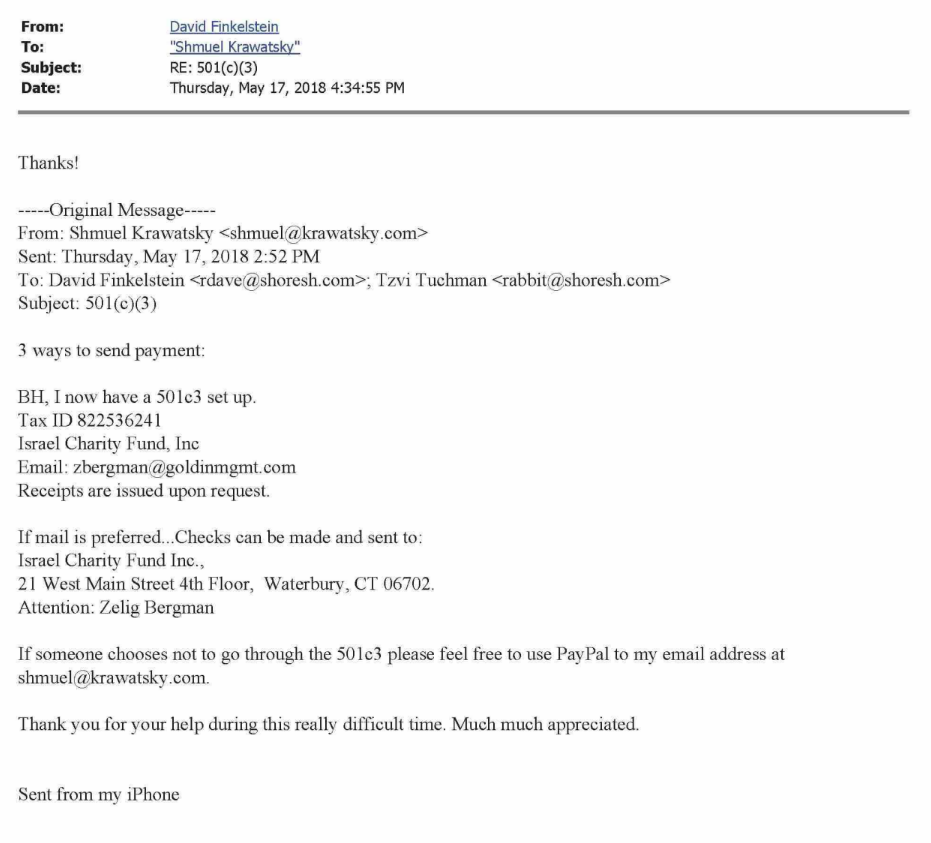
According to the motion response, the Israel Charity Fund is an organization set up by or on behalf of Shmuel Krawatsky to “help the family during this really difficult time.” The filing cites Exhibit A which is an email (screenshotted below) between Shmuel Krawatsky and Rabbi Dave Finkelstein and Rabbi Tzvi Tuchman, both of Shoresh, and dated Thursday May 17, 2018, in which Krawatsky tells Rabbi Dave that *he* now has a 501c3 set up called the Israel Charity Fund and information on how people can donate. The email also says if someone chooses not to go through the 501c3 they should feel free to use PayPal to his personal email address, shmuel@krawatsky.com. The email ends with him thanking Rabbi Dave for his help during this really difficult time, and that it was much appreciated.

Rabbi Dave answers Krawatsky thanking him.

The filing then references a second email chain between Krawatsky and Zippy Schorr, director of education at Beth Tfiloh school, informing her of three ways people can donate to the 501c3 “to help me with my overwhelming expenses.”

What’s implied in this email seems an explicit fraud. According to the mission statement filed with the IRS on the ICF’s 990, the purpose of the ICF is to “Support Jewish religious education and provide for social welfare and benefit of Jewish communities around the world.” Nowhere in that mission does it say or even imply that the money is solely for the purpose of financially supporting someone accused of raping children in launching defamation cases against his accusers.

The emails to Rabbi Dave and Zippy Schorr explicitly imply that the purpose of the nonprofit is to support the *Krawatsky’s financially* with no mention made of Jewish communities, religious education, or providing for social welfare, certainly not around the world.

The email to Schorr reiterates that if someone doesn’t want to go through the charity they should PayPal Krawatsky directly at his personal email. He then follows up with her asking when his health insurance is valid until and whether she was able to find friends to assist him with the 501c3. She answers that his health insurance is valid through August 31 and then after that he can still continue. In response to his question about the nonprofit assistance she says that she’s hoping a couple of people come through, and she wishes him a good Shabbos.

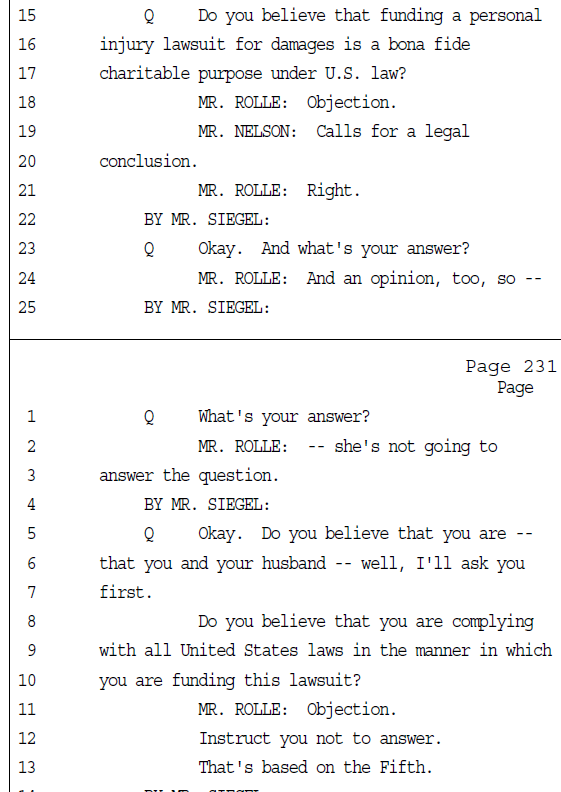
In a deposition referenced next by the filing, Shira Krawatsky is being questioned about an email sent by her husband to Rabbi Dave which says, Hi Rabbi Dave. For those who want to reach out and assist me, they may do so. To make a tax deductible donation, funds can be sent via Chase QuickPay or PayPal to Israel Charity Fund, Inc., and [an email address for Zelig Bergman]. When asked if she thought that soliciting tax-deductible donations to the Israel Charity Fund Inc. to be used to fund this lawsuit complied with U.S. law, her lawyer took the fifth on her behalf. In other words, she invoked her right not to incriminate herself. This not being a courtroom I can say that taking the fifth to that question looks pretty incriminating to me.

The filing then explains why the ICF is relevant to the case. The filing says that per an attached deposition the Krawatskys had already admitted that the ICF is relevant to the case. In particular it referenced a question asked by one of the families’ lawyers asking Shira about her sources of income, including money she received from the ICF to replace income lost as a result of the allegations, and her lawyer asks why they feel that question is relevant to the case. They answer because Shira is suing them for financial damages allegedly caused by the same allegations, and Shira’s lawyer acknowledges that that makes sense.

The filing says that the Krawatsky’s attempt to exclude any testimony about the ICF is a desperate attempt to prevent the jury from hearing that their damages are highly exaggerated, or to prevent them from having to plead the fifth about the charity in front of a jury and be subject to any inferences based on such a pleading, likely both. Neither, the filing says, is sufficient reason to keep this information from the jury.

The filing continues, Krawatsky seeks damages for lost income, earnings, emotional distress, specifically financial distress, but the availability of third party funds is relevant to asses the extent to which the Krawatskys actually experienced financial distress as a result of the families’ allegations.

The filing further argues that the Krawatskys are seeking damages that just don’t exist since the evidence shows that their income actually increased after the allegations against Shmuel Krawatsky were made, and was further supplemented by the ICF. Finally, the filing argues, the creation and existence of the ICF, them receiving funding monthly from the ICF, and the fact that they did not report the funds they received on their personal income taxes (according to the same deposition referenced above), are al indicative of their penchant for dishonesty, going to their credibility, which is admissible in a defamation case.

Any prejudicial effect testimony about the ICF may have on the jury, the filing argues, is a prejudice of the Krawatsky’s own making. They cannot have it both ways, the filing argues, insetting up and benefitting from a fraudulent charity that they failed to report, and then turning around and claiming that talking about such a fraud would be prejudicial toward a jury.  

Standard