If At First You Don’t Succeed

Some people just can’t be wrong. They can’t just take the criticism, admit they were wrong, apologize, and move on. Early on in blogging I learned that being wrong is a good thing—it means you learned something new. Knowledge is power. Well, I suppose no one could accuse George Will of being power hungry.

Following a Washington Post oped piece in which he called sexual assault “victimhood a coveted status that confers privileges,” George Will appeared on C-SPAN’s Q&A to respond to the outrage expressed over his article. Anyone hoping for an apology, or at the very least a clarification, had another thing coming.

Will opens by calling the people who vocally disagreed with his piece “the rabble.” I had a response prepared for that remark, but one commenter, ModerateRepublican, in the response section of The Blaze article, took the words right out of my mouth:

 So one thing is certain: the “rabble” he talks about probably includes virtually every woman on the planet earth.

Try this: [T]ell a female that you think women want to be raped because of the status and privileged they get by being raped, and see how she responds.

Next he incorrectly quotes a New York Times article citing the “1 in 5” statistic, stating that “The [Obama] administration has said that 1 in 5 women experiences sexual assault.” Using that statistic, he then goes on to discredit it by extrapolating from the 12 percent reporting rate mentioned in the Times article that were the two statistics correct, either the number of assaults—at the one college from which he too numbers, Ohio State—should be higher, or the number of reports should be lower. Had Will checked the New York Times article off of which he built his straw-man argument, he would have noticed that on April 30th, the Times printed a correction on the article stating that the 1 in 5 statistic it had quoted had not applied to assaults on college campuses, but to experiences over the lifetimes of women in general. Will’s Washington Post article was published on June 6th.

Moving along, Will then contends that new evidence standards set by the administration for college disciplinary hearings—preponderance of evidence—is too low, and will therefore result in false accusations. He argues that the evidence standards should be, as it is in the criminal justice system, beyond a reasonable doubt. The new evidence standards in question were suggested by the Department of Education in a “Dear Colleague” letter sent on April 4th, 2011 to colleges across the country. Interestingly, these new standards George Will is complaining about, have been standard practice for more than a decade in college disciplinary hearings. A guide published in 2003 by the Foundation for Individual Rights in Education (FIRE) states that “The vast majority of schools employ, at the very least, a ‘preponderance of evidence’ standard.”

College disciplinary hearings are not court cases; they do not bear the same penalties, do not adjudicate the same crimes, and do not have any bearing on the criminal justice system. Therefore, the criteria for adjudication are, and have always been, much lower. Either Will is advocating for “beyond a reasonable doubt” to be adopted for all disciplinary matters because he truly believes that such a high standard is required for any disciplinary matter, or because he’s jealous of the status and privilege conferred on sexual assault victims, and wishes to minimize the number of people who can officially claim that privilege.

Actually, the only thing George Will got right in the whole interview, was when he said that sexual assault cases should not be adjudicated by colleges at all, and should instead be handed over to the criminal justice system. The Rape Abuse and Incest National Network (RAINN), in a February, 2014 recommendation letter to the Obama Administration’s White House Task Force to Protect Students from Sexual Assault, recommended that instead of internal disciplinary hearings, colleges should “use the criminal justice system to take more rapists off the streets.”

There is no reason why crime should carry a different penalty or process simply because its perpetrator had the good fortune of committing his crime on a college campus. College campuses should not play haven or sanctuary to people who deserve to be prosecuted to the fullest extent of the law. Internal hearings instead of proper trials only serve to encourage abuse and discourage reporting. It should be noted that the reporting rate off college campuses, as reported by RAINN, is 40 percent. Compared to that, the 12 percent reported on college campuses is a horrifying pittance.

Ever the advocate for unfortunate young men who wouldn’t know consent if it slapped them in the face, Will blames a “sea of hormones and alcohol” for what will, when coupled with these “new” disciplinary hearing guidelines and recommendations by the Obama administration, result in “charges of sexual assault, and…young men disciplined, their lives often permanently and seriously blighted by this, and…litigation of tremendous expense as young men sue the colleges for damages done to them by abandonment of the rules of due process that we have as a society[.]”

Will seems to have a hangup with the fact that women drink on college campuses, and still have the gall to expect sex not to be forced upon them while in a state in which they are unable to consent. Perhaps, instead of worrying so much about the money that college campuses may lose as a result of disciplinary actions which may or may not be based on allegations resulting from accusations some feel are ambiguous since the notion that a person too drunk to stand straight is somehow able to give consent to sex, to them, is laughable, colleges should instead focus on educating its students on what constitutes clear and affirmative consent. The fact that men on college campuses never have to worry about being raped if they consume too much alcohol at a party should attest to not only the existence of a problem, but a pervasive rape culture which permeates college campuses.

Lest you think for a second that George Will doesn’t care about sexual assault, he assures us all that he cares even more than we do. He cautions against “defining sexual assault so broadly…that it begins to trivialize the seriousness of it,” thus implying that a case where a man as sex with a woman who is too drunk to consent, is somehow too trivial to be considered rape. The FBI disagrees.

The new Summary definition of Rape is: “Penetration, no matter how slight, of the vagina or anus with any body part or object, or oral penetration by a sex organ of another person, without the consent of the victim.”

Seems to fit pretty handily into the legal definition of rape.

Finally, he concludes by bemoaning the death of civil public discourse and trying to invalidate all of the outrage at his public display of ignorance, by holding up a few examples of people who said they wanted him dead for what he had said, or that he should be raped to know what it feels like. This is a common political trick in avoiding very real issues by focusing on the crazies on the sidelines, and projecting their extremes onto any intelligent and legitimate disagreement.

Honestly, I don’t know why I expected better of George Will. There are an unfortunate number of people who believe, as he does, that rape must fit a very specific template to be considered valid, thereby subscribing to a culture which not only discourages victims from coming forward by telling them that what happened to them was their fault, but also creates a climate in which an abuser feels comfortable and secure in the knowledge that even if his crimes are reported, he will likely receive no punishment. Rape culture fosters abuse, and environments which breed abuse. Columns and interviews like George Will’s attest to a complete unwillingness to dispel the ignorance and backward opinions that women’s rights and anti-abuse activists have worked decades to eradicate. Apparently abusers are more worthy of support and erring on the side of caution than victims. And he wonders why only 12 percent come forward.

Standard

No Means No Has Got To Go

I came across the following comment on an LA Weekly article responding to George Will’s characterization of being a rape survivor as a privilege:

[I]s “survivor” really the correct term for girls who get wasted at parties and are too drunk to remember whom they had sex with?

I’m only all too familiar with the atmosphere at this campus.  The majority of the women at UCLA are Asian girls who have no interests other than having their face between a book in their dorm room.  Even though they make up the majority, I would be willing to bet they’re almost never victims of “rape”.

The “victim” will always fit this profile: girl from a small town, too young to drink but ends up at a party where she gets wasted, ends up with a guy she thought was cute and then wakes up to regret. Instead of taking responsibility for her actions, learning and moving on now she’s told that she is a “survivor” of rape.

Taking responsibility for your actions would be the first step in getting on with life, but that’s not what society wants.  It wants you to feel eternal shame, regret, misery, self loathing.  Then they can get you the number to a nice, expensive therapist who’ll prescribe some effective drugs for your depression and now you’re now perfectly inserted into the matrix.

Really, to group these women in with real victims who are kidnapped at knife point and brutally assaulted is insulting, to say the least.

I couldn’t help but respond.

First, the “stranger in the dark alley” attack, is largely a myth in the US.

Second, your comment is a perfect example of rape culture; thank you for bringing up every commonly held misconception about rape and what constitutes rape. You made it easy to address. Rape culture, simply put, is a societal attitude of entitlement toward sex. Rape culture is telling a rape victim that she brought it on herself by dressing provocatively, by drinking more than one or two beers, by being a “tease.” Rape culture is the sense of entitlement to sex behind the resentment someone in the “Friendzone” feels at not having his “kindness” and time rewarded with the sex he figured he’d get if he logged enough hours being a friend. Rape culture is every time he says “she was asking for it.”

Rape culture is an attitude that believes that sex is something every man (generally men, but not always. I use men vs women in this piece because that scenario is most prevalent, but the dynamic exists in other forms as well.) is inherently entitled to, especially if a woman, in a man’s opinion, does more to indicate that she wants sex in general than she does to protest when a man initiates. Thus the unfortunate joke: Is it shoplifting or rape if you force sex on a prostitute. Mode of dress, how attractive a girl is, how drunk she allowed herself to get at a party—which is completely irrelevant since someone who is drunk lacks the mental capacity to consent— how overtly sexual she is in general, are all excuses used by society and people who subscribe to rape culture in trying to diminish the severity and validity of rapes which don’t conform to their mental image of what a rape victim to be. The stranger in the dark alley myth does a lot to reinforce rape culture. To someone who subscribes to rape culture, only the victim of a stranger in an alley, or a similar situation, can call themselves a true rape victim. Everyone else is either exaggerating, or seeking privileged status as a survivor.

I’ve learned a few things about rape culture, through discussion, that I’ve found interesting.

The question of prudence always comes up in discussions on rape culture—which precautions is it reasonable to ask a woman to take to avoid sexual assault, while simultaneously not blaming them for their rape. An example I like using in framing this discussion is walking at night, alone, in a neighbourhood known for crime, and getting mugged. While the mugger has absolutely no right to mug, there were precautions the victim could have taken to possibly avoid being mugged. That’s not to say that the victim is at fault for the mugging, but it leaves what to be said for prudence. It’s the same rationale behind advising women not to drink heavily at parties, or not to dress too provocatively on campus, or handing out straws which can detect date-rape drugs in drinks.

I always feel a mixed reaction toward women’s safety seminars. On the one hand, as I said, there is what to be said for prudence, but putting the focus on women protecting themselves rather than on men controlling themselves, has always seemed, to me, wrong. That mugging victim wouldn’t have to worry about being mugged if the neighborhood was cleansed of its criminals. Rape victims wouldn’t have to worry about being raped if men were better equipped by society to control themselves. What makes these discussions so difficult is a pervasive lack of education focused on teaching young men how not to be rapists, rather than teaching women not to be raped.

A perfect example of this is “No Means No.” No Means No was meant to raise awareness of rape on college campuses, and set a standard by which rape could be reduced: If you hear no, stop. Don’t ask again, don’t “just finish,” don’t back off and then start again—just stop. At the time—back in the eighties—it seemed like a good idea. Recently, however, there has been a push to redefine the way we view consent. The problem with No Means No, is that it places the onus on the woman to say no, rather than on the man to receive consent. Therefore, consent is not an affirmative process, just a tacit understanding until the woman says “no.” It’s kind of ironic how a slogan meant to fight rape culture instead promoted it by—almost certainly unintentionally—implying that one is entitled to sex without receiving prior affirmative consent, as long as they believe they have consent.

The problem with that is that it often becomes a debate over what constitutes no. Often the media perpetuates the notion that when a woman says no, she’s just playing hard to get. Rape cases have been lost because, despite the fact that there was no consent, the victim did not fight back hard enough. The onus was on the woman to protest instead of on the man to receive affirmative consent before initiating. Rape culture goes so far in its sense of entitlement toward sex unless the woman protests just the right amount, that there are still those who believe that partner rape (also known as spousal rape or marital rape) is not a crime! The rationale being that marriage itself constitutes overall consent, and therefore, consent is not required to initiate sex with your partner. I have a friend who was repeatedly raped by her husband, despite her protests. He believed, as do an unfortunate many, that marriage, by dint of the institution itself entitled him to sex whenever he wanted, regardless of his wife’s opinion on the matter. Even after she left him and demanded a divorce, he had no idea that he had done something wrong. Again, he felt entitled to sex, for whatever reason, and therefore required no consent.

There are people who will read all of this, and still fail to understand the validity and prevalence of rape culture and its terrible effects. They will continue to deny the validity of rape claims by people whose rapes do not fit into their idea of what rape should be to be valid. For their benefit, I’d like to explain what rape is. Rape, and the reason why its effects are so severe, is a violation of what it is that makes a person a person. It violates the sovereignty of a person’s body and sexuality. All we really control in this world is our body and what we choose to do with it. We choose what we eat, we choose what we wear, we choose whom we have sex with. Sexuality is the most intimate and personal function of our bodies. We exercise control over our bodies and sexuality when we give consent to sex and sexual activity. Rape violates the control a person has over what is most intimate and personal to them. It violates a person’s sovereignty over his or her body. It is one of the most traumatic things one person can do to another, and it often results in Post Traumatic Stress Disorder, addiction, complete destruction of self-image and self-worth, inability to form lasting, healthy relationships, depression, even suicide.

I’ve dealt with enough rape cases to know that regardless of how valid other people think a survivor’s claim of rape is, the effects are always the same, and always devastating. The PTSD, etc, is the same whether the rape happens in a dark alley by a stranger, in a little girl’s bedroom by her father or brother, or at a party by some bro who thinks it’s cool to take advantage of the drunk chick. Again, consent cannot be given by someone who is drunk because they lack the mental ability to consent. The violation is real regardless of the circumstances, the effects are real regardless of whether or not an opinion poll says they should be. The act of forcing or coercing someone to have sex with you without first obtaining consent is rape, and it is devastating. Period. The squabbles over whether or not the victim was at fault only highlight a serious problem that we as a society must address: Changing consent from something passive to something active.

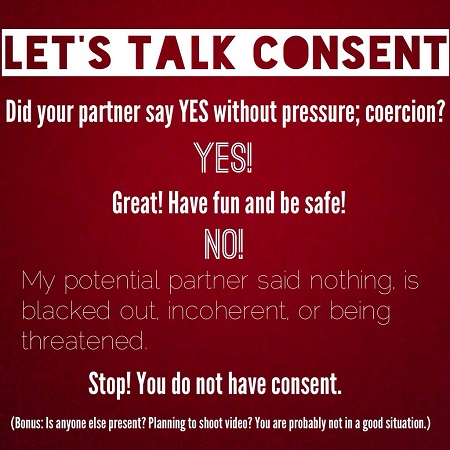
It’s time for Yes Means Yes. Consent should be affirmative and constant. It should be understood that unless she actually asks for it, she isn’t “asking for it.” That skirt she’s wearing is not an invitation for sex unless she actually invites you to have sex with her. There can be no room for ambiguity with Yes Means Yes because sex cannot be initiated unless consent is affirmative and understood. The onus is placed on the man to receive consent rather than on the woman to protest. Therefore, operating under Yes Means Yes, questions of how loudly or how violently a victim protested against her own rape, or whether or not she actually consented of she doesn’t fight back at all, will be irrelevant. Unless consent is obtained, it’s rape. Yes Means Yes should be an integral part of sex education programs in schools (many of which currently lack even basic consent as part of their curricula), promoted through popular culture and media, and enforced legally. Yes Means Yes would effectively end rape culture because consent would no longer be a matter of assumption or entitlement, implied unless a woman protests enough—it would be affirmative and clear with no room for ambiguity.

Standard

How “Journalism” Becomes an Excuse

Five months ago, I came this close to understanding what it means to die of shock. Mishpacha Magazine, a Charedi (ultra-Orthodox) magazine about as right-wing as they come, not only published an article about sexual abuse, but actually did the issue justice. The article, titled King of Hearts, interviewed Rabbi Moshe Bak, founder of Project Innocent Heart, an organization devoted to raising awareness about the prevalence and dangers of sexual abuse, and to educate teachers, students, and parents on how to recognize, prevent, and treat child sexual abuse. One sentence in the article left my jaw particularly bruised after making it hit the floor: “[A]lthough only a small percentage of abuse occurs on school grounds, the safest place for a predator to operate is in a Jewish day school.” I was shocked. Discussion of the topic is considered taboo; a statement like that, to the average Mishpacha reader, is akin to blasphemy.

That was the first time I had ever seen the issue tackled openly in the right-wing Orthodox press. Barring one or two Orthodox news sites, most publications prefer to, in the words of Hamodia editor Ruth Lichtenstein, protect their readers’ “right not to know.” Yeshiva World News refuses to cover any sexual abuse stories, and its moderators routinely shut down conversations on sexual abuse in the Orthodox community right when they’re about to get meaningful. I was pleasantly surprised, therefore, to see an article in last week’s Ami Magazine that openly discussed sexual abuse. Finally, I figured, we’re getting somewhere. I figured too soon.

The article, written by managing editor Yossi Krausz, covered a panel discussion held at John Jay College on the topic of child sex abuse and reporting in the Orthodox community. Krausz comes out swinging:

To put it mildly, the frum [religious] community has had some problems with much of the reporting—especially crime reporting—that’s been done on it. Perhaps “vilification” might be a better word than “reporting,” actually

I’ve long had a problem with this view of reporting done on the Orthodox community, particularly reporting which casts it in a bad light. Rather than take responsibility for the crimes it commits, the community prefers to play victim, claim anti-semitism, and use the media as an example of the ever-present bogeyman, the ghosts of anti-semites past supposedly hovering hungrily over that precarious little world, desiring nothing more than to devour it whole. To be fair, Krausz never actually uses the phrase “anti-semitism” in his article, but the sentiment is clearly implied. I have yet to see a single article, other than Mishpacha’s—and even that took a swing at the anti-abuse activist community, calling them “enraged bashing blog[ger]s”—take responsibility for abuse and the stigma surrounding it in the Orthodox community. The community prefers to obfuscate, dodge the issue, blame its reluctance to address the issue on the tone of the people who fight to end it.

I used to be an angry blogger. I’ve since learned that there are more productive ways to fight for my cause—now I’m a less angry blogger—but I remember the rage I used to feel every time I sat down in front of a keyboard. It would come pouring out of me, words, tears, hate, anger, frustration, defeat, a feeling of futility against a seemingly Goliathan community which had turned its back on me, encouraged me to suffer rather than report, called me a liar, called me an anti-semite, stuck its fingers in its ears to drown out the sound of my cries. I remember how I wanted it to burn. I remember how I cursed God. I remember how small I felt, how mad that made me, and how incredibly cathartic it felt to write. I remember why I felt that rage—it was the result of years of silence, abuse, pain forced inward, finally reaching critical mass.

What’s interesting is how much time is devoted to fighting “angry bloggers” and “media witch hunts” compared to the time devoted by the community to eradicating sexual abuse. I have two issues with the way the right-wing Orthodox press spins media coverage of its crimes. It typically points at the sensationalism of the stories and the disproportionate coverage when compared to similar crimes committed by other communities, nationalities, and ethnicities. Rapes are reported every day in the New York Post and New York Daily News, but only the Orthodox cases seem to make the front page. The New York Times doesn’t waste ink on just any rape case, but throw the words Ultra and Orthodox into the mix, and suddenly it’s above the fold. They have a point, but draw the wrong conclusion.

As Orthodox Jews, we project a certain image of moral superiority rooted in our presumed adherence to biblical law and morality. By our dress, our appearance, and our overt devotion to God and religion, we broadcast to the world that we hold ourselves to a higher standard; we tell the world that it can count on us to uphold morality and lawfulness. Which makes it all the more newsworthy when one of us does something that the world expects from people other than us. The media doesn’t sensationalize stories about Orthodox sexual abusers because it is anti-semitic; it sensationalizes stories of Orthodox sexual abusers because by the image we project, and the image it has accepted, such a thing should not exist. The fact that it does exist is therefore newsworthy. I almost take it as a compliment.

My second issue is that the community is so concerned about PR problems that it runs around like a headless chicken trying to treat the symptoms of the problem, rather than treating the cause of the problem. What endangers the Orthodox community more than PR problems, is abuse, particularly sexual abuse. I used to volunteer at Our Place, a drop-in center for kids at risk. The term “kids at risk” has become, in the Orthodox community, a tongue in cheek way of describing kids who are at risk of abandoning their religion. When I say at risk, I mean at risk of death by overdose, death by drive-by, death by exposure. I mean kids living on the streets, selling and taking drugs to survive, because the prospect of going back home, or going back to school, or going back to their communities is so terrifying, that risking death seems like a better choice to them. According to the founder, director, and many of the staff at Our Place, close to 80% of the children who come through their doors have suffered some kind of abuse, mostly sexual, but also physical, at the hands of someone in their community.

I’ve spoken to many of them, heard them laugh in that way you do when the choice is either laugh or cry, about things done to them by their teachers, rabbis, family members, mentors, in school, at home, in synagogues, in mikvahs (ritual baths). I personally dealt with a kid who was so terrified of going home that he would sleep instead on benches in parks, or check himself into homeless shelters. Unfortunately, he was under 16, and was often brought home by police officers who found him out in violation of curfew. I asked him if it was worth that kind of life just to be out of his home. He looked me dead in the eye and said yes. Perhaps if the community would spend half the effort fighting abuse as it puts into fighting the people who are trying to end it, that boy wouldn’t have to treat every night as though it could be his last. Perhaps if the community focused on ending abuse as much as it focuses on the negative PR generated by the people it has failed coming out and telling their stories, there wouldn’t be any stories to tell.

The only nod Ami’s article made toward survivors of abuse was when it mentioned two survivors, one of whom was me, who got up and shared their stories:

Two of the audience members subtly undermined the general tenor of the discussion. One young woman discussed her sister’s abuse by a neighbor; a young man discussed his own abuse. Both of them said that worries about shidduchim [prospects for marriage], either for their own family members or for the family members of the abuser, were why their parents didn’t go to the police. Those turned out to be bad decisions with tragic consequences, because they left the abusers free to prey on other children.

Of course the next sentence cost Ami any points it had scored with me:

But these stories had a different narrative from the one that the panel had been promoting. Instead of evil rabbis engaging in backroom machinations—the image that one would have gotten from much of the panel’s discussion—these speakers were pointing out, perhaps unintentionally, more subtle factors that exist in many cases. Yet in the context of the entire discussion, that point was probably lost on most listeners.

Which I read as:

Yes!!! An opportunity to not only misuse survivors and their stories to defend a community they so clearly indicted, but to also point out some flaws in a discussion which, given its limited time, couldn’t possibly do justice to the nuance of the issue, thus surely invalidating the entire issue! Did Chanukah come early this year?!

Snark aside, that was the only bit in the whole Ami article actually devoted substantively to the issue of sexual abuse. The rest was just a bunch of potshots at the panelists, complaints about an event billed as a panel discussion on reporting of crime turning into a discussion of the crime itself, and nitpicking at Julia Dahl, New York post reporter and author of Invisble City, who, admittedly, did get some facts wrong in her novel, which told the story of a city reporter sent to cover a murder in the Ultra-Orthodox community of Boro Park. While Dahl should have used better sources and done a little more homework, using her book as an excuse to overlook an issue which literally threatens the lives of thousands of children a year, is indicative of either institutional callousness, or a legitimate inability to look past the trees and see a forest.

I’m going to give Ami the benefit of the doubt and assume the latter. It is hard seeing a community you love being taken to task for something you’d sooner not believe exists in your world. That being said, it should be far more offended by the abuse of its community’s children than by the tone of people who may get a little carried away in their zeal to protect those children.

Standard

The Show Must Go On

Author’s note: This story was originally published in Ami Magazine. It has been edited from its original form. It was originally published under a pseudonym.


My story isn’t easy. It’s an uncomfortable subject for many people, for many reasons. I hope that in sharing it I can help not only myself, but others going through a similar situation.

Mental illness has always been a touchy subject. Society as a whole has done a decent job of addressing it, but as Orthodox Jews, we’re taking our time. We fear the stigma, the implications for shidduchim (Jewish matchmaking prospects) and reputation. While I’ll admit that mental illness is something to take into account when considering a prospective spouse, it must be understood that the culture built around the fear of mental illness and the stigma not only hurts countless people, but magnifies the problem. The damage stigma causes to people who suffer from mental illness, and the culture of denial and concealment, perpetuate the problem by ensuring that the people who need it will be too scared to seek treatment. My and my family’s suffering may have been avoided had this stigma not existed.

My birth was not a highlight in my family’s history. My mother was on the back end of an awful marriage, which ended shortly after I was born. That’s when her bipolar disorder decided to manifest. Various mental illnesses can lie dormant for years until some kind of inciting trigger sets it off. Bipolar is one of them. You’re born with a genetic predisposition toward the disorder, not unlike the genetic predispositions toward heart disease or cancer, but it generally takes some environmental force to trigger it. In my mother it was triggered by her divorce, and she suffered a breakdown. She was hospitalized for two months in the psych ward of a local hospital and placed on meds.

Psychiatric treatment is not a perfect science, and devising an effective regimen can be tricky. Often, drugs are not enough, and studies show that treatment is much more effective with accompanying psychological treatment as well as meds. Even when an effective regimen is devised, it can become less effective over time. People on meds need constant monitoring to ensure that their drug levels in their blood don’t get too high or too low, and the drugs’ effectiveness can eventually wear off. It’s difficult, which means that one of the most important factors in psychiatric treatment is how compliant and willing the patient is.

My mother wasn’t very compliant. She had grown up believing that mental illness was either a contrivance on the part of doctors (and what do they know anyway, right?) or that you were a gibbering loon who regularly converses loudly with people no one else can see as he stumbles down the street. The idea that most people have of functional people with a legitimate but manageable illness was foreign to her, her family, and her community. She would comply with the doctors and their regimen for as long as she needed to, but inevitably, she would declare herself “cured” and stop taking her meds.

This happened pretty regularly for 16 years in three year cycles. She would stop taking her meds, and for two months she would rapidly decompensate. She would become angry, snappish, moody, manic. She’d subject me to some kind of mistreatment, sometimes it was as small as just snapping at me if I spoke, sometimes it was a new starvation diet she decided was a good idea for herself which I for some reason had to adopt as well. My family would let her progress until she did something violent to someone and even then they were hesitant to have her committed. They didn’t like having to admit that there was enough of a problem. They downplayed it, pretended as if it could be managed at home, and no amount of experience ever wised them up. “What would the neighbors say.” “Shidduchim.”

So she would be committed, stay there an average of two months, during which she would go from angry, to “if I’m going to be here I’m going to run the place” to grudgingly compliant. I’d come visit her often. It wasn’t half bad, actually. The food was surprisingly good, and I was young enough to appreciate the activities they had for the patients. When she’d be released we would make her a welcome home party of sorts. I’d decorate banners to hang in the house, heralding her return. She’d mellow out, stabilize, and the good times would return. We’d go to restaurants during the week, touring different cities, and just sit around and talk on shabbos (sabbath) afternoons. Life was pretty good when she was stable. The two months of instability and subsequent two months of her being committed seemed a price worth paying for my mother.

Bipolar disorder, as the name suggests, is a cycling between highs and lows, or more accurately, mania and depression. In my mother, mania would make her a thousand times herself. She wouldn’t sleep. She would become very outgoing, energetic, very friendly with everyone but me, but with a very short temper. She became the life of everyone’s party. But she also became angrier, sarcastic, mean. After a few weeks of that she would crash. Her world would become grey, muted. She’d lie in bed all day, sleeping or watching TV, barely capable of walking to the fridge to get food.

They treated her with mood stabilizers, antipsychotics, anti-depressants, which worked great when she was depressed because they gave her some semblance of a life, but when she’d cycle back to manic (a muted sort of manic when she was on her meds, more like just high enough to function) the meds would make her feel limited, like her mind was hitting a glass ceiling teasing her with possibility but never allowing her to reach it. Kind of like that mashal (parable) people use to describe gehinnom (hell), where God is compared to the sun, and gehinnom is an eyepatch. She’d put up with it for about three years and then decide that she had enough. It would usually even out, though. She would crash hard and, albeit grudgingly, in some way acknowledge the fact that she needed treatment. She would never say those words, but she understood it.

For some reason, after years of being on Haldol, she suddenly developed a severe allergy to it. Her face swelled up and she had to go to the ER where they gave her IV antihistamines and immediately took her off the medication. Her doctor was supposed to replace it with another antipsychotic, but he never got around to it. To my mother it was like a convicted lifer getting a furlough. It wasn’t complete freedom, but enough to give her hope. Also enough to finally start functioning the way she felt she should. For two weeks she became more energetic, but not overly energetic. More alert, but not hyper-aware. Better but not crazy. Her doctor seemed impressed, and not only officially discontinued her antipsychotic, but lowered her other dosages. This kept happening, slowly over the course of about two months, until she was on such a low dose that she declared herself cured and stopped taking her medicine altogether.

That’s when she really started declining. She quickly started becoming manic. She became slightly less coherent, spouting ideas that only made sense to her. Her memories were distorted. Her difficult childhood rose to the surface, reawakening old vendettas ad grudges that she’d buried. She turned against everyone she believed wronged her. Her parents for not being there for her, her friends for not being supportive enough, her relatives for things they’d done to her as children, and I became the reminder of her failed marriage and ruined life.

One Friday night, when I was about sixteen years old, things came to a head. Because my mother was divorced and suffering with bipolar disorder, we lived by my grandparents. The household consisted of me, my mother, my grandparents, and my uncle, who was disabled and required constant care. He suffered from schizophrenia which went undiagnosed and subsequently untreated long enough for him to stab himself in the kitchen one night. Something went wrong during the surgery to repair his heart, and he spent the next fourteen months in a coma. He woke up, but since then he’s required constant care. We were an odd family, but my grandparents made it work.

Shabbos was always nice. My grandfather sitting at the head of the table, leading us through the meal, softly singing his zemiros (traditional songs sung on the Sabbath) in tunes from his childhood, telling us stories about “der alter heim (the old country).” He died when I was eleven, and my grandmother tried to take his place, but it wasn’t the same. Shabbos was never the same after he died. There was no substitute for him. Gradually shabbos became less about us eating together as a family, and more about getting the meal over with. We would all bring books to the table and do our thing as we made our way through the courses, hurrying to finish so we could each go nap, or in my case play. There wasn’t much ceremony to it, even less feeling. No more zemiros, no more stories. No more conversation.

Over the years, my mother’s approach to religion has moved toward the “I need something from God, let’s see what he’ll give me” approach. She wasn’t overtly religious, and didn’t really do anything particularly religious, unless she wanted something from God. Then she would go overboard, hoping for some immediate divine reward in return for her sudden piety. These “episodes” would usually coincide with her manic episodes. If she started to pray every day, or cover her hair, or do anything particularly religious, it was almost a harbinger of trouble to come.

That Friday night she had her hair covered and was singing shalom aleichem (traditional song welcoming the Sabbath). I came to the table with my book, feeling a little apprehensive. She saw the book and got angry. I was messing up her perfect shabbos. God wouldn’t give her what she wanted if I read at the table. She demanded that I take it away. I didn’t understand why I should. I mean, it wasn’t like this week was any different from any other; it wasn’t like we were suddenly going to be a regular family; what else was I supposed to do at the table if not read?

She lost it. She started insulting me, cursing me, telling me she wished I had been aborted, telling me that it was my fault her boyfriend wasn’t marrying her, and that if I weren’t around she would be able to be with him every night. I ran from the kitchen where we’d been sitting into the living room and barricaded the recliner against it. That didn’t stop her, though. She kept yelling and cursing at me to the air, to the walls, to my grandmother who was trying to calm her down. I couldn’t take it anymore. I kept the recliner barricaded against the door and slipped out of the house through the living room door.

I ran crying to my friend’s house, where I cried some more. They were incredible. His mother took me to a side room and asked me what happened, and then she and my friend sat with me for a few hours. She offered to have me over for the night, but I said no. I wanted to go home, see if things had calmed down. Maybe she would apologize. Maybe it would be ok when I got back.

I came back into my house through the living room door, hoping that they hadn’t figured out I had left and had left the room barricaded. I wanted to be alone. When I opened the door I saw my aunt and uncle sitting there with my mother and grandmother. They were all laughing at something my mother had just said. It was like nothing had happened that night, like she hadn’t told me that she’d have gladly traded my life for more sex, like she hadn’t told me that my existence was such a nuisance that she’d have been better off aborting me. She turned to me, the vestiges of laughter still on her lips, and said “hi.” No “I’m so sorry,” no “I will do anything you need me to do to get your forgiveness,” no “can we please talk about it?” Hi.

“YOU WANT TO FUCK HIM SO BADLY? WHY DON’T YOU GO FUCK HIM THEN?!”

Those were the last words I ever spoke to my mother. I ran to my room, crying, flopped into bed and vowed, as my tears soaked my pillows, that on my life I would never speak another word to her. It’s been five years and I’ve kept that vow.

She’s never once apologized, or even tried to. She still talks at me, but I don’t react. I still live in that house with her and my grandmother, but I haven’t so much as looked at my mother’s face, let alone spoken to her in five years.

That Friday night was the beginning of the end of my family and my connection with it. My mother continued to decompensate. She became increasingly angry, more violent. She shouted, cursed, and threatened, both me and my grandmother. I can’t count how many times I begged my grandmother to have her committed. I’d plead, beg, scream, hoping that she would come to her senses and have my mother committed, of not for my sake then for my mother’s. She needed treatment and we needed a break from her. My grandmother kept clinging to the hope that this was all part of a process which would eventually level itself out and result with my mother cured and able to function independent of medication. I’d point out all the times in the past when she and my family were wrong and ask why this time was any different. It always came down to the neighbors and shidduchim.  I tried to convince some of my family to circumvent my grandmother, have my mother committed against both of their wills. None of them wanted to cross my grandmother, and all of them shared her concern for our family’s appearance and reputation. Neighbors. Shidduchim. As if either of those have MDs.

Finally things got bad enough for shidduchim and neighbors to not matter as much. That’s when my mother played the guilt card. Over the years my mother has built up quite the arsenal of guilt trips, things she accuses my grandparents and her siblings of having done to her over the years which contributed to the shambles her life was. In between fits of violence she would play victim just long enough to make them appeal to their guilt and empathy. Whatever kept her out of the psych ward was fair game. As soon as they would acquiesce, she would go back to angry and violent. Much of that violence and anger was targeted at me.

I have a brother who was taken from her when he was an infant. My whole life I’ve been hearing about him. For years she had been going to family court, trying to win first visitation, and then full custody. Every time she seemed to get close, she’d stop taking her meds and wind up in the hospital. She never did manage to get him back. As long as she had me, though, it didn’t matter as much. At least she had one of her sons. But now I wasn’t talking to her, and she couldn’t bear to lose another son. I knew that was the worst possible thing I could do to her, which is why I stopped talking to her. She didn’t deserve children and I wanted her to be childless.

Rather than trying to repair her relationship with me, she tried controlling and beating me into submission. If she couldn’t have a son who loved her, then by God she would have one who feared her. Chosech shivto soneh b’no. Ish imo v’aviv tirau. (He who withholds the rod hates his child. A man should fear his mother and father.)Those were her mantras. I heard them often, usually right before I felt them.

Unfortunately, this left my grandmother in the middle trying to play peacekeeper. For my part I tried to make it as easy as I could for her, never instigating the fights my mother picked with me. My mother, though, occupied every waking moment of her day, and a few of her sleeping moments, too. My mother would keep her up until very late and then wake her up very early in the morning. Eventually my grandmother lost the ability to sleep altogether. She saw a psychiatrist, a friend of hers, who prescribed Zoloft, an anti-depressant, to help her mood and help her sleep. I remember the exact moment she called and told me she had decided to go on meds. I wanted my mother dead. I could handle what she was doing to me, but I hated that my grandmother was becoming collateral damage. Again I begged her to have my mother committed. Again she refused. The Zoloft would help her cope.

Two weeks later she collapsed on the kitchen floor, delirious and semi-conscious. My mother wanted to just put her in bed and let her rest. She tried stopping me from calling an ambulance. It’s a good thing I did; my grandmother, as a result of the Zoloft and poor diet, had developed a severe sodium deficiency. I rushed with her to the hospital, sitting in the passenger seat of the ambulance as she lay in the back, the EMTs trying to wake her up. We got to the hospital and my grandmother was taken to radiology to rule out stroke. I paced the ER, frantically calling my relatives, letting them know what was happening. They dropped everything and came running.

My mother came too, right as we were talking to my grandmother’s doctor. I was hoping she wouldn’t but there was nothing I could do about it. She wanted to be alone with my grandmother, and my uncle motioned me to come outside. I went with him, but stayed close; I wanted to keep an eye on my mother.

“RACHEL! NO!” My uncle dove at my mother as my mother tried to remove the central line from my grandmother’s neck. “But she wants to go home! She said so!” A passing nurse called security, and they escorted my mother out. She could have severely injured my grandmother, but my family still wouldn’t have her committed. The sodium deficiency was so bad that they admitted her to the ICU to keep her levels closely monitored. I stayed with her late into the night, and then came back the next day, but purim (holiday celebrating the Jews’ salvation from extermination at the hands of the ancient Persian king and his viceroy) was the next day and I had to prepare.

I spent that purim in the hospital with my grandmother. They had a very nice megillah (story of purim) reading for patients and family in the hospital atrium. I enjoyed the parts I didn’t sleep through. The food they had afterward was pretty good for hospital fare, but what I loved most was the effort the volunteers put into trying to make it as real and as festive a purim as was possible in a hospital, surrounded by the sick and dying. I think that night was one of the most beautiful purim experiences I’ve ever had. The singing was more real and heartfelt than anything I’d ever heard at home, and the feeling of togetherness of a roomful of people, each mired in their own personal tragedies, coming together to celebrate the salvation of our people, and the hope that must always exist even when death seems certain, brought me to tears. I went home late that night, and woke up early to get back to the hospital.

I spent as much time with my grandmother as I could, but even the most devoted seventeen year old can only stand so much hospital time. I made my excuses and left. I was supposed to be going to my yeshiva (religious school) seudah (festive meal), but I just went back to my room and sat on my computer. I just needed some alone time, some time away from the world and its problems. I had brought food with me from the hospital and ate my seudah alone while my cousins, uncles, and aunts celebrated together with my mother in the living room.

Some families get a little loose with alcohol and weird things happen by their purim seudos. Never ours, though. My family never drank. Our seudos were always tame. In sharp contrast to the sounds of a struggle and shouting I was hearing. I forced myself out of bed and out into the hallway and found my mother running through the house, in full view and earshot of all of my younger cousins, loudly accusing my disabled uncle’s home health aide of killing him. I found them grappling in my uncle’s room, my mother trying to push her to the floor. One of my uncles came running and pulled my mother away; the home health aide ran out of the house, yelling behind her that she quit. I ran after her and stopped her outside. My disabled uncle remained in the living room, watching the scene with a bemused smile on his face.

“Either she goes, or I quit. I can’t work like this anymore.” It was this, not everything my mother had done prior, not the beatings she had given me, not the way she used to physically push my grandmother around, not trying to rip out my grandmother’s central line, that final got my mother committed. Good home health aides are very hard to find, especially good ones who work a twelve hour shift. While my uncle kept my mother busy, I ran to the hospital. I still needed my grandmother’s permission before I could have my mother committed. I raced into her room and explained what was happening. It took ten minutes of convincing before I got the green light. I called my uncle at home and told him to have her committed. She was gone by the time I came home.

My grandmother came out of the hospital a shell, depressed to the point of catatonia. She’s gotten a bit better, but is still too depressed to function. My mother has turned her into a slave. I still don’t talk to my mother. My family still refuses to acknowledge their mistakes; they still refuse to do anything about my mother. I eventually learned to fight back when she beat me, and now she’s scared of me, but she keeps my grandmother under her thumb, uses her like a slave, and my family does nothing.

This article was originally meant to be published under my real name, but my grandmother adamantly forbade it. Ironically, that argument was the most lucid she had been since she came home from the hospital, and the most lucid she’s been since. Again the reasons for not printing my name with the article were neighbors and shidduchim. My cousins were becoming of marriageable age. Some people never learn.


Standard

The Alchemy of Agony

Author’s note: I know people find this topic very sensitive, so I would like to open with a disclaimer. It is not my intention to compare any two tragedies, only to derive, if possible, some meaning from my and my grandfather’s experiences.

I was raised by Holocaust survivors. I was fed a steady diet of heroic stories of those who died at the hands of the Nazis. The Holocaust was always portrayed as something horrific that had been done to us out of hatred by the Nazis, sanctioned by God for some indeterminate reason, which, much like the process by which nature produces diamonds, beat, burned, and forced the best out of the Jewish people. To this day I still can’t sing ani maamin without crying, as I picture the lines of Jews walking toward their deaths, defiantly singing that haunting yet hopeful song, a song that told both the Nazis and the Jews still left in the camps, that no matter how dark the night, dawn will come. I was raised believing that this was the norm during the Holocaust, and that the Jewish people, even when cast down into the lowest and most hellish of depths, still not only overcame, but rose higher, and became greater than they had been before.

Then I grew up a little. I read Elie Weisel. It hurt me to read the way he described what Jews did to each other during the Holocaust. None of us have a right to judge anyone who lived through that period (certainly not any more than we have a right to judge anyone in whose shoes we haven’t walked), but the depravity to which so many sunk floored me. It hurt me. It shattered my image of pious men with long beards and fiery eyes marching proudly to their deaths, God in their hearts and faith on their lips. I read accounts of Jews who collaborated with Nazis, outed other Jews in hopes of saving themselves. Jews who took advantage, sexually, of other Jews. Jews who participated in the torture and beatings of other Jews. I’m crying as I write this because I’m mourning the innocent part of my soul that died when I learned these things.  My grandfather, in all the stories he told me as I lay on the couch in the dining room after our Friday night meals, never once mentioned any of this.

Or maybe he did. Maybe he did begin to scratch the surface of the darkness surrounding the real story of the Holocaust. Maybe he did begin at the time to temper my starry eyed reverence of people whose strength was indeed legendary, with stories of those who were not as fortunate. He told me about the people who managed to get as far as the fences and instead of trying to escape, flung themselves at the fences, killing themselves rather than suffer another day; about the people who committed suicide immediately following liberation because they couldn’t imagine life after what they had experienced. Perhaps the rosy image I grew up with was a manifestation of a child’s mind, reinforced by the hagiographies recounted through spruced up stories of rebbes and chassidim.

It took years until I could reconcile the two sides I know about the Holocaust. I’m still working on it. But my life thus far has provided me some insight to the power, for good and for evil, of trauma and tragedy.

There’s something transformative about pain, I’ve found. It drives us to our extremes. People like to ask themselves, as I have many times, “What would I do in that situation?” I like to think, as I’m sure most people who consider this question would, that they too would die heroically, giving their lives in defiance of a genocidal oppressor. Others are very clear in their position: They would either be one of those killed immediately, or they would defect to the other side out of sheer self-preservation. The real answer? It’s impossible to know. Tragedy takes a person, spins him around, confuses him, and then exaggerates whatever’s left when the spin cycle stops. It turns your life upside down. What you believed before no longer seems important, and what you knew no longer seems true. You’re left having to rebuild yourself from scratch.

Pain and tragedy breaks, to some extent, everyone it touches; that part is always the same. What subject to change is the aftermath, the part where you rebuild yourself. It is possible to transcend pain, transform it into something beautiful. Eric Weiner, in his book Man Seeks God, describes a man named Pieter, whom he met on his travels. Pieter’s son died a few weeks before he was set to graduate high school. He tried running from his pain, biking from Holland to Turkey, cursing the world, God, the Higher Power, what have you, as he went. As he traveled, the people he met realized his pain and took him in for the night, fed him, gave him shelter. “It was beautiful,” said Pieter. “There is pain. There is beauty. There is help.” Pieter transformed his pain into an art form and became a dervish. Weiner describes what he saw in Pieter as the “Alchemy of agony. Suffering not blunted, but transformed.” Pieter discovered a purpose to his pain, not necessarily an explanation or a reason, but a purpose: a way to transform something terrible into something beautiful.

My grandfather transformed what he experienced in the Holocaust into something beautiful. I saw it in his eyes every time he looked at his grandchildren. The proud defiance, the purpose to his pain, the ultimate good of his suffering. He saw us as not just a replacement for the lives lost in the Holocaust, but as a transcendence of what was done to him, a living testament to the possibility of hope and rebirth in even the darkest places. We have a very large family. I have close to fifty first cousins, many of whom have children of their own. So many children, in fact, that I’ve lost count.

Unfortunately, my little part of the family went to hell pretty early. I don’t have much to do with the rest of them. When I was approximately one year old, my grandfather guessed what would happen to me if I stayed with the family—with my mother—and arranged for my sale to another family. I was to be sold for $1 million to another Jewish family in the area. My mother was in a mental institution at the time, and the transaction was supposed to happen before she got out. It didn’t. She found out and stopped it. For some reason she saw fit to tell me this story as a young child, no doubt she thought it would illustrate her “love” for me. Now that I’m older, though, and can appreciate its significance, there’s something that bothers me about it. Most people wonder about what would have happened to them had they been born into a different family, or in a different era. Generally the question is purely theoretical, but in my case it was almost a reality. I wonder, sometimes, if I could go back and make sure the sale was completed, would I?

It’s a tough question. On the one hand, I may have had an easy life. The family buying me would have undoubtedly have had a lot of money, evidenced by the spare million they were apparently willing to spend on me, odds are they wouldn’t have abused me the way my family did, and I would have led a very simple religious life. On the other hand, perhaps I would not be the person I am today. Then again, perhaps I would be. Perhaps I would still be the writer I am today, with all the same insight and understanding, the same curiosity, the same combination of belief and skepticism with which I try to approach every situation. Perhaps. Then the question becomes, is it worth it? Is everything I’ve suffered worth what it may or may not have made me?

I don’t have a concrete answer yet, but even that’s progress. I’ve gone from wanting to be dead to using what I’ve learned to try and help others currently experiencing what I’ve experienced. I honestly don’t have an answer to whether or not it was worth my life to be the person I am today, but until I have the answer, I still have my pain and what it made me. I’m not sorry for what I am now, even though I may sometimes wish what I am now would never have been necessary.

Yom Hashoah is an interesting day for me because on the one hand I can’t ever imagine myself living through that kind of hell. I can’t see myself surviving it. To build a life afterward is, to me, unfathomable. And yet, it happened for so many. For many it didn’t, but for so many it did. They came here, or moved elsewhere and build homes, businesses, families, fell in love, wrote, sang, cried, laughed—they not only lived but transcended; they became everything the Nazis tried to take from them. Those who didn’t magnify the tragedy. I still have no idea why some people can transcend their experiences and some can’t. I don’t believe it has to do with mental, emotional, or physical constitution. I honestly have no idea what determines who transcends their pain and who doesn’t. I leave that up to God. What Yom Hashoah represents to me is not only a memorial of the people who died, the people who fell, and the people who suffered, but the people who rose, the people who built, the people who transcended. To me it represents hope.

Standard

My Room

Author’s note: I wrote this two years ago, but never made it public. It’s still relevant, and I was feeling like this again over purim. I’m in middle of working on a post about sadness over the holidays, and I felt I had to finally make this public. I hope no one can identify with this, but if you do, please take some solace in the knowledge that you’re not alone; that other people feel your pain and pray constantly that you never feel it again. 

I live in a room. My room. It is mine. That’s why I live there. I am my room. My room is who I am. At least that’s how it feels when I look around it. I look around it and see a person, an identity, a life compressed into an eleven-by-twelve-foot space. Completely. It’s mine. And it’s private. Authorized personnel only.

The door to my room is badly damaged, as is the doorpost supporting it. I used to try to lock my room with combination padlocks and latches drilled into my door and its doorpost, but those were broken by people trying to get into my room. They damaged my door and the doorposts supporting it. But what exactly is the significance of a door—or rather, more importantly, what does a door characterize?

When attempting to sack a castle or fort, an army will always attempt to penetrate the entrance, be it a gate, or a door, by battering at it until it gives way. I once wondered why the doors to castles and forts opened inward. I mean, if you think about it, that’s a rather serious security flaw. A door that opens outwards is much harder to break through because in order to do so, you must shatter the door itself rather than just forcing it to give way and open. The reason I found was so that troops retreating from battle, or supplies or wounded soldiers, would not have to stop and wait while the doors open to gain entry; rather, they could continue riding or moving forward while the castle welcomes them. My door opens inward.

I live in my room. By that I mean that everything that made and makes me who I am is contained with me within the confines of my room. Confines. Perhaps. Perhaps not. As a child, growing up, I was constantly on display to my family, everything I did, everything I said, thought, or felt, everything I became, on display and available for analysis in the aide of a specific agenda. My preferences in food used by one party or another to curry favour with me in an ongoing battle between my mother and the rest of my family over who could claim their love and authority over me exclusively. My tastes in writing used by the same two parties in a constant struggle over who had exclusive rights over my moral and ideological fabric. The library books I used to take out were used by my grandmother to point out how awful an influence my mother was being, and my grandmother’s attitude was used by my mother to point out how restrictive the life my grandmother promised would be for me.

Eventually I learned, albeit unconsciously, to hide who I was and who I was becoming from anyone who might use it for something other than what it was intended for. I never wanted to celebrate my accomplishments because I would be the only one truly celebrating—everyone else would be looking for a way to use it to their advantage. My interest, and subsequent professional interest, in computers, my ability and accomplishments in graphic design, my talent for writing, the causes I had become passionate about, the people who were becoming a part of my life, the people I loved and cared about, and the people I hated and wanted dead—all of them I kept to myself because I wanted what they all meant to me to be mine exclusively for a change, and for them to remain exactly as I intended them to be in their purest, most uncorrupted forms. I wanted something for myself.

Well, the locks hadn’t worked, and my door kept getting kicked in, so I locked the only portal I had left into my self or identity: my mouth. Sure I talk about myself to my friends and acquaintances, but not with my family. Not with the people I share a house with. There are seven rooms in my house, and one of them is mine and that is the way it is staying. I leave nothing of myself outside of my room, because for the first time in my life, I finally have something that is my own. Hang the possessions, the corporeal and tangible expressions of my identity, personality, and self, what I’m keeping private in my room is what makes me the person I am. The feelings, emotions, beliefs, talents, abilities, flaws, faults, defects, and the knowledge and understanding amassed because of all of it. That is what comprises me and my room, and in fear of clouding the waters of my self I keep it well hidden and locked away.

I hate it.

I hate the solitude.

I hate the fact that I reside in a house but live in a room.

My room is a necessary, but self-imposed prison, one to which I—the prisoner—hold the key. What’s keeping me in here are the people around me who would once again exploit what I am and the identity I’ve created to try and gain exclusivity over me, and I don’t trust anyone enough to give them the opportunity to prove otherwise. I pray one day to live in a home with many rooms, and many people with whom to share those rooms.

Standard

There and Back Again

It’s not easy having a relationship with God, especially if you never had a good relationship with your parents. That’s the comparison generally used when explaining the mystery of God’s plan, to a parent making decisions for their child that the child is too young to understand. Of course, children tend to rebel against their parents; it’s all a part of growing up. But they usually come back when they realize that their parents loved them all along and had only their best interests at heart. It’s a lot harder, though, when it’s God you’re dealing with, because parents respond more overtly and clearly than God does. With God, all you have is faith, and your belief that everything He does is ultimately for the best. It’s so easy to lose sight of that.

Life had fallen apart. After months of trying to play peacekeeper between my abusive mother and me, my grandmother broke down and was hospitalized. When she left the hospital, she was severely depressed, nearly catatonic. The only way for me to get money for daily necessities was to sit with her and try to coax some emotion out of her. If I could get her to talk–to feel–then I could connect with her enough to make her understand why I needed money. I was 17 years old, hardly a trained psychologist. It was torture to have to do that every day. She would sit there telling me why she had given up on life, how everything that had happened was her fault, and how she had felt in the moment she had given up.

I would run out afterward, after I had gotten the money I needed, and scream. Just scream. And punch the walls, and curse God and demand to know why–why I was being subjected to my life. All those years in a dysfunctional family, and then the abuse, and then having to get my heart ripped apart every day just to survive. God was torturing me and I hated Him for it. According to the Torah, the penalty for cursing God is death. Personally, I didn’t care; I wanted to die anyway.

I went to shul every day, three times a day, but the words I was saying felt wrong on my lips. I was praying to a God who would never answer, asking for mercy I’d never receive. I choked out shacharis, mincha, and maariv through tears and sobs, and every day it got harder and harder. Eventually I stopped crying. Like a child who is told that Santa Claus doesn’t exist, I got over the fact that God wasn’t there and tried to move on with my life. Sure, I went through all the motions, but it was only because that was the life I knew. Until I found something else I could believe, I wasn’t quite ready to abandon my lifestyle.

God was gone, and in His absence was a void. I started looking for something to fill it. First I looked for a way to maintain my beliefs in the absence of God. I had always been taught that what separated the Jewish people from the atheists and idolaters of this world was their morality. No longer believing in God made me feel amoral. I started studying moral philosophy, trying to find a way to maintain a belief in absolute morality while still eschewing the idea of absolute morality requiring a deity, or higher entity. Kant’s moral philosophy, based on the categorical imperative, appealed to me at the time, especially since it acknowledged the practical need for the idea of some higher power to exist in order to maintain any absolute truth, but allowed for no higher being to actually exist. To quote Voltaire, “If God did not exist, it would be necessary to invent him.” In short, “Act only according to that maxim whereby you can, at the same time, will that it should become a universal law.”

So I had morality, which made me feel somewhat better, but I felt something still lacking in that void left by God’s departure. My life became a war between the two sides of me, the part that wanted Judaism and the part that wanted to reject God entirely. Though I had given up on God and religion, I felt sad doing so, as if an important part of me had just been lost. I started debating anyone who would accommodate me. Usually, I would take the side of Judaism against any opposition, but my heart wasn’t in it. I was trying to convince myself as much as my opponents. Instead of feeling vindicated after winning a debate, all I felt was shameful, and frustrated. I read every hashkafa book I could get my hands on, watched every video about atheism I could find, argued about both with whomever would give me their time, and none of it helped fill that void.

The more I searched, the more I kept seeing that there really is only one truth when it comes to belief in God: There is no proof; there is only faith. That’s what emuna p’shuta means to me now. Not blind, unquestioning faith, but the understanding that after you’ve questioned, after you’ve searched high and low for proof, all there really is, is faith. Confronted with this truth I had to decide: Do I, or do I not, believe in God?

It’s not a question you can answer in one day, so I took my time. I sat back and examined my life as it unfolded, trying to honestly determine if I could believe in God or not. It’s always the little things. The money I would make here and there when I needed it most, the opportunities that seemed to arise from nowhere, the people who came into my life when I had no one. Little things, but to me they were signs of some divine intervention. Grudgingly I accepted the existence of God, but that didn’t put Him back in my good graces. I hated Him just as much, but I couldn’t deny His existence. I just couldn’t see any good or purpose in my suffering.

That autumn, I wrote a draft of my memoir. Two weeks, fifty-thousand words. I barely ate or slept. After it was finished, I labored over it for a few days, correcting spelling and grammatical errors, until it was, for a rough draft, perfect. That night, I went to a FedEx store and had it printed and bound. While I knew I was supposed to be feeling elation at having accomplished something so incredible in such a short time, what I actually felt was sadness and emptiness. I nearly jumped in front of a train that night. That book had been my purpose, and there it was, in my hands, printed and bound–finished. My purpose, finished.

On a suggestion from a friend, I started volunteering at a drop-in center for kids at risk. I felt that perhaps others could benefit from my experience. In doing so, I discovered a purpose, a silver lining, almost, to everything that had happened. I still didn’t like the process, or the fact that I had to experience any of it, but God’s purpose started making sense–the good I had been looking for was beginning to make sense. It may seem odd for me to call the fact that I have the benefit of such unfortunate experience a good thing, but, to me, there is nothing more beautiful than that first smile breaking across a face stained by too many years of crying. If my experience means that I can be the cause of that smile, then that’s the purpose–that’s the good.

I don’t think I’ll ever understand why I was chosen for the life I was given, but I don’t think I need to know that anymore. Not yet, anyway. I will one day, after I’ve lived my life, and I move on to the next world. For now, though, I have my God, I have my purpose, and that’s all I need. Don’t get me wrong, my relationship with God is anything but easy, but it’s the fact that there’s a relationship that I enjoy so much. I feel that, after everything I’ve been through, and after losing and then finding God again, I am much closer to Him than most other people. I feel that closeness every day, and I have no doubt that God loves me. I see His kindness in my life every day. I am a proudly Orthodox Jew, and I love my God.

Standard

This Is My God

For the longest time I haven’t been able to bring myself to say the name “Hashem”. It feels wrong to me, like I’m forcing myself to utter the name of a being I know to be something entirely false and contrived by people with whom I would never want to associate. Don’t worry, this article isn’t a renunciation of my religion. No, I believe with all my heart in “Hashem;” I just can’t bring myself to utter that word, or even think it without cringing. When I need to refer to my Creator in conversation, I call Him God. That’s who I feel my bond with: God. Hashem makes me want to run and hide; God makes me feel safe and loved and protected. I feel God, not Hashem, watching over me. God is who I pray to, not Hashem.

Until this morning I couldn’t understand why Hashem is so objectionable to me. I thought about it because it’s bothered me for the longest time; I couldn’t say the name of my God without feeling dirty; I’ve really felt guilty about it. I thought about situations in which I would be inclined to discuss Hashem and, for the most part, they’re all with people who use Hashem to their own advantage. People discussing the “kids at risk” crisis, or the latest “falsely accused rebbi” or hateful discussions about how gay people are the scum of the earth and intend to destroy us one male sexual encounter at a time.

I realized that any time I have ever been spoken to about Hashem, barring a few exceptions, it’s been a discussion I wanted to run away from, with a person I wanted to berate for their ignorance. They were twisting my God into something so horrible that I couldn’t even say His name as it is accepted in my religious circles. Hashem is a disgusting idea to me because the people who claim to worship Him and embrace His law made their idea of Him so reprehensible.  

God, though…God is entirely my own construct. No one refers to God by that name in my community. In fact, most find it a bit uncomfortable when I do, like I’m an outsider trying to sound intelligent about a subject with which I couldn’t possibly be familiar. But God is my understanding of my chosen deity and religion. God is someone who loves me, protects me, and gives me a better way to live my life. God is something I want to be closer to. God is something I can work toward. God is the deity of my bible, the savior of my nation; Hashem just makes me cringe.

Someone once asked me an interesting question: Does someone who has an easy life have an easier time with faith than someone who has a difficult life? As I was trying to come up with an answer, someone listening in on the conversation interjected and said “It’s two sides of the same challenge.” On the one hand, the person who has a hard life is confronted with so much evil and pain that he may lose sight more easily of God, because the God he knew and loved seems so heartbreakingly absent. On the other hand, The person who has an easy life never has to confront the question of God’s existence because, in a sense, he never really needs God for anything. God is incidental in his life, and therefore, he may forget that God even exists and is the Master of Creation.

I had a hard life. Have a hard life. I’m only 21. I’m having a hard life. My mother abused me, physically and emotionally, for years. My grandmother tried to hold things together and keep the peace, but eventually she fell into her own depression. Life went to hell. We had money but no way to access it because my grandmother needed to sign the checks, and she was, effectively, catatonic. I was a high school kid, suffering through my abuse, not sure how I would pay for food or clothes, never feeling safe because my grandmother could no longer protect me from my mother.

At first I cursed Hashem. I cursed Him for the life I had been promised by all my rabbis and teachers, and the life He had given me; I cursed Him for letting my abuser go on unchecked, as she pleased, while my grandmother and I suffered; I cursed Him for the things I had to do in order to live day to day; I cursed Him for not just taking my life and letting it all end. Then I prayed. Every day, with tears in my eyes, I prayed, begged Hashem to help me. I stopped going out very much because I didn’t want people to see me crying.

I begged my family to help. Some of them knew what was going on, but for one reason or another, always had more pity for my mother than for me. My grades plummeted. I started skipping school and staying home, online, where my real friends were. My family told me that I had to go to yeshiva and rebuked me constantly for my “sins”. They seemed to think that if only I would be the perfect yeshiva boy they had envisioned, my life would somehow perfect itself.

All I saw were people who knew, but did nothing—who would only judge me, and focus on my spiritual shortcomings, rather than help end my abuse and help me heal. Hashem wasn’t there for me, and those who worship in His name only used Him to make me feel worthless and guilty. Regardless of what I needed to do to survive, it always seemed contrary to what they believed Hashem wanted. If I skipped school in order to earn money so I could pay for things like food and clothing, things that most teenagers have provided for them, I was sinning. I was expected to conform to everyone else’s norms even though my life was falling to pieces. All this in the name of Hashem. This wasn’t the life I had been promised; this wasn’t the Hashem I had been told about. I stopped believing in that deity.

For a while I had no god. I tried finding proof for the existence of the one I’d abandoned, proof that He had never existed, or proof of some other truth entirely. The more I searched the more I realized I would never find proof: It always came down to faith.

I examined my life and the course it had taken, and I couldn’t deny the hand of some intervening being. Hashem and His worshippers had never helped me, but there were those who did, and situations which somehow managed to work in my favour that I couldn’t explain logically. I had to finally admit that something was intervening, some sort of deity, but which one?

I started learning more about this deity I had once known as Hashem, but now He seemed different, more like a God I could connect to rather than the Hashem from which I felt so removed. I began to understand His law, His will, the way in which he governs our world, His mercy, His judgement, His anger and kindness. I still wasn’t seeing His plan as ultimately good, but at least I could begin to understand the rules—the method to His madness.

This deity I was getting to know needed a name. He was the god of the Judaism that I had accepted, but the feel of Him, and of my understanding of Him, was so radically different from the way I felt and understood Hashem that I couldn’t refer to Him by that name any longer. Hashem to me was synonymous with unfettered, blind, zeal, to the point where it superseded His actual will. I named Him God. I still can’t say Hashem without cringing, but I am an Orthodox Jew and I love God, because he is the God I chose, instead of a god I was forced to accept. His law is the law I embraced, not the laws that had previously been imposed on me. He is, in every sense, my God.

Standard

I Have a Dream

In my last post I referenced a Mishpacha article that characterized the bloggers who cover sexual abuse in our community as “angry.” In the response I wrote to Mishpacha I explained that the anger that the community sees in those bloggers is the result of years of indifference toward survivors, and the outrage at the lengths to which the community goes to quiet survivors and protect abusers. I would characterize myself as an angry blogger. I try being a little more moderate most of the time, but I can’t help it sometimes; sometimes I just can’t hold it all in; I can’t see the situation objectively and dispassionately, and the anger I try to keep in check explodes outward, channeled into the biting words of a caustic blog post.

I didn’t start out as an angry blogger. When I first got involved in the subject, I was warned by the people I worked with not to get involved with those bloggers. They explained to me the dangers of descending into that tar-pit. Once mired, I was warned, it would be very hard to extricate myself. I heeded their advice and tried reaching out through my writing to the very organizations that my now colleagues spat on in their posts.

The first big project I undertook was trying to get a meeting with the powers that be at Agudah—the bane of every blogger in the abuse-coverage world. Agudah. Mere mention of that organization can bring some people to apoplexy. The way I saw it, though, they were doing a disservice to the very people they were trying to help. While it’s true that the Yeshivish world seems very closed to dealing with abuse, and seemingly prefers believing that it can’t happen rather than acknowledging and dealing with the issue, their children are in no less danger than the children of people who do know how to properly handle abuse and abusers. While the stories I’d heard at the time did gall me, and I was inclined to be upset with the community for causing that pain, those children helped focus me on reaching across the aisle.

I was a young idealist at the time. As a young frum Jew who looked like a part of the community I was trying to change, I figured that Agudah would sooner deal with me than any of those ”angry bloggers.” I reached out to an Agudah spokesperson; we exchanged a few emails, and set a time for a phone conversation. We covered everything from the community’s aversion to mentioning anything related to sex, be it abuse or between consenting people, why I believed the community so adamantly refused to believe that abuse was an actual issue, to the psak that had been issued at the Agudah convention a few years ago which permitted reporting only after a rabbi had been consulted. The spokesperson was very sympathetic to both my experience and those of my friends, but said that there was little he could do to affect change. The conversation concluded with this admonition from him: “Tafasta meruba lo tafasta,” which translates roughly as “take what you can get.”

I was furious when I hung up the phone. I thought I had gotten close, and all I had gotten was “take what you can get.” I went on Facebook and immediately became what I had sworn I’d never be. “Agudah’s official policy on abuse: Tafasta meruba lo tafasta.” I had become an angry blogger. For the next few months the articles and Facebook posts I wrote could have been featured on FailedMessiah. It was open season on Chassidim and anyone from Lakewood. I was burning the skeletons of bridges I had been trying to build.

Honestly, it feels good to cut people and communities down to size. It feels powerful. I get to sit in judgment from behind my keyboard on other people; I get to take the high ground and condemn them. The moral high ground is a great place to be. People loved my writing; I garnered praise from those in the blogger/activist community. The validation and praise felt euphoric. I felt drunk on the hatred of those around me, and the anger and frustration I held within me. Those children I had set out to protect had taken a back seat to my need to vent and inflict pain on those who had hurt me.

In all my writing, however, in all the cleverly worded barbs and sharp admonitions, there is a certain emptiness, a feeling like I am wasting my time and accomplishing nothing. The people who harbor the same hatred and anger lap up my writing and beg for more, and the people who I set out to educate stay uneducated. I feel like a dog chasing its tail.

This post was supposed to be completed and published on Martin Luther King Jr. Day, but I got sidetracked in a Greenwich Village bar, and then by the inevitable hangover that followed. That being said, it’s never too late to talk about MLK.

It’s the 1960s, close to 100 years following the emancipation proclamation, and blacks, while not quite still in the cotton fields, are still treated like animals. Signs forbidding their entrance to whites only shops are still common. A white man and a black man are still forbidden from sitting on the same bench, or sitting in the same section of the bus, or even drinking from the same water fountain. They are “separate but equal,” perhaps the most tongue in cheek bit of institutionalized racism in history. To quote MLK in his Letter from a Birmingham Jail, in response to why he felt he couldn’t have waited for a more opportune time to hold his protest in Birmingham:

But when you have seen vicious mobs lynch your mothers and fathers at will and drown your sisters and brothers at whim;…when you suddenly find your tongue twisted and your speech stammering as you seek to explain to your six year old daughter why she can’t go to the public amusement park that has just been advertised on television, and see tears welling up in her eyes when she is told that Funtown is closed to colored children, and see ominous clouds of inferiority beginning to form in her little mental sky, and see her beginning to distort her personality by developing an unconscious bitterness toward white people; when you have to concoct an answer for a five year old son who is asking: “Daddy, why do white people treat colored people so mean?”;…when you are humiliated day in and day out by nagging signs reading “white” and “colored”; when your first name becomes “nigger,” your middle name becomes “boy” (however old you are) and your last name becomes “John,” and your wife and mother are never given the respected title “Mrs.”; when you are harried by day and haunted by night by the fact that you are a Negro, living constantly at tiptoe stance, never quite knowing what to expect next, and are plagued with inner fears and outer resentments; when you are forever fighting a degenerating sense of “nobodiness”–then you will understand why we find it difficult to wait.

I can empathize with how MLK must have felt, sitting in a jail in Birmingham for the crime of not waiting for a permit to protest the injustice he and his people had been suffering for centuries. While I’ve never suffered the way the blacks did for centuries in this country, I have seen friends of mine become suicidal, self injurious, develop eating disorders, and suffer with PTSD while waiting for their community to help them. My first emotional reaction to seeing that is sadness. Then intense anger. Then pure hatred.

The only time I’ve ever managed to overcome that hatred and write something I feel was actually constructive, was in my post titled Olam Hafuch Ra’isi. That post took weeks to write. I discarded paragraph after paragraph, countless hateful, scathing criticisms of my fellow Jews. I can’t count how many times I started writing that piece and then stopped because I couldn’t stop the hate I feel so often from coming through in my writing. After weeks, I finally managed to write that post, and it was the most popular piece I have ever written. Everyone liked it. My fellow anti-abuse activists, fellow survivors, and even people who usually dismiss “angry bloggers” with disgust, read my piece and walked away thinking. I am prouder of that piece than anything I have ever written, and I wish I could do that with every piece I write.

After finishing that piece, I understood, to a point, how MLK must have felt writing his letter from that Birmingham jail. If you have not yet read it, please do. To me, it, paired with his I Have a Dream speech, is the activist’s manifesto.

I can’t imagine that MLK never hated the white people for what they were doing to his people, but he realized that his cause could only be furthered and realized through peaceful protest, education, and most importantly, a willingness to accept white people as equals if they were willing to accept blacks as true equals. His movement was not about revenge, or making the whites suffer for what they had done once blacks gained equal rights. He envisioned a world where “little black boys and girls will be holding hands with little white boys and girls.”

That was his dream. Not a world where anyone who had wronged him would be brought before his people and be made pay for what they had done. His message was one of forgiveness, acceptance, a willingness to embrace those who had wronged him should they be willing to embrace his people in the same way. His iconic speech on the steps of the Lincoln memorial end with these words, words that make me cry every time I hear them:

[W]hen we allow freedom to ring, when we let it ring from every village and every hamlet, from every state and every city, we will be able to speed up that day when all of God’s children, black men and white men, Jews and Gentiles, Protestants and Catholics, will be able to join hands and sing in the words of the old Negro spiritual, “Free at last! free at last! thank God Almighty, we are free at last!

This is my dream. That one day I will be able to live in my community, secure in the knowledge that abusers will be brought to justice, survivors will receive the help and support they need and deserve, bust most importantly, that all that hatred I feel toward fellow Jews will be gone, and that I will feel as comfortable around them as I do around fellow activists. My dream allows for the existence of Agudah, Satmar, Lakewood, and Skver. In my dream they all acknowledge the faults within their communities, rectify those faults, and ensure the safety and support of all survivors. In my dream the “angry blogger” has no place, not because he serves no purpose, but because his necessity becomes obviated by mutual understanding, proper education, and a commitment to safety and justice.

In the meantime I will commit to do what I can, to overcome the hatred I feel, and help foster the love and acceptance I want to exist. It will not be easy, but I will make an effort.

This is my dream. I may go my whole life never seeing my dream realized. But a man can dream, can’t he?

Standard

Tonight I Mourn

It’s not even tisha b’av yet and I’m crying my eyes out. Most people I know go through the motions, mourning some abstraction, a glory they’ve heard about like a copy of a copy of a copy, retold for two thousand years. A building, representing God’s glory on this earth and a place where we could connect with Him, almost undeniably. But it was destroyed twice. Who can even remember.

So once a year we sit around and we try to eke tears from our eyes, eyes dried by luxury and complacency, by a lack of understanding of what true devastation entails, by smugness and arrogance, position and power, by lack of any emotional connection to one another. We try to cry because we have to. Cry if you can, but I almost wish I couldn’t.

For me, the destruction of the Temples is not an abstraction, because while I can’t remember its sacking millennia ago, I see it’s consequences. The tragedy of this world, the barbarity of which humanity is capable, and by the same token, the callousness. I suffered for years while no one helped. I cried for years and no one cared. My abuser was given everything she wanted and I had to fend for myself, even if it meant addiction, and dropping out of school, and getting my heart torn to pieces witnessing what was happening to my grandmother, and I was always the bad one. Olam hafuch ra’isi (an inverted world I see).

I have too many friends with similar stories. They cried for years along with me, even though we didn’t know each other. Countless people crying in unison as their lives are destroyed one abusive act at a time. No one cares. Tonight I mourn for myself, because no one will mourn me. I mourn for my friends because no one can hear them. I mourn for all those people who took their own lives rather than live on this sickening planet one minute longer.

We lost our grandeur because we hated our fellow man. In two thousand years, have we learned nothing? Tonight, I mourn for the conscience that died in all those people who made us suffer.

Standard