Why I Eat So Much

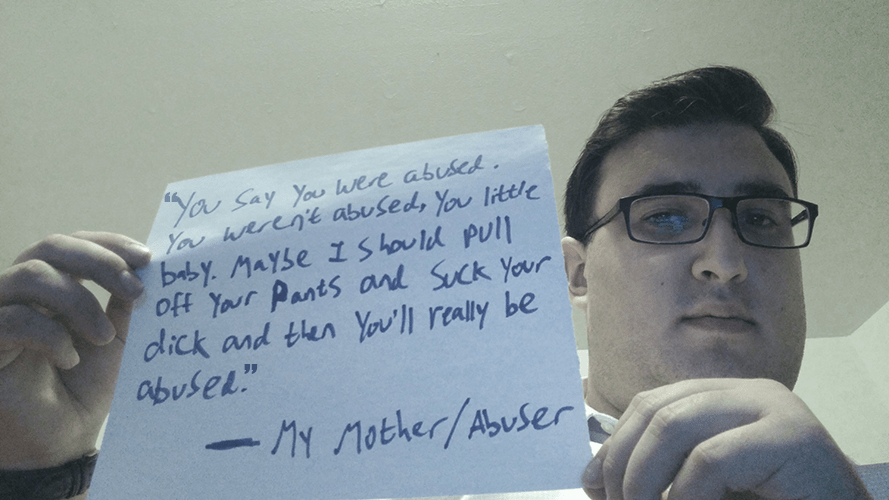
I never realized how complicated my relationship with food was until I moved. I’ve learned a lot since I moved, particularly how messed up my relationship with food is. It started with being able to cook. I was able to cook when I used to live at home, but it wasn’t so simple. Nothing really was. Cooking was a kind of trade-off requiring serious consideration of cost vs benefit. On the one hand I would have yummy food when I finished cooking, but on the other hand, I wouldn’t be safe while cooking. Not emotionally, anyway.

Abuse is insidious in the way it affects your life so completely, ruining even the little things that should be ordinary and routine, performed without thought or consideration of consequences.  Like cooking dinner. Like going to the fridge to see what’s in it. Like going to the kitchen to get a fucking banana. It shouldn’t be difficult. It should be something you don’t even have to think about, something you just absently get up and do while engrossed in a show you’re bingewatching on Netflix, or a conversation with your best friend about “oh my god did you see what she was wearing?!?” It shouldn’t require cost-benefit analysis.

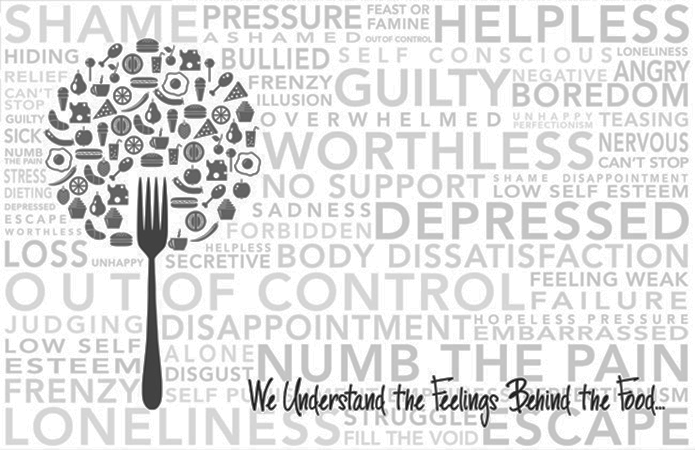
I’m pretty fat. There’s no sugarcoating that. I can already hear people tapping away at their keyboards, typing messages to me telling me I’m handsome, and not to hate my body, and to love myself, and blah blah blah. Save it. I’m not ashamed of it. I don’t hate my body. I do wish it were different, but I’m ok with what it looks like. I don’t think I’m ugly. I’m just fat. Get over it. It’s not because I have a glandular problem, or slow metabolism, or one of a dozen other excuses I could come up with (not to delegitimize people who actually have these problems)—it’s because I eat a lot. But what’s interesting, and what I’m beginning to understand, is why I eat so much.

I’ve been fat for most of my life. It started in third grade for reasons that aren’t really relevant right now. I started significantly gaining weight, however, after my abuse was kicked up a notch. My room was the only safe place for me in the house. My room had a door I could lock, or at the very least barricade if my mother tried hurting me. I spent a lot of time in my room, especially if I was cutting school, which happened more and more as the abuse went on. But locks weren’t a perfect solution. I can’t count the number of times she broke the locks, or broke down my door. Sometimes I would just forget to lock it, and she would get in. Or I left it open to let the cleaning lady in, and my mother would rummage through my stuff while my room was being cleaned. Most of my stuff she wasn’t interested in, but what did interest here were my books and my food.

I’ve paid hundreds of dollars in fines to the library because she stole my books and wouldn’t give them back when they were due and couldn’t be renewed because other people had placed holds on them, or because the books were irreparably damaged. My food interested her, not because it was food she couldn’t have gotten from the same grocery I’d gotten mine from, but because the food was mine. Her rationale for stealing my books and my food was that she had given nine months to my gestation, her pain to my birth, and fourteen-odd years to raising me and “giving me everything.” This, in her mind, entitled her to everything that was mine. It entitled her to my food, my books, and my body. It entitled her to abuse me. She took my stuff because it was mine and she believed she was therefore entitled to it as some twisted reparations I owed her as her son.

What this meant, was that the notion of leftovers didn’t exist in my mind, neither did security in the knowledge that I would have food to eat the next time I wanted some. What that meant was that every time I got food, whether it was takeout Chinese, a bag of popcorn, some bagels, a pack of lox, and some cream cheese, or a bag of oranges, I had to eat it all, right then, in one sitting, or at the very least in one day, or it would be gone the next time I wanted it. Of course I could have just ignored the fact that she was stealing from me and just have kept buying more food as I needed it. But it wasn’t the fact that she was stealing from me but the reason why she was stealing from me that made me want to thwart it.

Every time she stole it triggered me. It made me feel unsafe, like I didn’t even have a room, a fridge, a tiny little space that was mine and mine alone, a space in which I had control over my life and my decisions, in which I had some privacy to just be the person I was becoming. It reminded me that I had no control over my life, over my body, that whatever she wanted she could have, and whatever she wanted to do to me she could, because I had no say in my life. It was a complete breach of whatever illusion of security or privacy I had made for myself, and it scared me. So I had to eat everything I bought, regardless of how much it was, or how sick it made me. I had to eat it because eating all of it, even to the point of nausea, still felt better than that feeling of insecurity I felt when she stole from me.

Cooking was a whole other problem. Every time I cooked, she would stand over me, trying to see what I was making, commenting on how it smelled, asking if she could have some. I never responded to her as I had stopped talking to her completely when the abuse got really bad, but what she did was unbelievably triggering to me. I would keep the lid of the pot on, even if I smelled the contents burning, just because I didn’t want her to see what I was making. I wanted something for myself. I wanted some privacy. I wanted there to be something in my life that she wasn’t forcing her way into, and even though this stubbornness was harming me, I needed it. I needed it just for the sake of my sanity. I needed it to feel like a human being.

If I walked away for even a minute—just to pee or get another ingredient—she would run over to the pot, lift the lid, smell it, sample it, and make sure I knew she had. If I didn’t take the pot with me to my room when I ate whatever I had made, she would scrape the dregs out of the bottom of the pot, and then stand outside of my room loudly commenting about it. She would even dig through the garbage if I had thrown something out, either to taste it or to see what I had made. As pathetic as it was to see, it infuriated me and triggered me that she would go to such ridiculous lengths just to impinge on my privacy. Just because she could. Just because she felt entitled to it. To me.

This may seem like a weird power struggle to someone reading this who had the good fortune of being raised by loving parents in a safe environment, but when you’re abused, normal flies out the window. It loses its definition. There’s no such thing as normal. Everything has subtext. Everything has a deeper, manipulative meaning that may not be readily apparent to uninformed observers. Everything means something else. Everything is a power struggle. Everything. Is. So. Fucking. Triggering.

Eating too much was the only way for me to keep my sanity. I couldn’t leave leftovers. If I put something in the fridge, I’d constantly be worrying about it. Cooking food wasn’t a good option either, because it would involve subjecting myself to an hour or more of my mother talking to me, leaning over me, commenting about me, being around me, triggering me. Even going to the fridge to get what was there wasn’t ok for me because it meant she would see me, start talking, and trigger me. I wanted to minimize the time I had to deal with her.

Takeout was the best option. But the thing about never feeling secure in your next meal is that even when you know you can have food whenever you want or need it, it still makes every meal feel like your last. Which meant that even when I ordered takeout, even when I knew I was going to be buying all three meals as I needed them, I’d still buy too much, and would therefore, invariably, eat too much, just to make sure I had eaten enough and wouldn’t be in such desperate need of food if my next mealtime came and for whatever reason I couldn’t get any food.

If I bought takeout, I’d buy two entrees, two sides, a soup, and two sodas, eat it all, and feel like my stomach was coming apart at the seams. Another byproduct of never feeling safe with my food was the speed with which I ate. I’d wolf my food down, which, as anyone can tell you, especially when dealing with large quantities of food, is not healthy. If I bought stuff at the local grocery, I made sure I had more than I needed just to be sure, and then ate all of it. I ate until it hurt. I ate until I felt safe.

I haven’t lived there for 5 months and counting, and I’ve come to realize some things. It started when I got my regular-sized fridge. When I moved into my apartment, my landlady provided me with a wine cooler in lieu of a fridge. It was fine really, because I had brought a minifridge with me. But for the first four months of living there, I didn’t have a freezer, which was not only annoying, but also a painful reminder of the place I’d left. When I lived over there (I’m loathe to call it home), I had eventually bought myself a minifridge—the same minifridge I brought with me when I moved—but it didn’t have a freezer. We had freezers in the kitchen, but I had no way of ensuring that what I put in there would stay there, and I tried my best to keep the time I spent out of my room to an absolutely minimum, so I never bought anything that needed to be stored frozen.

When I finally got my regular-sized fridge, complete with beautiful freezer compartment, it finally felt like I had a normal home—a home that was mine, that I controlled, in which I was safe. I couldn’t place the feeling, but I knew it felt right. This past Thursday night it finally hit me: For the first time in my life I have a fully stocked kitchen, fully stocked refrigerator, fully stocked freezer, and I have control over all of it. It’s completely safe. No one can use it to control me. It’s mine. I finally have control over what I eat, when I eat it, how much of it I eat, and whether or not I want to save some for later.

If I want to make myself dinner, now all it involves is googling a recipe, going over to my cabinet, getting the ingredients, getting stuff from my fridge, cutting it all up, mixing it all together, cooking or baking it at my leisure, all safe from any worry of being triggered, manipulated, controlled, or otherwise made to feel unsafe. It’s no longer a calculation but a reflex. I’m hungry—I make food. I’m full—I stop eating. If there are leftovers, I put it in the fridge. When I want it again, it’s still there. I no longer have to eat the way I used to. I no longer need to feel like my stomach is exploding to feel safe. I no longer have to spend time deciding whether or not it’s worth leaving my room. I’m safe. I’m home. I can eat like a normal human being for the first time in my life and it feels amazing.

Spices feel amazing. Ice cream feels amazing. Putting the container away feels amazing. Leftovers are a miracle. I’ve lost ten pounds in the month since I’ve gotten my fridge and I could not be happier.

It’s still not perfect. I didn’t just magically stop eating too much just because I realized I don’t have to. It’s an ongoing process. Sometimes I have to actually tell myself that I’m safe, that I don’t have to eat anymore, that just feeling satisfied is ok and that I don’t have to eat until it hurts. Sometimes that isn’t enough and I really feel like I need that feeling. I’ve started keeping a gallon of water handy and chugging that until I feel that same fullness. That helps sometimes. Sometimes even that isn’t enough and I still eat like I used to. It’s going to take some time until I get used to this new life, but in the meantime I’m happy that I’ve even come this far.

On the first night of Pesach past, I asked my rabbi if I could say Birkas HaGomel after surviving for so many years where I used to live, including two suicide attempts. He told me that I didn’t meet the halachic requirements, but the blessing encompasses everything I feel, and everything I want to say to God about my life, so here goes: בָּרוּךְ אַתָּה ה’ אֱלֹהֵינוּ מֶלֶךְ הָעוֹלָם הַגּוֹמֵל לְחַיָּבִים טוֹבוֹת, שֶׁגְּמָלַנִי כָּל טוּב.
Standard

Looking Past Politics and Seeing Humanity

On April 17, I attended a protest outside the UN, the purpose of which was to to demonstrate our belief to the UN Security Council that withdrawing their (embarrassingly paltry) peacekeeping force from Darfur would leave Darfurian refugees with nothing to protect them from the Sudanese military. The sign I carried, which read “To NCP: Rape is not a weapon of war,” was in reference to the Darfurian village of Tabit, where the Sudanese army following government orders systematically raped over 200 women. The genocide, to date, has killed 500,000 people, and within Darfur alone, displaced an estimated 2,500,000 people. As causes go, you’d think that’s a pretty good one, right?

As we were standing there, holding our banner and listening to a speech from one of the leaders of the protests, three counter-protesters showed up and tried to shout us down. They were shouting something about western imperialism and intervention in internal African affairs, when one of them, the whitest white man I have ever seen, completely lost it. Literally shaking with anger and spitting with rage, he got in the face of the man giving the speech (a Nigerian man), and raged about how we were western imperialists who were promoting the destruction and murder of Africa and its people. So deep was his hatred of anything Western, that he wouldn’t even begrudge a protest asking for a UN peacekeeping force comprised entirely of African soldiers, because he truly believed that the UN was an American puppet organization.

But what was really incredible, was when the counter-protestor got into an argument with a Sudanese man who now lives in New York, a man who lost family to the genocide, a man who would still have that family if someone—anyone—had intervened to stop Omar Al Bashir, the political Islamic genocidal president of Sudan, and told that man that the intervention he was begging for, the intervention that would have saved his family, 500,000 people, and millions of people from being displaced, raped, maimed, and herded into displaced persons camps, was wrong because no one has any business telling an African nation what to do. Not only that, but he equated the desire and request for intervention with Hitler herding Jews into cattle cars for transport to death camps (Don’t ask me how he arrived at that conclusion; I have no idea). Godwin rolled over in his grave.

I wonder if once—just once—that idiot ever sat back, shut his stupid mouth, and really put himself in the place of a Darfurian rape victim, or the lone survivor of a family butchered by genocidal murderers. I wonder if he ever let his ideology, his political preconceptions, take a backseat for a second, and just thought about what it would mean to be in such a position. To be in the position of that Sudanese man he equated with Hitler. It may not have led him to the same conclusion, but I doubt he would have ever let himself rage like that in public against a man begging for the lives of his people.

This callous disregard for the humanity of a problem in favor of its politics is unfortunately common among discussions of social and human rights issues. I was talking to a woman who had been abused by her ex-husband. She told me that when she asked her rabbi for advice, he told her to, “Go home, wine and dine him, look good, and get pregnant.” The idea being that their marriage and relationship could be saved through the mutual bond of a child to care for. What would that rabbi have said if he had paused for a moment before responding, and put himself in that woman’s position. What would he have felt had he considered, just for a moment, what it must feel like to be beaten by the man who is supposed to love you most. Would he have told her to go back, prepare food for him, and have sex with him, if he had instead pictured himself ostensibly being told to reward his abuser for his abuse?

Would anyone tell a survivor of sexual abuse to just “get over it,” or stop “using it as an excuse to justify their sins,” or call them “attention seeking” or “drama queens” or ostracize, shun, or publicly humiliate them if they just stopped for a second and put themselves in the shoes of a boy or girl, man or woman who survived sexual abuse and is now suffering with depression, PTSD, or eating disorders, who, by necessity, became addicted to drugs and alcohol just to escape the horrifying reality of what happened to them, who daily has to fight just to give themselves a reason not to kill themselves and end the endless pain—would anyone who really empathized with a survivor ever let those words pass their lips if they really understood? Would anyone every tell an LGBT person that they were a damaged, disgusting, loathsome, unnatural abomination if they, even for just a second, truly felt the pain that LBGT people experience every day that they’re forced to deny who they are for fear of what their family and community would do if they found out?

None of this is to say that everyone must agree on exactly how to solve these problems. There will obviously always be differences of opinion on how to fix any problem, from how to solve inner city poverty to raising awareness about child sexual abuse. What does need to change is the focus on the politics of the problems rather than the problem itself. Politics need to come secondary to the needs of the people in pain. Extending or eliminating the statute of limitations for child sexual abuse might open yeshivos to more litigation? Ok, there may be a solution to that problem for yeshivos, but shouldn’t an organization claiming to have the best interests of klal yisrael in mind have as its primary focus the physical and mental wellbeing of its children rather that sacrificing them on the altars of their constituent organizations’ reputations? Shouldn’t ensuring that child sexual abuse ends and that survivors can get the help they need and bring their abusers to justice without fear of retribution take precedence over anything else?

The resulting problem is not only stagnation on finding real solutions to these problems, but a widespread refusal to even discuss problems for which solutions don’t seem readily available. Homosexuality is considered an abomination by the Torah, so why even discuss it? Never mind that our children are suffering, harming themselves, being sent to traumatic reparative therapy programs, and killing themselves when the pain becomes too much to handle. Let’s not discuss it because the Torah says that gay sex is an abomination and therefore a solution isn’t readily apparent. Let’s not discuss the plight of agunot because Halacha is Halacha, this is how it works, and there don’t appear to be any solutions that will satisfy everyone, so why even bother? I’ve encountered this attitude far too often, and it is what is holding us back as a community from coming up with real solutions to help those among us who have been ignored for years and most need our attention and support.

I’ve always been of the firm belief that even if we don’t see a solution, it is still our obligation to discuss these problems as a community, and it is still our obligation to feel the pain of those experiencing these hardships. Necessity is the mother of invention. If we truly felt their pain, we would move heaven and earth to help them. We would move mountains to ensure that not even one woman is chained to a marriage she doesn’t want. We would bend over backwards to ensure that not a single LGBT member of our community contemplates suicide. We would do everything in our power and then even more, to prevent another child from ever being raped or molested, and that if by some unfortunate circumstance they were, they would be believed, accepted, supported, and given the help they needed, and see their abuser, whether he or she be yeshivish, chassidish, modern orthodox, secular, or non-Jewish, prosecuted to the fullest extent of the law.

The next time you hear someone telling you that they’re in pain, instead of dismissing them—listen. Take a second to feel their pain with them; let them know that you’ll be there to help carry their burden and that you won’t rest until they have justice—until they have peace.

Standard

A Different Take on the Four Sons

This is a view of the Four Sons I’ve been kicking around for a few years. I’ve never much liked the way they’re all treated. We elevate the wise one; we castigate the “evil” one; The simple one we sort of overlook; to the one who doesn’t know how to ask, we give basically the same answer as we give to the “evil” one but with less kick.

What if each of the four sons is at a different point in his religious journey. What if they’re all the same person at different points in their lives, or representative of four types of religious people.

The wise one has it all figured out. He was somehow endowed with some knowledge of the divine and has easily found his religious identity. He doesn’t need any convincing. Preach away to an eager choir.

The “evil” one to me has never been evil. He’s not indifferent, but ambivalent. He’s being torn apart inside by the doubts he has on one hand and the desire to connect with God on the other, and he’s desperately trying to resolve that conflict. Some people misunderstand him and break his teeth, so to speak, but all he’s really doing is trying to engage so he can finally find his way. Yes, he may be combative at times. Yes, he may lash out. But it’s what he needs to find his truth. Be gentle.

The simple one isn’t bothered by it. He kind of coasts through life religious because that’s how he was born, never really trying to figure it out one way or the other. His faith is simple in the sense that it isn’t based on much inner conviction. He believes what he was raised to believe, and he doesn’t rock the boat.

The one who doesn’t know how to ask is the most misunderstood, though. It’s not that he doesn’t know how to ask. He does. He tried. The one who doesn’t know how to ask started out as the “evil” one. He asked until he was blue in the face but no one wanted to answer him. He’s the second son who wasn’t handled gently, with kindness and love, but with anger and intolerance. He’s sporting a set of broken teeth. It’s not that he no longer knows how to ask, rather he doesn’t care to anymore. He’s utterly spent. Emotionally exhausted. So completely sick of faith and the faithful that he doesn’t even care to try. Go apologize.

Standard

There is No Derech

About a month ago, a friend of mine shared a Humans of New York photo of a rabbi, clearly not Orthodox, whose message sparked a huge debate among my friends:

“I’m a rabbi. But I don’t try to provide any answers. I tell people what tradition says, and if they find meaning in it, and it works for them, then they are welcome to apply it. If not, we’ll look at other possibilities. I think that every generation has a responsibility to create its own understanding of religion. I believe God can grow as we do. I could be accused of diluting Judaism, but I think that if it has no relevance to people’s lives, Judaism will cease to exist.”

The purists (some of whom were not even Orthodox) among my friends ridiculed him has a Reform or Reconstructionist well-meaning idiot who was turning Judaism into something you pick out at a lunch counter. One of my friends called it “Shoot from the hip feel-good crap.” Another, who isn’t Orthodox, kept calling for the “truth” as opposed to whatever this rabbi was selling. I happen to be Orthodox, but the direction the conversation was taking bothered me considerably. Mostly because I wholeheartedly agreed with that rabbi’s message.

I grew up singing “Hashem is Here, Hashem is There” in kindergarten. I was Shabbos tatty a few times in nursery. I knew my chumash well in second grade, and got a few awards for my knowledge of Mishnah and Gemara in sixth grade. Lock stock and barrel I bought what my rebbeim sold me. I was a very good Jew. I went to shul three times a day when I turned thirteen. I went to Motzaei Shabbos learning programs. I was such a good Jew, that I used to believe wholeheartedly what my friends in that thread believed. I, too, at a time, couldn’t understand how a sane, rational Jew could possibly choose anything but the kind of Orthodoxy I was raised with, how a Jew could even contemplate marrying a Non-Jew, or how a Jew, or anyone for that matter, could be so blind to the obvious Creator of the universe who had made bats’ echolocation so precisely, and colored peacocks so beautifully, and engineered the human eye which is better than any camera man has ever made.

I believed all of that while losing my faith. I believed all of that even after I’d lost my faith and was forcing myself to keep Shabbos even though I no longer believed in the God it attests to. I finally did find my faith again. Well, maybe ‘again’ is the wrong word. Truth be told, I had never had faith to begin with. I had had a mantra to parrot, not faith. In finding God again, in recognizing God in my life and developing the relationship I now feel with God, I realized how lacking my faith had been when I was that person. At the time I had believed not in God but in the stories people had told me. My trust had been in my teachers, my grandparents, my family and the stories about God they had told me. Not God. In discovering God for myself and letting God into my life, I came to realize what I now believe to be the ultimate truth of true faith: God cannot be taught—God must be experienced.

This truth used to not matter much to anybody. Well, at least not to most religious people. Whether or not they fully understood God or their religion wasn’t really relevant to them or the lives of the people around them, or the religious communities in which they lived. In those communities, religion was the cornerstone, inviolable, absolute. You were raised religious, and you stayed religious, and if you didn’t, woe is you. Questioning wasn’t acceptable. Not only didn’t you get a choice in the matter, it was never even up for discussion. You were religious, and that was that. You served God ideally out of love, and if not you served God out of fear of lightning bolts striking you from Olympus, and if not, you served God out of fear of what your parents and the community would do to you if you didn’t. You didn’t have outlets to discuss your doubts, because doubt wouldn’t be tolerated. You’d be left absolutely alone and abandoned if you questioned or left your faith, so you stayed and pretended that you still believed while inwardly hating every second of your miserably conflicted existence, and feeling very, very alone.

The internet threw a very interesting wrench into the works, though. The nature of communities changed. There are communities for everything. Birdwatchers, soap box derby enthusiasts, Klingon grammarians, you name it, the internet has it. All it takes these days to leave your community, is a connection to the internet. That’s all you need to find fellow atheists, agnostics, antitheists, skeptics, people who are struggling with their faith, people trying to convince you to leave your faith, people trying to convince you to keep your faith, people telling you to ditch both and come get high with them. And thus the paradigm shifted. Whereas communities used to be rigid with rules set in stone under penalty of death, we now live in a time where the notion of community and belonging, even family, is a fascinating amalgam of people we interact with in person, and people we interact with online, some of whom we have never met and will likely never meet.

Even cooler are the real communities that have grown out of these online communities. Footsteps, an organization that provides educational, vocational, and social support to people who wish to or are considering leaving right-wing Orthodoxy, was started by one person handing out flyers on a college campus, but has grown into a very large and influential organization through their massive online presence. Approve of them or not, they’re the result of this new community paradigm. All of this means that the things that kept people in line in religious communities, the implied threats, the stick always hiding behind that carrot, are no longer relevant. The consequences of reaching out to other people who are also doubting God and religion no longer exist, or are no longer nearly as severe. It’s literally as easy as the click of a button to find people who are also on their way out of religion, and will gladly help you leave.

So what does a religious community do when leaving religion becomes that easy?

Well, The right wing of Judaism has responded to this change by just banning everything it believes is making people leave Orthodoxy. Cellphones were banned in schools because kids might God forbid text or call a girl, and start a relationship, which may become sexual, which will make the kid stop being Orthodox. Internet was banned because of the ideas and content available online which may lead someone to stop being Orthodox. In fact, so dangerous was the internet deemed by many schools, that having it could get your kid expelled. The same with television.

Next, the right-wing turned its focus to women as one of the causes of people leaving Orthodoxy. Women dress too provocatively, making men act on their desires, which leads them to other things, which leads them off the path, which leads them to abandon Orthodoxy. Women, therefore, had to adopt new modesty standards to insure that men wouldn’t be aroused by them and thereby be brought to sin. Skirts had to be between four and six inches below the knee while sitting. But they couldn’t be too long either, or a man might start to think about whether or not her legs were stockinged underneath the skirt, which might lead him to arousal, which might lead him to sin. Women were forbidden from driving because that freedom may cause them to become involved in relationships which may lead them away from Orthodoxy. Girls as young as three or four had to be blurred out of the newspapers because any image of any female might inflame a man’s desires beyond his ability to overcome them, which may led him to do things or look at things which may lead him to leave Orthodoxy. Of course, all of these rules were enforceable by the one thing the community had left: Your children would be expelled from school if it was found out that you broke any of these new rules.

Has any of that worked? Well, no, no it hasn’t, which anyone who knows the words ‘speakeasy,’ ‘moonshine,’ and ‘bootleg’ could have told you. Even the strictest sects—the ones which make men and women walk on opposite sides of the street—still have people leaving in droves. But even more common than people leaving is people staying, dressing the part, but connecting online, through WhatsApp and Facebook, and leading a double life with their new, chosen communities.

The time of Avodah Mi’yirah is over. The time of serving God because we fear either God’s or the community’s wrath is over. It just doesn’t work anymore. Kol kores and pashkevillim banning things and excoriating different practices no longer work. All they do is give bloggers like me fodder.

So how do you keep people Orthodox in a world where it’s so easy to choose otherwise?

Two years ago, when the Internet Asifah was happening, I asked my rav what he thought of it. He said he thought it was ridiculous because banning the internet isn’t the way you get people to stay off it. The way you get anyone to do anything is by explaining to them the reason, positively, why it is to their spiritual benefit to do it. Explain to them why they should stay off the internet. Give them some kind of personal connection to the commandment you believe they’ll be keeping by staying off the internet, and you won’t need to ban it, you won’t need to filter it. They’ll stay off because they want to stay off, not because someone put a gun to their child’s head. That’s how you create a love and appreciation for Orthodoxy in the modern world. Not by creating a fear in people if they don’t listen, but by fostering a love in them for the God they believe in, by giving them a real understanding of and connection with God’s law, and most importantly, by helping them build a personal relationship with God as they understand God, and as they experience God.

What’s the real truth? There is no derech. No one derech, anyway. There is no one way to understand and feel God. In order to truly believe in God we need to each, individually, experience God in our own lives.

That’s why I wholeheartedly approve that rabbi’s message. He may not be Orthodox, but I don’t believe that if he saw my Orthodoxy as sincere and my relationship with God as real, he would ever tell me to abandon it. This is the message we should be spreading. This is the way we should be raising our children. This is the way we should be building our communities. This is the way we truly serve God.

Standard

Standing on Principle Even When it Hurts – How to Deal with Avi Yemini

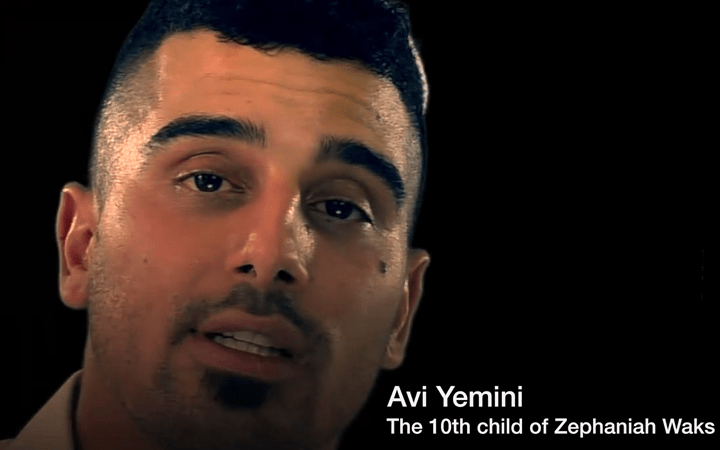
During the Australian Royal Commission into Institutional Responses to Child Sexual Abuse, Avi Yemini, a son of Zephaniah Waks and one of the brothers of Manny Waks, released a video levelling accusations against his father. He alleged that his father beat his children with belts and was generally emotionally abusive toward them. He then went on to challenge the legitimacy of the Royal Commission, and the testimony given by his brother, Manny Waks, and his father, Zephaniah Waks. According to Avi, Zephaniah’s claims about being ostracized by Chabad were fabricated. Avi has since gone on to defend Rabbi Glick, and Chabad in general, who have been accused of being complicit in the covering up sexual abuse, minimizing the experience of survivors, and ostracizing Zephaniah Waks after he and Manny went public regarding the sexual abuse suffered by Manny.

These allegations put the survivor community in a very difficult position, especially those of us who are active in the fight against sexual abuse and coverups in the religious Jewish community. On the one hand, we have Zephaniah Waks, who was undoubtedly ostracized by the Chabad community. This has been proven by the Royal Commission. Zephaniah has spent the past two years fighting along with his son, Manny—both of whom who have suffered for this cause—to put an end to the culture of silence and stigma around sexual abuse, not only in Australia but around the world. On the other hand, we have Avi Yemini, Zephaniah’s son, who is claiming that one of the men we’ve been holding up as a martyr for our cause, abused him physically and emotionally as a child.

There are a few points that need to be addressed there.


  • What Avi Yemini wanted to say to the royal commission regarding Zephaniah was in no way relevant to what they were investigating. They were not investigating the personal lives of Manny and Zephaniah Waks—they were investigating institutional responses to child sexual abuse. Whether or not Zephaniah abused Avi is irrelevant to that investigation. More to the point, whether or not Zephaniah deserved shunning for allegedly physically abusing Avi, that is not why Chabad shunned him. They shunned him for aiding Manny in his fight against Chabad for covering up sexual abuse.


  • Avi Yemini can defend Chabad and call the claims a farce until he is blue in the face, but The Royal Commission has already proven that there was a coverup; they’ve already proven that the community shunned Zephaniah because he dared challenge them on that coverup; they’ve already proven that Chabad of Australia cultivated a culture of silence, coverup, stigma, and denial surrounding sexual abuse, and that Chabad cared more about its reputation than the children in their care.


  • Manny Waks has nothing to do with the allegations Avi Yemini is levelling against Zephaniah Waks, and is in no way tarnished by the claims against Zephaniah. I have the greatest respect for Manny and his accomplishments.


  • At the core of the statements Avi Yemini has made, underneath the defenses of Chabad, the claims that his father and brother exaggerated or fabricated their experiences, is his claim that he was abused by his father.


To me this presents the biggest challenge we face as a community of activists. Bigger than Agudah, Satmar, Chabad, Skverr, Torah Temima, Lakewood, or any others. With all of those institutions we stand firm on the moral high ground taking aim at people we know are wrong, people whose coverups accomplish nothing but hurting children, and perpetuating an environment in which children are placed in constant jeopardy. There is no righteousness in their denials and refusals to change. There is only opportunism, cruelty, vanity, and perhaps, if we’re charitable, willful ignorance.

I’ve been discussing this with some people, and their general sentiment has been that the potential damage that will be done by acknowledging the allegations Avi is making against Zephaniah may outweigh our moral obligation to give every abuse claim equal time and consideration. Hence, the silence thus far from the activist community regarding the claims against Zephaniah Waks was, perhaps, in the interest of protecting children, an ostensibly righteous excuse, but an excuse with which I disagree. Some people have said that this is an unfair conflation of two issues which have nothing to do with each other, or whose severities are not equal—physical abuse vs sexual abuse. Others have said that their reluctance in addressing these issues publicly is that it will give ammunition to Chabad who will use it to dismiss the findings of the Royal Commission, and by extension the claims of our entire cause. Being that Avi so densely interspersed his allegations against Zephaniah with claims that the Royal Commission was a farce, they argue that it may be impossible to separate the wheat from the chaff.

This subject has been weighing heavily on my mind since I was made aware of it, and I’ve decided, regardless of any objections by my friends or colleagues, to make a public statement about this in the form of this blog post. My reasoning is as follows.

We hold the people and institutions we’re trying to change to a very high standard. We demand absolute transparency, we demand that they be free of any taint of abuse, and we challenge them every time they give us an excuse for not acknowledging the claims of a survivor. Moreover, we object every time they disregard the claims of a survivor who may no longer be religious, or is addicted to drugs, on psychiatric medicine, or in psychological treatment, since the survivor is clearly mentally disturbed, or clearly has an axe to grind being that he or she is no longer religious; we point out that the very reasons they are claiming they’re entitled to deny the allegations are in fact effects of the abuse and coverups, not the cause of the complaint. That’s the way I see Avi’s claims. A kernel of truth surrounded by untruths, brought on by the pain of his claims being ignored.

How can we not hold ourselves to the same standard just because we find it inconvenient and potentially harmful to our cause. How can we demand, for example, that Agudah support the Markey bill, which would open yeshivos to potentially crippling litigation, and criticize them when they actively fight against such legislation, when we ourselves aren’t willing to bleed a little for our cause.

Yes, Chabad may use this article may be used as ammunition, even though it clearly states that they are guilty of everything they have been accused of. Yes, this may be touted by our opponents, or by people on the fence who are desperately seeking any means by which they can maintain their cognitive dissonance, as an excuse to dismiss our cause. But if we wish to see our cause succeed, if we wish to see the change we’re asking of these institutions implemented, then we need to be pristine in our record of handling similar situations. We can have no blemishes against us which they could later use to call us hypocritical. We need to be a light unto the communities, and stand as a perfect, shining example of what we would like to see—a world in which abuse is universally acknowledged, and dealt with in a lawful manner that encourages prosecution of abusers and support of survivors.

If we claim to care about children, then we have no business equivocating with different kinds of abuse. Abuse is abuse and no form of it is tolerable. No coverup of abuse is tolerable. No tacit denial of abuse allegations is tolerable, regardless of against whom they are levelled and what the consequences may be. In being the perfect example of the change we wish to see in this world, we will get closer to fulfilling our dreams.

The claims that Avi Yemini has made against the Royal Commission, and the claims he makes against Manny and Zephaniah regarding their ostracism and the coverup of their allegations—which have already been proven by the royal commission—are not to be taken seriously. He’s already been proven wrong. The issue we must discuss is the allegation of physical and emotional abuse he has levelled against Zephania Waks. Avi’s claims deserve the same attention we would give to any other survivor who came forward with an allegation, even if his allegation puts us in an uncomfortable position.

Standard

How the Internet Saved My Life

When I started this blog, I intended it to be a place where I could share my thoughts with people who would hopefully like them, share them, discuss them. I’m not quite sure what I was hoping for beyond what every blogger hopes for—high hit counts, lots of shares, fawning adoration, if we’re being honest, some validation of my wacky ideas. It started a year and change ago on Tisha B’av at Aish Center in New York City. I had come early to their Tisha B’av program, and I was just chilling on a couch in their library with my smartphone.

I’d written a piece the previous night about how I relate to Tisha B’av, and what the day means to me. I thought it was a good piece, good enough that the world should see it. At the time I didn’t really have my own blog. I ran a blog for Our Place, I sometimes contributed to FrumFollies, but I didn’t have a place of my own to share my ideas. I copied the piece to Pastebin and shared it around, but there’s a reason, apparently, why people use WordPress, not Pastebin, for their blogging. A friend suggested I start a blog. I hadn’t wanted one at that point because having a blog means you have a commitment to your readers to write content that will keep them interested in you, and I wasn’t sure I had enough to say to fulfill that commitment. Sitting there on that couch, I wasn’t sure I could keep the commitment, but I knew that people had to read what I was writing. I felt I had something to add to the conversation. On Tonight I Mourn and The Gift of Tears I built my blog.

I didn’t just want my blog to be a place where I dumped my ideas waiting for unsuspecting people to stumble upon them and read them. I wanted it to be a new beginning, a more mature representation of my thoughts and beliefs, a departure from the biased, childish naiveté of my Our Place blog where I was forcing myself to seem more religious than I was to appeal to a more right wing demographic of potential donors, and the caustic, scorched-earth  indictments of my contributions to FrumFollies. I wrote things in both places which, while they made sense to me as a time, now make me cringe. They were preaching to a choir that already knew the lines. I wasn’t provoking thought, internal debate—I wasn’t starting a conversation—I was just shouting my way into the middle. I was determined to change that with my new blog, and I believe I have.

Along the way, though, what being a blogger means to me has changed. Honestly, the experience has been nothing short of humbling. Over the past year, I’ve received emails from people I greatly respect who have experienced tragedy, telling me how much my writing has meant to them. My readership has grown to a number I never would have imagined. My posts have been picked up by other publications and have started conversations so big that I’ve lost track of them. But they’ve also connected me with beautiful people, people with incredible hearts whose support and care has helped me through some very difficult times.

Over 50,000 people read my post about my mother’s abuse. For the next three days, I received so many messages sending me love, support, advice, offers for help and empathy, that I had to spend a few hours each night responding to all of them. I’ve made some good friends because of that post. The Carlebach post that followed was the first time I had truly connected with my readers as equals. I left the post open ended, hoping for a discussion, which I got. I spoke to people on all sides of the issue. People who were victims of Carlebach’s, people who had grown up with Carlebach, whose lives had been changed immeasurably by him and his music. I spoke to people who called me a liar, people who praised me for my courage in writing about a subject so delicate, people who themselves were conflicted about the issue and were grateful for the opportunity to discuss it. For the first time, I wasn’t just giving an idea to my readers hoping they would agree with it—my readers were giving me the ideas.

And then you people changed my life, and made me understand the true power of blogging. On January 8, my mother came back home. Those of you who follow my blog know that I was under the impression that she was going to Ohel permanently, and that my grandmother and I would finally be able to rebuild the lives that my mother had broken. But she came back home. I had woken up late that day. Business had been very busy, and mornings that I got to sleep in were rare. I woke at 10:30, and spent the next 45 minutes in bed watching Netflix. At 11:15, I heard her voice in the hallway. I heard her voice for the first time since the family meeting at the hospital, and the fact that I was hearing her voice just did not compute. She couldn’t be there. She couldn’t. How could someone who lived in Ohel be there in my hallway.

I listened for a minute to make sure it wasn’t just my aunt who has a very similar voice. It wasn’t my aunt. It was my mother. Frantically I called my aunt. “She’s here. She’s here and I don’t know what to do. She’s not supposed to be here. Why is she here?”

“Well, where else should she be?”

“She’s not supposed to be here! Is this something that’s been happening when I’ve been at work? Has she been visiting?” Her visiting my grandmother from Ohel is something we had discussed with the social workers at the family meetings.

“Well she’s human, she has to go somewhere.”

“She has Ohel! What is she doing here?!

“She’s not in Ohel; Ohel didn’t take her.”

At this point I started having a full blown panic attack.

“What do you mean they didn’t take her…”

“They didn’t accept her.”

“And no one thought it might be a good idea to tell me?”

“I don’t know, we didn’t know much ourselves.”

“You knew enough to know she was coming home, and you didn’t tell me anything!”

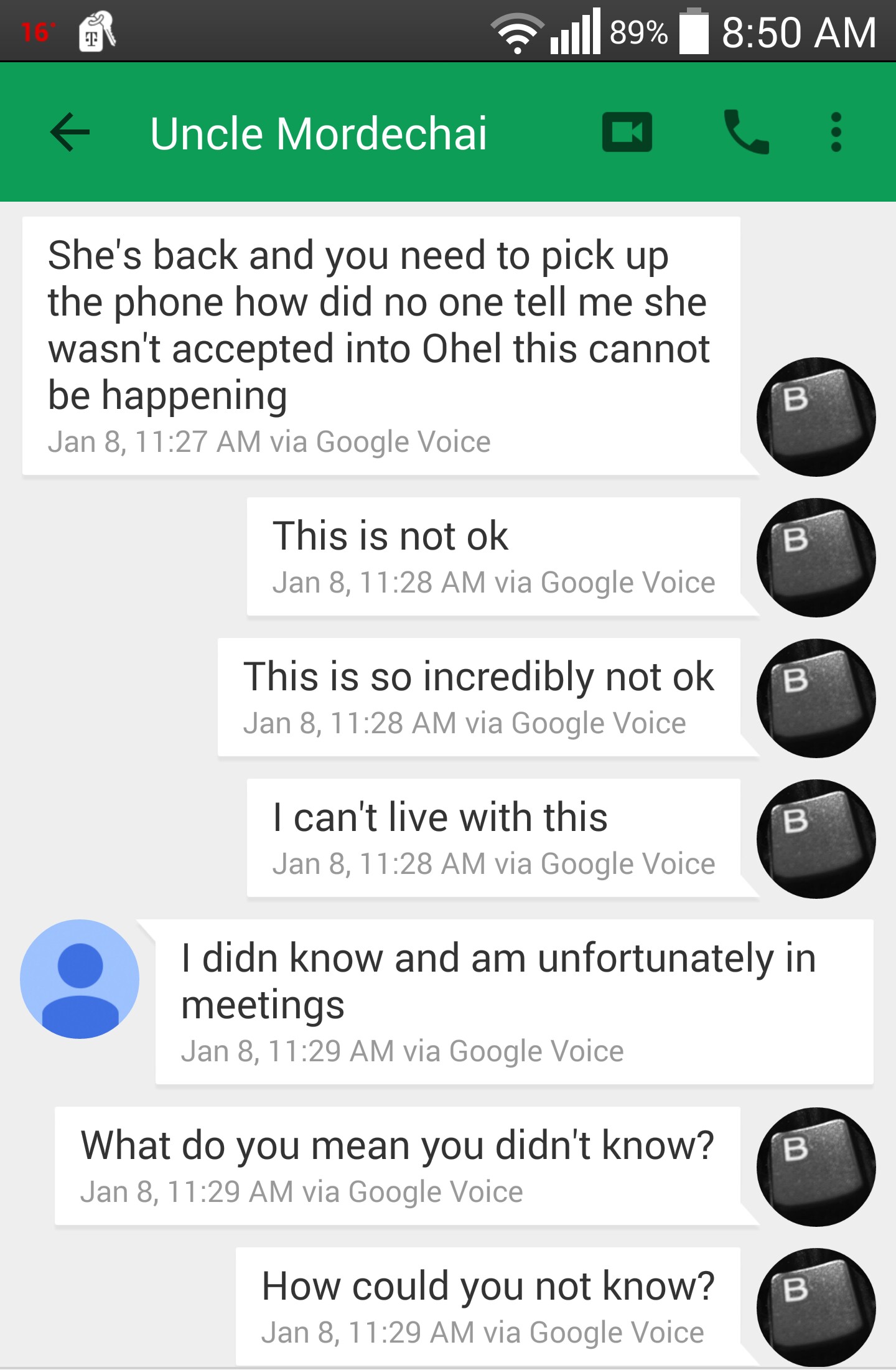
She started stammering, trying to find an excuse, but she was never the one who made the decisions anyway, so yelling at her was pointless. Next I tried calling my uncle. He didn’t answer, so I texted. I had texted him on December 2 asking him if the Ohel interview happened, but he had never answered. On January 8th, this conversation happened:

Screenshot_2015-02-15-08-50-29~2Screenshot_2015-02-15-08-50-18~2Screenshot_2015-02-15-08-50-40~2

I got dressed in my room. At 11:35, I posted this message to an online support group I help run:

“She’s back and oh my god I don’t know what to do and my family isn’t saying anything and Oh my god help I can’t live like this I can’t I fucking can’t she didn’t get into Ohel and no one told me and she’s back and I want to die and help I need to go to work but I can’t deal with life right now I can’t I can’t I can’t do this I thought I was free Oh my god someone help[.]”

At 11:45, I packed my briefcase with what I’d need for work, my medicine, and my laptops, and I left, not knowing if I’d ever be back, or how I’d live. I was, effectively, homeless.

It couldn’t have happened at a worse time. I had just come back from a trip to Chicago a week prior. During my trip, I’d expressed interest to some of my friends in moving there permanently if I could find a job. Through some connections, a tentative job offer was made, which would probably start by the end of summer. That left me a few months to get my affairs in order in New York, including paying off my unfortunate credit card debt. Thinking that my mother was safely in Ohel, thus giving me as much time as I needed living with my grandmother all expenses paid, I spent all my money paying off the trip, and began paying off the credit cards. I had no money in my bank account.

My day started in Crown Heights, where I had four driving lessons to give. I had no idea what I would do after work, but I knew I couldn’t afford to take off, because whatever I did do after work would probably cost money. It’s a miracle I was able to focus.

Thankfully, by 12:12 PM I had already been offered a place to crash temporarily. My friend, Chaim Levin, offered to let me stay on his couch. While that was a generous offer, what Chaim actually did, was sleep by his parents for Friday night and Saturday night, allowing me to get a decent night’s sleep on his bed, for which I am deeply grateful.

At around 1:00 PM, I got a message from Elad Nehorai offering to help me raise money by crowdfunding to move into an apartment. He asked me how much I needed; I told him $5000. I wanted a number that would get me as much as I needed to move, but not more. He got to work on starting a GoFundMe. Being that I run what I like to think of as a sort-of-successful blog, he told me to write a post about my situation, and appeal to my readers for help. I pulled over to the side of the road, wrote it, and sent it off. Elad continued to work on the finishing touches for the campaign. By 2:40 PM, it was up and running.

At 2:24 PM, I called my best friend, and for about a half hour, had a complete meltdown. I was crying, gibbering, talking to myself, shaking, incoherent. She just listened and offered her empathy, which is exactly what I needed. I told her that Elad was helping me with crowdfunding, and she set to work finding me an apartment. By around 6:45, she had found something and emailed the landlady. At 9:00 PM, I went to see the apartment.

At 2:46 PM, I called my uncle. I wanted to know what was going on. I don’t remember the exact conversation, but I remember yelling at him for two minutes about how unacceptable it was that she didn’t get into Ohel, blaming him for it falling through, and demanding to know why no one told me. He said something along the lines of “You’re coming on very strongly, but you have to understand there’s only so much one person can do.” I asked him, “You couldn’t at least tell me? You couldn’t warn me?” He claimed that they didn’t know what was happening. I called bullshit because he had to have known at the very least that she wasn’t accepted into Ohel. He had never answered my texts. He hadn’t even tried to keep me, the one person who was most affected by what was happening, apprised on what was happening. I yelled at him for not telling me, for making me think I was safe when I really wasn’t, for turning me into what amounted to a homeless beggar, for making me uproot my life at a moment’s notice. Then I paused to catch my breath, and waited for him to say something. When he didn’t, I told him “I’m going to hang up now. You go try to find a way to live with yourself; I’ll go try to find a way to live.”

Those were and will be the last words I speak to my family. They’ve hurt me enough.

By 3:00 PM, $500 had been raised. By 6:30 PM, $4900 had been raised. By the following day at 2:07 PM, $7,000 had been raised. By the time the campaign ended a few days later, close to $8000—$3000 above the goal—had been raised.

Around 7:30 PM, I went home to pack my things. I walked in without anyone noticing, put everything I thought I would need into two large suitcases, and moved onto Chaim Levin’s couch. The next day, Elad arranged for me to spend the Shabbos meals by two lovely families who made my first Shabbos as a displaced person feel much less scary. By Sunday afternoon, the landlady had called my references, vetted me, and told me I could move in at 6:00 that night. I didn’t have the money that had been raised through GoFundMe yet, but she confirmed through Elad that it was there, and agreed to let me move in before signing the lease and paying the rent and deposit. Since I’ve moved in, she has been nothing short of a saint.

Around 5:00 PM on Sunday January 10, I went home one last time to get my stuff. On my own, I dragged my fridge, TV, toaster ovens, books, computers, and other stuff to my car as my grandmother and mother watched, not quite sure what I was doing, but pretty certain that I was moving. I didn’t say a word to either of them. By 10:00 PM I was moved in.

The one thing I regret about the move is cutting my grandmother off. I don’t blame her at all for what happened; she was just as much a victim as I was. She still is. I can’t talk to her anymore because anything I tell her will get back to the rest of my family, and I can’t have them knowing about me anymore. I’ve ignored their texts and calls, not that there have been very many. I hope one day to have a relationship with her again, but as long as my mother is alive and a part of her life, I don’t see how that’s possible. I pray that she understands and forgives me, but more importantly, I pray that she finds a way to let go of the guilt that she’s been carrying all these years about my mother. She doesn’t deserve it.

What’s amazing about this whole story, and what makes me truly appreciate the power of blogging and social media, is that all the people who helped me, all the people who have shown that they truly love and care for me, the people that I now consider my family, the people who support me unconditionally, are all people I have met online. Shay, Chaim, Elad, and all the other people who have been there for me, and continue to support me, are all people I’ve connected with online. The money that was raised, was donated by people who, for the most part, have never met me, and will, most likely, never meet me. The only connection they had with me was my blog, and yet they’re the ones who helped me when I most needed it. That is the power of the internet.

The internet has really shaken things up since its inception. The advent of high-speed internet and its ubiquity has thrown a wrench into the social order. Whereas people who formerly felt isolated, whether because of their ideas, their questions, their family situations—people who felt powerless and helpless, like they had no one and no options—were alone, without a community to help or support them, without the basic comfort of another human being to say “I’m here for you,” now have that through the internet. I am no longer a victim because of the internet and the friends it has given me. I am religious because of the internet and the people I found online who were going through the same struggles I was, who listened and advised instead of judging and dismissing. To me, the internet, and how you all helped me escape, is nothing short of miraculous. I thank God every day for the internet. I’d be dead without it, either by suicide or by circumstance.  I have a voice because of the internet. I have a family because of the internet. I have all of you because of the internet.

I have a life because of the internet.

Standard

Please Help Me Get Out

Author’s note:Here is the link to the GoFundMe campaign. Thank you all so much for your help and support. http://www.gofundme.com/asherlovy

About two months ago, I wrote an article detailing the abuse I’ve been suffering for the past 20 years. In that article, I detailed how, among other things, she threatened to kill me and my grandmother, and poured oil, bleach, and ammonia under my door in an effort to kill me. Happily, she doesn’t know how to kill people so it didn’t work, but the intent was clear. I still have a chemical burn scar on my arm from falling in that.

About a month and a half later, I wrote a post about how I was finally free. We had had a family meeting at the hospital, my grandmother had found the courage to tell my mother she couldn’t return home, and my mother was to be admitted to an Ohel supervised apartment. I thought my grandmother and I were finally free. For the first time in my life I was able to approach my front door without getting a panic attack. I was able to sleep at night without listening to my grandmother being threatened. I was able to live without the constant threat of abuse.

I thought I’d finally be able to put my abuse behind me and move on with my life.

This morning she came back.

I couldn’t believe it. I was hearing her voice. In the house. The voice of the woman who had abused me for 20 years. She was back. I called my uncle,  but he didn’t answer. I called my aunt, and all she could say was that Ohel didn’t take her, the hospital discharged her, and “What can we do? She’s a human being.” No one told me. No one warned me. And now she’s back and since I’ve heard her voice, I’ve been in a panic.

I need to move now. I need to. I cannot live there. I won’t survive there. It hurts me to be so needy that I need to ask others for help, but I honestly feel I have no other option. I need to move tonight. Thank God I have such amazing friends, one of whom is letting me crash at his place until I can move, but that won’t last long. I need to move now because I can’t go home and I don’t have where to go. Unfortunately, I don’t have the money to move now.

My dear friends and readers, anybody who knows me knows that I don’t like asking for help, and I don’t like accepting charity. But I am desperate. A friend of mine has set up a crowdfunding campaign to help me move immediately. I need $5000 total to move right now. Please share this with your friends, and anyone you know who can help me. You are literally saving my life. Any amount we help me.

Standard

After 20 Years I’m Finally Free

A few weeks ago, I wrote a post about life in my house. I detailed the abuse I was experiencing. Over 50,000 people read that post, and it was shared over 1,500 times. I received an enormous outpouring of support, both in the form of sympathy, and actual offers of help from lawyers willing to take my case pro bono, invitations for Shabbos, and advice based on personal experience. More people than I can count shared their own stories and experiences in dealing with an abusive family member with a mental illness. Honestly, readers, you humbled me; you showed me the power of social media, and the significance of the words “me too.” Thank you so much for being there for me.

It’s been a couple of weeks, and there have been a couple of developments I’d like you all to know about. But let me back up 20 years, and explain exactly how significant these developments are.

My mother has been in and out of the psych ward at Maimonides hospital since I can remember. The first time I can remember, I was four, and it was after she had a “manic episode” and took me, on Shabbos, to a man’s house where I witnessed them having sex. I wasn’t quite old enough at the time to understand the significance of what they were doing, but I do now. The weekend ended with my mother and that man getting into a physical altercation; my grandmother had to come over to break up the fight and make sure I got home safely. The police were called and she was committed. That’s the first time I remember.

The rest were a blur, happening every three years like clockwork, as she cycled between long periods of depression, followed by long periods of stability, followed by her deciding that stability meant she was cured, ceasing to take her medicine, rapidly decompensating, culminating in her involuntary commitment. I was too young at the time to really understand what was going on, but I knew it was bad, and I knew it was stressful. I didn’t have to handle it back then, though; that’s what my grandfather was for. Unfortunately, he died when I was 11, and my grandmother was left to be the disciplinarian in the house, and she became the one to call the police when it was time for my mother to be committed.

The two months my mother would take to decompensate would be different for me every time. Sometimes it wasn’t half bad. She would take me to interesting places, spend all her money on me, and make me feel like the most important person in the world. Sometimes it was all about her, and I had to watch every word I said to her, lest I send her into a rage. Sometimes she just left and shacked up with some guy for a while until I’d find out who he was, call his house incessantly, cursing him for taking my mother from me, until the guy would decide that the annoyance I posed was not worth the sex he was getting, and send her home. Sometimes it involved a diet that my mother decided she had to try. But it’s no fun doing a diet alone, so she would force me to go on that diet along with her. These diets usually ran along the lines of the starvation diets to which models, actresses, and people with eating disorders subject themselves—totally unsuitable for an adult, let alone a child.

But there was always a running theme, a way for me to know what was coming. It was always religion, and a focus on my biological father. I am the result of an affair my mother had with her hairdresser while married to her then husband. I don’t judge her for having that affair; her husband was an abusive man who I don’t doubt did many horrible things to her. When I was born, I posed a problem to the family; a mamzer is not something you want to have around when there are shidduchim (matchmaking prospects) to consider. My family asked a rav (rabbi) and a psak (ruling) was give: I was to be considered not a mamzer, since my mother was still married to then husband and possibly still having sex with him, and I was given her husband’s surname. For all halachic intents and purposes, I was her husband’s son. Understandably, she did not like this.

But she never really made a point of mentioning it unless she was on her way to the hospital, so to speak. Then she would bring it up at any opportunity. She would call me by my full name, and use her hairdresser’s surname rather than my given surname. She would make a point of the fact that to her I was a mamzer (illegitimate child), and be quite cruel about it. I know better now than to care, but back then it was not pleasant hearing that I could never marry anyone who wasn’t also a mamzeres (fem. illegitimate child). It was very important to her that I know the truth.

Another recurring theme was religion. My mother has never been particularly religious, but she would become incredibly devout right before having a complete breakdown. She would cover her hair, pray all day, often uttering God’s name as it is spelled out, rather than the accepted name for God in prayer (Ye-ho-vah rather than Ado-nai), which to me at the time was akin to desecrating God’s name. She would continue with this extremism until she realized she wasn’t going to get what she wanted from God, by which time she would be hospitalized. She would always come back barely religious again. In some way seeing her irreligious was a comfort; it meant that she was stable.

The final harbinger of her breakdowns was always the list of grievances she had against anyone and everyone she felt had ever wronged her, no matter how slightly. She is a master at bearing grudges and laying guilt trips. From $35,000 my grandparents supposedly stole, to her failed marriage, which she claims my grandparents pushed her into (which may very well me true), to all the times she “sacrificed” for me and I hadn’t reciprocated. As a ten year old. How selfish.

So life was not easy growing up for me. Aside from all that, there was always an undercurrent of conflict between her and my grandparents over who was truly responsible for parenting me. When my mother was first hospitalized, shortly following her divorce, my grandmother sued for custody and won. Her argument was that if my mother was too unstable to care for me, someone else had to have custody and be responsible for me. To be honest, I was always quite pleased that my mother didn’t have custody of me. I never really trusted her like that.

My mother was not pleased at all, however. When I was around 11 years old, she sued for custody from my grandmother, and being that she was stable at the time, the judge granted her full custody rights. Mind you, the entire time we were all living in the same house—my grandparents, my uncle, my mother, and I. Despite winning custody, there were constant arguments over who had the right to a say in what was best for me, from the books I read, to the shows I watched, to the food I ate. Everything was a conflict between my mother and my grandparents. And I was always caught in middle, often prompted to choose a side. The problem was, I generally preferred my grandmother, but was too afraid to say so. To be honest, there were times when the conflict confused me. I remember one time, after spending a weekend hearing my mother tell me all the horrible things my grandparents had supposedly done to her, picking up a knife and running at my grandfather with the intention of stabbing him.

This continued for the first 16 years of my life. It was difficult, but I always had my grandparents to lean on (after age 11 it was only my grandmother). At age 16, my grandmother fell into a deep depressing following a hospitalization which was a result of a side effect of an anti-depressant she’d started taking when the situation became too much for her to handle. That’s when things really got bad. My grandmother could no longer act as a buffer between me and my mother, and my mother was free to do whatever she wanted to me. That’s when the beatings started. The verbal and emotional abuse was worse than ever. I still have the marks on my doorframe where the posts were splintered by my mother’s attempts to break down my door. I never got around to fixing that.

It was harder dealing with my mother on my own, especially after I stopped talking to her. That really sent her over the edge. My mother has a son from her ex-husband, a son who was taken from her at the end of the marriage and placed with an adoptive family which has raised him like their own. My mother tried for years to get custody, but every time she got close, she had a breakdown and the judge ruled against her. Losing my brother hurt her deeply, which made what I was doing to her by not talking to her that much worse: she had lost both her sons. Unfortunately, rather than self-examining and coming to understand why she had lost me, she turned that hurt into rage directed at me.

For the first time, I was left to fend her off myself, and it was much harder then than it had been when I was younger. I was older so I could take more, and boy did she dish it. In lieu of my grandmother, I was the one who had to have her hospitalized, which made me the consummate bad guy. She would come back fro the hospital angry that I had sent her away, and the cycle of abuse would start all over again.

These past few months have been the hardest months of my life. The abuse was the worst I’ve ever experienced. It wasn’t physical, because she knows full well I would fight back, but there are other ways of hurting people. She deprived me of sleep, abused my grandmother knowing full well there was nothing I could do about it—my grandmother refused to let me take any action—she threatened my life and safety, damaged my property, and let no opportunity to let me know exactly how worthless I was go to waste. But none of that compared to the anxiety her instability caused me. I was constantly on alert, my fight or flight reflex screaming at me 24 hours a day, 7 days a week, always ready to spring into action should she do something really harmful to my grandmother or me. Months of constant anxiety. That was the worst.

She was in and out of the hospital 4 times in the past 5 months, each time they would keep her until she was stable enough that they could no longer justify keeping her against her will, and each time she would come back and immediately become unstable. The problem was, there was a little bit of a catch-22. I had a life to move on with, but I couldn’t move on until I knew my grandmother was safe, but it seemed that I was always the catalyst that set her off. So I was at once the solution and the problem. The only person who could solve that problem was my grandmother, but she refused to kick my mother out of the house. Every time my mother was hospitalized, my grandmother would take her back in, no matter how vehemently the rest of my family and I protested.

The problem was, that as bad as my mother was, and as much as she made my grandmother suffer (I believe my grandmother suffered much worse than I did these last few years), my grandmother refused to throw her out unless she knew for a fact that my mother would not wind up in a state mental hospital. My mother had been sent to one before for 6 months, and it had been a very unpleasant experience. Nothing anyone said to my grandmother could convince her that my mother would not wind up in a state hospital if thrown out of the house, so my grandmother kept allowing her back, regardless of the suffering she knew she was accepting.

But what was different this time than all the other times, was the fact that my grandmother finally spoke up to us and said that she hated how she was suffering. She actually told us that had she her way, she would be rid of my mother, as long as she could know for sure that my mother would not be sent to a state home. The last time my mother was released from the hospital, a social worker was assigned to her case to stay on top of her treatment compliance and work with her toward a supervised living arrangement away from our house through Ohel. My grandmother was skeptical because Ohel had never wanted to accept my mother before due to how unstable she could be, and the supervised living arrangement never went anywhere.

After the incidents I wrote about in my last piece about it, my grandmother realized that this couldn’t continue. I made sure my family was putting as much pressure as they could on her without outright forcing her to make a decision. About three weeks ago the hospital held a family meeting. They had tried to hold one a month prior, but I refused to show up. I was told later, that it’s very possible that my mother was allowed home because I didn’t show up at the meeting and make my case. As reluctant as I was to be in the same room as my mother, I forced myself to go to this family meeting.

We got to the hospital and rode the elevator up to the fourth floor. My mother was waiting to greet us, and she seemed happy that we had all come. She proudly pointed me out to all of her ward-mates. “That’s my son!” I just kept my eyes on my phone. I wasn’t there to see her or be shown off; I was there to make sure she never came home again. Her social worker and psychiatrist then met us, and the meeting began. The psychiatrist laid out the situation, with comments from the social worker. They told us that she was ready to be discharged, and that we had to make a decision what to do with her, whether to let her come home, or push her into an Ohel supervised apartment.

When we had walked in, my mother had made a point of asking my grandmother in front of all of us whether or not she would be allowed home. My grandmother said yes for lack of a better option, and my mother genuinely believed that my grandmother meant it. As the meeting progressed, it became my turn to speak. I had a lot of things I wanted to say to her doctors. I detailed the abuse she had put me through, and asked them how they didn’t feel responsible for any of the damage my mother had caused as a result of being released when she was clearly a danger. The psychiatrist took slight offense at my tone, and told all of us that it was not his responsibility, but ours to decide whether or not to allow her back home despite their warnings to the contrary. The point was well made, and it was time to decide what to do with my mother.

My mother started about me to the doctor. “It’s not my fault, it’s that bastard! He doesn’t talk to me! He provokes me! He does things to me! If he weren’t home, everything would be fine; he should be the one to move!” The doctors tried to calm her down, but she would not stop. She was escorted out of the room, and stood by the glass looking in. The meeting continued, and the doctors explained to us that his recommendation was to tell her that she was no longer welcome home and that she was either going to Ohel, or a homeless shelter. We asked some questions, made sure my grandmother was satisfied that Ohel would be a safe place for her, and then it came time for the decision: My grandmother was finally put on the spot and asked whether or not she would tell my mother that she couldn’t come home.

My mother was called back in. Immediately, she asked my grandmother whether or not she would be allowed back home. “I’m sorry, it won’t work out. You can’t come home.”

“But you said I could! You told me I could when you walked in!”

“I’m sorry, but you can’t. It won’t work out.”

“I took care of you for years! I too care of you after tatty died! You let Moishe (one of my uncles who married late and lived with us until that time) live there until he was 39 years old; why can’t I live with you?”

“I’m going to be moving into a smaller apartment, and I won’t have room for you.”

“That’s ridiculous! I want to live with you! Anywhere you go I want to go!”
“I’m sorry, it won’t work out.”

At that point the doctor took over, and explained to my mother, forcefully, that it was over. That she was never coming back home. My aunt chose that moment to tell my mother that it was because she was so unstable that this was happening. My mother didn’t like that, and grabbed my aunt’s wig off her head and flung it across the room. The psychiatrist yelled at her to calm down.

“I DON’T WANT TO GO TO OHEL!”

“Well,” said the psychiatrist levelly, “It’s either Ohel, or remember what we discussed?”

“Yeah. The shelter.”

“You don’t want to go to the shelter, do you?”

“No!”

“So then you have to go to Ohel. I’m sorry, but that’s the way it is. Your mother can’t take care of you, and this is the best solution.”

“FINE, BUT I NEVER WANT TO TALK TO ANY OF YOU AGAIN, ESPECIALLY YOU, BASTARD!” she yelled, pointing at me, and stormed out of the room.

I have never been prouder of my grandmother.

The house has been quiet and safe for the first time in years. I cook dinner for my grandmother when I can, take care of the grocery orders, and make sure she eats. For the first time I can remember, my grandmother sat with me in the kitchen with me while I cooked dinner, and watched Netflix with me. We talked about the show, and what I was making, and for the first time in years, I felt connected to her again, like I finally had a family. She’s still severely depressed and it’s very hard to get her to open up and talk, but there’s the start of a relationship, and it feels so good, honestly. I feel happy to have a family for the first time in my life. They all stood up for me, they all finally listened and took my side, and they finally made it safe for me and my grandmother. I actually think I love them.

I’m writing this as I fly to Chicago to see my friends, and I’m trying to hold back the tears, but it’s not really working. On the way out this morning, my grandmother smiled at me and wished me a safe trip. I think it was the most beautiful thing I have ever seen in my life. I look forward to seeing it many more times.

Hi, my name is Asher, and I have survived.


Standard

Carlebach, Cosby, and Separating Art from Its Artist

UPDATE 12/8/2014 6:30 PM: Since posting this article last night, I’ve been contacted by quite a few people with firsthand accounts of Carlebach’s abuse, specifically, inappropriate phone calls, inappropriate flirtations, and most seriously, molestation of minors. 

A few weeks ago, my shul (synagogue) held its annual Carlebach Shabbos. Benzion Miller, the Aron Miller Memorial Choir, and roughly 1,500 people showed up to sing, and dance, and celebrate the life, music, and legacy of Rabbi Shlomo Carlebach. There’s no question that Shlomo Carlebach touched the lives of tens of thousands with his music, his passion, and his apparent utter devotion to God and the Jewish people, and returned souls to Judaism at a time when religion seemed on the decline. But there was a darker side to the legend, a side that forces the uncomfortable question: Can we separate the man from the legacy—the art from the artist?

So there I was, sitting in my pew, 1,500 people around me, all singing Carlebach. I couldn’t help myself. It’s impossible not to sing along. The melodies are beautiful in their simplicity, saturated with soul, and electrifying in crowds. It’s impossible not to be swept up in the frenzy. My fingers drumming along to the melody, my feet tapping, a smile tugging at the corners of my mouth despite my best efforts to the contrary, I sang along with everyone else. How could I deny it? In a room filled with people from the far-right to the far-left to the non-observant, all singing the same music, all united in a way they have never been before, and will likely never be again, how could I not be swept up by the crowd? Men in shtreimels (circular fur hats worn by Hasidic men) with long, untrimmed beards, dancing with their fellow Jews, some wearing knit kippot (skull caps), some with ponytails, some in suits, some in jeans and a t-shirt; has anything, in the history of the Jewish people, ever united people so different, than the music of Shlomo Carlebach?

Following the service was a Carlebach dinner held at a local catering hall, with our scholar-in-residence, Rabbi Sammy Intrator, Carlebach’s long time right hand man. He started the night off with a song, and once the crowd was warmed up, he began to talk about Reb Shlomo. He told us story after story about Reb Shlomo’s compassion, his love for his fellow Jew, how deeply his desire to foster peace and love in this world ran, and how in-tune his soul was with God and the world. In true Carlebach style, he told us some of the stories that Carlebach used to tell, singing them exactly as Carlebach used to, bringing them to life with as much of the emotion and heart as he could. Carlebach’s stories always make me cry. As hard as I try not to, they always manage to get me.

Carlebach had an amazing gift for touching the souls of people with his stories of Chassidus (a more spiritual and mystical approach to Orthodox Judaism), and how the simplest Jew could have the greatest impact; his stories keep alive the memories of fallen communities and dynasties that perished with time and in the Holocaust, and the memories of the great men and women that would otherwise be forgotten. You would have to be lacking a soul not to tear up at the story of Chatzkele Lekavod Shabbos. And as I sat there listening to Sammy Intrator reincarnate Carlebach so beautifully for his very captive audience, I felt a little dirty. My holy brothers and sisters, I remember—I REMEMBEEEEEEEEEER—the Shlomo Carlebach that I grew up hearing so much about, the great man who reunited Judaism in the Diaspora, but I also remember the Shlomo Carlebach who fondled women who came to him for guidance, who masturbated on women who worshipped him, and who covered it all up by telling them that they were holy, and special. I remember the stories I’ve heard firsthand from people who experienced the darker side of Carlebach. And as I sat there laughing and crying as Sammy Intrator spoke, I felt myself tearing apart.

A battle was raging in my head: How can you sit there and listen to this when you know what he really was, and what he did to those women? But, but, look at the holiness he brought to this world, the people he united, the masses he returned to Judaism, the power of his music, and the strength of his enduring legacy! Yeah, but his legacy was built on the backs of an endless string of victims! But, but look! Look at all these people, singing, and crying, and laughing, and loving, and opening their hearts to one another! Surely that must count for something! Maybe, but who will remember the victims, and how is it right to sit there and tacitly support a man who caused so much damage?

I don’t know.

Honestly, Carlebach is a difficult subject for me. My inner conflict was punctuated by the recent resurgence of rape allegations against Bill Cosby. I loved Cosby. I loved his show, I loved his comedy, I loved his smile, I loved what he represented. Just like I loved Carlebach. It’s always this way. It’s always the people you love the most who hurt you the worst. Of all the people who had to be sexual abusers, of course, it had to be Shlomo Carlebach, and Bill Cosby. Right in the childhood. Right in the heart. Cosby is easier for me to throw under the bus, because while I’ve enjoyed his work, it’s never touched my soul. Carlebach is special to me. Carlebach represents a Judaism I’d love to see in this world. I mean, I suppose he would, if not for the small matter that he was a sexual abuser. Why does it have to be so difficult.

Both Cosby and Carlebach got away with what they did for so long because of how loved and cherished both they and their work were. But can their work stand alone? Is it possible to separate the art from the artist? It’s an ongoing question for me. On the one hand, I see the beauty that Carlebach brought into the world, and I don’t want the world to suffer the loss of what Carlebach gave it because of his sins. Perhaps the beauty, and holiness he facilitated was there already, waiting only to be discovered and brought to light, and he was only a conduit. Perhaps we would have had it through someone else, someone less flawed. Perhaps we should therefore allow what he revealed to stand while we leave him to rot.

On the other hand, as blogger Elan Morgan pointed out on a friend’s Facebook page:

IMPORTANT: We cannot separate the men from their art when they used their status from that art both to commit and conceal their violent behaviour. To continue to share their art is to continue to share one of the weapons they used to commit their crimes.

Perhaps we do more harm than good by perpetuating the tools of these people’s abuse. Perhaps we are contributing to the pain felt by Carlebach and Cosby’s victims, who for so long were denied justice, by touting the instruments of their abuse as something worthy of praise and enjoyment. Perhaps we make those men that much more acceptable by refusing to give up what they created simply because our lives are enriched by the fruits of those poisonous trees.

Or maybe there’s a baby to be saved somewhere in the putrid bathwater. Maybe there’s a message, some truth, a little good that can be salvaged from these men’s abominable lives. Might the message not be valid regardless of its source? Can we not keep the moral values Cosby preached while damning the damaged he caused to 17 (and counting) women, or the love and acceptance exhorted by Carlebach while distancing ourselves from the man himself and his actions.

There are a million answers to these questions, and frankly I haven’t found mine yet. It’s something I struggle with every time I hear one of Carlebach’s songs, or see the popularity people like Eitan Katz, or Yehuda Green have because of their similarities in musical style to Carlebach. I still feel dirty and conflicted when I sit in shul and hear one of Carlebach’s tunes used for lecha dodi (Song to greet the Sabbath sung by Friday night prayers), finding myself at once moved and repulsed. To be honest, I still use those tunes myself when I lead the prayers, because I know the congregation likes them and will sing along. I don’t know what the balance should be, or if there even is one to be had. Maybe you people can help me out; what do you all think?

Standard

Who Am I: I Am Unbreakable

Hi, my name is Asher, and I’m a…

I don’t know. I’m twenty-two. I work two jobs, one as a driving instructor, the other as a computer technician. I make good money. I dress well. I write well. I look fine. I’m a jokester. Sometimes I’m very quiet. Sometimes I’m the life of the party. But that’s when I’m not home. That’s when I’m wearing my mask. My life isn’t easy. At home I’m…

I thought things had gotten better since last time. I mean, things were never great, but they were livable. But then they weren’t. My mother started abusing my grandmother again, turning her into her slave, making her do things you wouldn’t make the most menial laborer do. My mother forced my grandmother to wipe her ass, and bathe her, bring her whatever she wanted at any time of the day or night. My mother made sure my grandmother didn’t sleep, made sure she couldn’t rest, and all the while degrading her, calling her names, accusing her of every wrong in the universe, laying a mighty fine guilt trip.

And I sat safely in my room, listening, waiting, attentive, making sure my grandmother’s life was never in danger. I couldn’t sleep either. What if she snapped. What if she hurt my grandmother. I was on constant alert. I needed to make sure my mother didn’t escalate to violence against my grandmother, make sure she didn’t act on the countless threats. And there was nothing I could do, you know? My grandmother refused to throw my mother out of the house even though she hated living the way she was. My grandmother was too merciful to see my mother on the street, or in a state mental facility.

My mother stopped taking her meds about a year ago, it turns out, and for the past year, she’s been steadily getting more unstable. The more unstable she gets, the more she starts lashing out at everyone she believes wronged her, and made her life the meaningless pile of shit it is today. The way the mental health system is set up in this country, the only way to get someone committed involuntarily is if they pose a danger to themselves or others. That law is very broad and ill-defined. I could see the danger my mother posed. I could see the damage she was causing my grandmother, but there was not a single thing I could do to prevent the inevitable violence. The law only recognizes physical violence as danger, and threat of violence is not always enough. I could only pray that I could contain it when it occurred, and call the police in time to stop it from escalating.

I got my chance about four months ago, when she got into a fight with her boyfriend. She had taken to walking around the house naked in the weeks leading up to this, and she was naked four months ago when they got into their fight. I heard him hit the ground and scream, so I ran out of my room to see if anyone was hurt. He was running down the hallway toward the door. I stood in the hallway, back to my naked mother, preventing her from chasing her boyfriend. “Get out!” I yelled at him. He didn’t need telling twice. I went back in my room, grabbed the phone, and called the police. They came within two minutes, barely enough time for me to pull on my pants and run to the door to open it for them. My mother was sitting in the kitchen with my grandmother, next to the door. Both were telling me not to open it. Open it I did.

She was taken away, and I thought we’d finally get some peace. I thought the hospital would treat her, make her take her meds. I thought they’d be responsible enough to send her home stable. Heh. She came home and went right back to abusing my grandmother. She never touched her, but I could see my grandmother suffering. I begged my family to do something, and this time they tried, but there was nothing they could do with my grandmother refusing to act against her daughter. Things got worse.

A few days before Rosh Hashana, I was getting ready to leave to work, and I heard my mother yelling more violently than she had been. She was threatening to kill my grandmother. I had to leave for work, but I didn’t want to leave my grandmother alone with my crazed mother, so I called the cops. A horde of them showed up along with EMS, after a fashion. Took them twenty minutes to get there. Apparently threats of death aren’t enough for New York’s finest; they didn’t care because no one had been hurt yet, and she had no weapon yet. EMS came in, checked out my mother, asked my grandmother if she felt she was in danger, and then left. My grandmother had covered for my mother again. I went back in the house to get my laptop, and my mother threatened to kill me if I ever called the police on her again. Apparently she felt powerful because they hadn’t taken her. I knew it was going to be a long holiday.

It was terrible. My mother was as angry and violent as I had ever seen her, shouting at my grandmother, making her do disgusting, degrading things I’d sooner not mention here to preserve my grandmother’s dignity, in addition to the usual slave labor she forced on my grandmother. I wasn’t let off the hook either. The entire night, she stood outside my door shouting, cursing, threatening, and insulting me, loudly enough that I wouldn’t be able to sleep. I slept maybe a total of 6 hours over those three days. Rosh Hashana came and went, and I was worried about what to do going forward. I doubted I could go much longer without sleep.

Thankfully, I got a text from my aunt after Rosh hashana. Apparently, my mother had gone over to my uncle’s house, and shattered a window there that morning. My uncle hadn’t called the police because it was Shabbos, but after asking me what to do, he did call. They came and dragged her, literally kicking and screaming, into an ambulance, and off to the psych ward. And my grandmother and I breathed a little easier. Surely this time something would be done. My uncle had been talking to the hospital, and they assured us they had the resources to monitor her once she was released, and help her comply with outpatient treatment. Eventually, they promised, she’d be stable enough to be moved to a supervised living facility. I should have known they were full of shit.

A month later she came home, and this time it barely lasted at all. Two weeks ago Friday, right before Shabbos, she sent my grandmother to ask me to turn the light in her room off. I know my mother doesn’t give a fuck and a quarter about Shabbos, and more to the point, why the hell would I do anything for someone who abused me for so many years, so I just laughed and went about my business preparing. Apparently that was the last straw. She well and truly lost it. It all came out, all at once, the anger, resentment, the jealousy, how she “gave up so much” for me and how ungrateful I was being. How I was a lowlife bastard, a little baby who claimed to be abused, but was really abusing her. And that’s when I knew: She’d read what I’d written about her. I heard her hitting something on my doorframe. “I just took the mezuzah (Small parchment scroll with bible verses, placed on doorposts in Jewish homes; it is meant to serve as a protection) you hold so dear, and burned it in the Shabbos candles.”

Then she started threatening to kill me if I didn’t leave the house immediately. She tried breaking down my door, but I stood against it, shoring it up. She swore she’d kill me if I didn’t leave, and ran around the house yelling words to that effect for the next few hours until my grandmother managed to calm her down. I didn’t leave my room that night until I was sure my mother was sleeping. The next morning, I assumed everything had calmed down. I walked into the kitchen, around 12:30 in the afternoon, to fetch some stuff for my Shabbos meal.

Shabbos for me is now a very lonely affair. I have a hot plate and fridge in my room, so I buy all my food on Friday, and just eat it alone in my room if I’m not invited out for any of the meals. I make Kiddush, and wash, and then eat alone in my bed while reading a book. Sometimes I’ll sing to myself. It used to bother me, being alone on Shabbos, but after 6 years, I’m used to it. It’s what I know. Anyway, I needed some grape juice, so I left my room, and went to get some from the big fridge in the kitchen. My mother was sitting there with my grandmother, and as soon as she saw me, she started again. This time there was no calming her down, much as my grandmother tried.

I went back to my room and started my meal while my mother raged outside. It worried me, but it was always just talk, and I wasn’t going to let it bother me too much. Then I heard her come back to my door, and this time she was threatening to do something to me and my grandmother, leave the house, and leave us to die together. Now I was worried. I heard her pouring something outside my door, and walk away. She’s going to set the house on fire, I thought, and I’m trapped inside. I’m going to have to walk through fire to get out of here. Quickly, I looked around my room for something I could drape over myself as I ran through the flames I was sure were just moments away. I grabbed a flame-retardant blanket and stood by the door.

I touched the doorknob to see if it was hot, but it felt as cool as it always does. Ok, if it’s not fire, then what is it? I had heard something being poured outside my door. “I poured oil outside your door. I hope you slip and fall and break your neck. Maybe you’ll wind up paralyzed like your uncle in some nursing home. I hope you suffer and die.” I could live with that. I went back to my bed. My appetite was gone at this point, but I still had a good book to occupy my mind. My mother wasn’t having any of my not leaving the room and tripping on her trap, so she came back and tried again. I saw a clear liquid sliding across my floor from under my door, and smelled bleach. Shit.

I quickly grabbed a bundle of white laundry out of the hamper, mopped up the bleach, and slid the whole mess up against the bottom of my door. It needed washing anyway, right? Besides, on its own, bleach isn’t flammable. Unless mixed with ammonia. And then I heard something else being poured against my door. As any child who has ever done a chore knows, you never mix ammonia and bleach. Ever. The fumes are toxic when mixed, and the solution is highly flammable. I grabbed my blanket again and stood by the door, touching the doorknob every few seconds. “I’M GOING TO LEAVE NOW AND WHEN I GET BACK YOU’LL BOTH ME DEAD. I’LL CALL THE POLICE AND TELL THEM I DID IT. I DON’T CARE; I HATE YOU; I JUST WANT YOU BOTH DEAD.” And I heard the front door close.

I stayed in my room until I was sure she was gone, then went out to check on my grandmother. Of course, I slipped on the oil and went down, scraping my elbow forearm on the floor. I felt my arm start to burn and looked down. The skin had been ripped off, and the ammonia and bleach mix were beginning to burn the flesh underneath. I got up and ran to the sink, furiously washing the wound. After it stopped hurting that much, I checked on my grandmother. She wasn’t hurt, just shaken, scared, and hopeless. She didn’t know what to do any more than I did. I went back to my room and took the opportunity to sleep. With the way things were going, I wasn’t sure I’d get another chance very soon.

I elected not to call the cops this time because it was Shabbos, I wanted things to quiet down, and I wasn’t sure they’d take her. I didn’t want another false alarm riling her up. I prayed for quiet. The next few days were mercifully tolerable. She still threatened me when she saw me, but she wasn’t acting on it, which was a step up. That lasted until Thursday night.

Thursday night, she sent my grandmother to ask me for the iron and ironing board. My grandmother is not a particularly loud person, and I had been sleeping, so I didn’t hear her request until my mother started threatening to kick in my door if I didn’t give her the iron and ironing board. Well, I’ll be damned if I give in to someone threatening me like that, so I stood up against the door, ready to brace it when she inevitably tried kicking it in. She started attacking it fiercely, more violently than she had before. That door has taken many beatings from her before, and I guess this time it just couldn’t hold up. After about two minutes of her kicking it, the door finally splintered, buckled, and came off its hinges. I had barely enough time to throw some pants on, and grab my belt as a weapon in case she attacked me.

I stood in the doorway, blocking her entrance, holding up my belt as a warning. I wouldn’t attack her without provocation; it would ruin my case when I called the cops. She sent my grandmother in to get the iron and ironing board, and loathe as I was to let her have it, I wasn’t about to stop my grandmother. She has enough people forcing her to do things she doesn’t want to without adding me to the mix. Iron in hand, my mother stood there, facing me. I looked at her face for the first time in six years, and what I saw was a pathetic little toddler, stamping her feet because she wasn’t getting her way.

“You’ve taken everything from me. You stole this iron, you stole my last dollar, broke my computer, and my tv, I gave everything up for you, EVERYTHING!” Looking at her face while she delivered this diatribe, it was all I could do not to laugh. This pathetic creature was the cause for all our suffering. This little shit was what caused our family so much grief for so many years. “You ARE a bastard! I don’t care what anyone says! You’re a bastard!” I’ve never understood why that’s my failing and not hers. I’m not the one who spread her legs for someone other than her husband. “You don’t know what I’ve been through because of you; you don’t know how much I’ve suffered. You don’t know what it is to be abused. I was really abused. I was raped. You have no idea. You couldn’t handle the truth. You don’t know how good you have it; I’m only telling you this because I love you.”

I knew she’d been raped when she was 16. She’d told me so when I was 13. I knew she’d had a hard life. She and my grandfather hadn’t always seen eye to eye, to say the least, and being from the old country, as he was, he believed in not sparing the rod. My mother married at 17 to a husband she barely knew, a violent man who hit her, mistreated her, and no doubt raped her himself. She claims she’s been mistreated at the psych ward she’s been sent to for the past twenty years. It was an odd moment hearing her opening up about what had been done to her. I took a second to see how I felt about it. Not a single shred of sympathy at all. The way I see it, someone who themselves suffered should know better than to do it to someone else. I’ve suffered at her hand, and if it taught me anything, it was how careful I must be not to hurt someone else unless I have very good reason to.

This seemed like as good a time as any to pick up the phone, right in front of her face, and dial 9-1-1. The cops came a few minutes later, and took her away to the psych ward. Finally, I thought, another little breather. Two hours later, my grandmother got a call. It was my mother from the hospital: they were discharging her. Four hours later she was home, and she was pissed. I had no door, just a sheet, flapping gently in my empty doorframe. Thankfully my mother was done with me that night, and was content with just yelling at me from her room while forcing to grandmother to pick up where my mother had left off with the ironing. I was so tired I somehow managed to fall asleep anyway.

The next morning, this past Friday morning, I was awoken by my mother screaming in my doorway. She had torn off the sheet, and was trashing whatever was in reach from the doorway. I’d made sure to sleep fully clothed because I expected that sort of thing. I jumped out of bed and ran over to the door to protect my stuff. I grabbed the sheet back from her and put it up again. She tore it down. I grabbed it back and put it back up. She tore it down. And on it went for ten minutes until she got the message: That sheet was mine. She ran and got my grandmother.

“HE STOLE MY SHEET! THAT’S MY SHEET FROM MY BED FROM WHEN I WAS MARRIED AND HE STOLE IT!” I bought that,” my grandmother replied levelly. “BUT YOU GAVE IT TO ME. “He needs it,” my grandmother pointed out, “you tore off his door.” “WELL, HE DESERVES IT. HE STOLE MY IRON, HE STOLE MY SHEETS, HE STEALS EVERYTHING FROM ME. POOR ABUSED BABY. YOU SAY YOU WERE ABUSED. YOU WEREN’T ABUSED, YOU LITTLE BABY. MAYBE I SHOULD PULL OFF YOUR PANTS AND SUCK YOUR DICK, AND THEN YOU’LL REALLY BE ABUSED. YOU CAN MASTURBATE IN FRONT OF ME! YOU’RE NOT ABUSED, YOU HAVE IT GREAT!”

And for the first time in all this, I was really scared. I had no more options. I’d called the police and they had brought her back. I couldn’t live like this. I couldn’t. Could I? Who could? And then like an angel from heaven, sent over 4G LTE, my aunt messaged me. After realizing that she was getting nowhere with me and the stuff I’d supposedly stolen, my mother called my aunt, demanding she return a sweater my mother had given her a few months back. “GIVE ME BACK MY SWEATER, LEAH, OR I SWEAR I’LL COME DOWN THERE AND KILL YOU.” My aunt, bless her heart, who has in the past been my mother’s champion regardless of how unstable or violent she’s gotten, had the good sense to call the police to report the threat. They were there five minutes later, and took her away, as she ranted on about the sweater and the iron and all the other supposed crimes we’d all committed against her. This time it stuck. She’s there now, and we’re all figuring out what to do next.

So what does this make me? Victim? Survivor? Honestly I’m not sure. I’ve been meaning to write a book about my experiences, but honestly, I don’t feel I can until this is behind me. I don’t feel I can say I survived if I’m still trying to survive. I can’t say I’m past it when I’m still getting panic attacks every time the front door opens, because she might be back before I have a new door. But I’m not a victim, am I. I’m fighting back when I can. I’m standing up for myself. I’m not that little kid anymore who sat there and took it. This time I’m doing what I can to protect myself and my grandmother. So what does that make me, somewhere in between?

Hi, my name is Asher. I’m twenty-two years old, and my story is still being written. I have my share of scars, I have my wounds, I have my cracks. I still have my battles to fight, and sometimes I win and sometimes I lose. Sometimes I can stand tall in the face of everything, and sometimes I can’t. Sometimes I bend, sometimes I sway. I don’t know yet if I’m victim or survivor.

But this I do know: What I am is Unbreakable.

Standard