How NaNoWriMo Saved My Life

My family has always been a little skeptical of writers. My grandmother, especially. “Oh, they’re being paid,” she’d say, as if the act of accepting money nullifies whatever idealism and feeling the author poured into the piece. It really annoyed me. I mean, I’m a writer, aren’t I? I’ve even been paid for some of what I’ve written. As any self-respective content-creator, I was duly offended. I’ve since learned that she’s only half wrong: There is writing that is purely opportunistic, words penned to promote a specific agenda or idea with no feeling behind it; voiceless words, pushing platitudes that a thousand thousand other people have pushed, each varying only slightly from the empty words of their predecessors—those variations being only a way of shoehorning the same tired, irrelevant, manipulative idea into something designed to hook the brainless masses. Those writers should be dismissed for being paid.

And then there’s writing you feel in your core. There is writing that makes you want to laugh, cry, jump for joy, punch walls, pull off your clothes and jump into a pool wearing nothing but your skivvies, and sit curled up in a corner alternatively talking to your security blanket and shoveling half-melted ice cream into your already caramel stained mouth, all at once. There’s writing that changes you. There’s writing that calls to your soul with a voice that demands to be heard. There’s writing that is born of passion, experience, and a burning desire to share with the world a masterpiece, painted by pen, one word at a time. There’s writing that alters the life of the reader—that can save or destroy the life of the reader. Such is the power of the written word. Like any other implement, it can build or destroy, beautify or befoul, inspire or devastate. Trust me, reader, when I tell you that it has the same effect on the author as it does on you.

Writing has been my outlet, the method why which I heal, and my contribution to a damaged world I hope to do my part to heal. Through writing, I can express what I can’t bring myself to utter. I’ve felt everything I’ve made my readers feel, and more. The more I’ve written, however, the more I’ve come to realize that as cathartic as the experience of writing can be, nothing compares to the power of a reader’s feedback. The timing makes this all the more significant for me: It’s November, and NaNoWriMo saved my life.

Those of you who follow my blog are familiar with my story. For those of you who aren’t, here’s what you need to know. My life completely fell apart six years ago. It took me a while, but after around a year, and with some help from a certain special someone, I was finally ready to write about it. I wrote a very long article for Ami Magazine, which was published. It’s hard to describe how liberating it felt to tell the world about my life after suffering silently for so long. I knew I needed to do more. For months my friends had been buzzing about NaNoWriMo (National Novel Writing Month), which is a sort of contest put on every year by the Office of Letters and Light, to see who can write a novel within 30 days. There aren’t really any prizes, but you do get serious bragging rights. There are write-ins, and all sorts of motivational tools on their website. If you’re going to write a book, November is the time to do it. And I wanted to write a book.

And so, I did. Fifty-some-odd-thousand words in two weeks. I barely ate or slept. This book was going to be the meaning for everything that had happened to me; it would give reason to all the suffering—it would be my reason for living. It took everything out of me, but there it was: My story. It was a memoir, not a novel, but still. It was pretty cool. I spent the next week and a half editing the thing, rewriting parts that needed fixing, correcting the odd typo here and there. Finally, about a week ahead of the deadline, I had something I thought was publishable. (It wasn’t, but I was a kid, so what did I know.) Proudly, I walked to the Fedex office three blocks away, and had my manuscript printed and bound. And there I stood, holding what had kept me going, my raison d’être, in my hands, and I wasn’t quite sure how I felt about that.

I remember feeling at once profoundly euphoric and profoundly meaningless. Those pages in my hand had been my life, from the time Ami had published my article to the time my manuscript came out of the printer at FedEx, and now I had it, and I wasn’t sure what was next. What if it was rejected. What if it was never published. What if my purpose never came to fruition. I walked out of that FedEx Office smiling and crying, and into a nearby subway station to catch a train home. And as I stood there on the platform, watching the train coming, a voice niggled at the back of my consciousness, asking “What if?” For the second time in my life, I considered it. Indeed, what if. I’d never see my purpose fulfilled, but then again, I probably wouldn’t anyway. What if. What if I didn’t have to wonder. What if it ended right there, with my life literally in my hands. What if.

I got on that train instead of jumping in front of it, but that feeling of meaninglessness didn’t go away. The euphoria did, though, and the next day I showed up at the last write-in of NaNoWriMo profoundly depressed. As I sat there flipping through my manuscript, my laptop dinged, notifying me of incoming email. It wasn’t from anyone I knew, but the subject said it had to do with my book, so I opened it. It was from a friend of a friend who had seen the summary of my book on my NaNoWriMo page and had a similar history. We chatted a little bit, and got to know each other, and then she sent me her story. It was remarkably similar to mine, right down to the family history of mental illness, abuse, anxiety, and PTSD. She told me how much it meant to her to see someone writing their story—her story—knowing that there were other people out there who knew what she was going through, and who cared about her.

And right then, I knew what my purpose was. That feeling of meaninglessness went away. I knew that my purpose was not just to get my book published, but to use my abilities as a writer to help others who don’t have a voice, who are either not ready or able to express themselves, tell their stories, or begin the process of healing. My purpose was to be there for those people and tell them that they are not alone. As I wrote in another piece on this blog:

…I discovered a purpose, a silver lining, almost, to everything that had happened. I still didn’t like the process, or the fact that I had to experience any of it, but God’s purpose started making sense–the good I had been looking for was beginning to make sense. It may seem odd for me to call the fact that I have the benefit of such unfortunate experience a good thing, but, to me, there is nothing more beautiful than that first smile breaking across a face stained by too many years of crying. If my experience means that I can be the cause of that smile, then that’s the purpose–that’s the good.

So, yeah, that’s how NaNoWriMo saved my life. What’s your NaNoWriMo story?
Standard

Unesaneh Tokef Through The Eyes of a Survivor

I find it hard to pray for myself. I always feel unworthy. I feel like a hypocrite standing before God, imperfect as I am, a sinner set in his ways, asking God to do me yet another favour I know I’ll never return. I’ve heard the speeches. I’ve heard my rav (rabbi) tell me over and over again, that regardless of what I believe will happen after Yom Kippur (Day of Atonement), one moment of pure teshuva (repentance), one moment of repentance, a single instant in which I tell God that were every moment that moment, I would never sin again, is enough to constitute repentance and earn me forgiveness in the eyes of God. No matter how many times I hear it, I can never accept it. Afar ani b’chayai (I am like dirt in my lifetime—taken from the Yom Kippur liturgy)—what right do I have.

So I spend my Yom Kippur doing other things. I focus on the Avodah (litany of the service in the Temple), I cry during eileh ezkerah (litany mourning the death of the Ten Sages by the Romans), I sit quietly in my seat and stare at the choirmaster as he conducts his choir. I pray for other people because I can’t pray for myself. I pray for my friends, for (some of) my family, for the countless victims of abuse and suffering, for the dead who can no longer pray for themselves, both those whose lives were taken by others, and those who took their own lives. I pray for other people, and in doing so, I pray that God sees fit to help me a little bit, too.

For the past five years, Unesaneh Tokef (litany composed by Rav Amnon of Mayence—recounted in part below) has been the hardest prayer for me to utter throughout the entire liturgy of the High Holy Days. I always end up crying bitterly. Thus far, thank God, no one has come over to me and asked me why someone so young cries so hard during a prayer that confronts mankind with a mortality that youth should find, at most, abstract. I have my answer all prepared in case someone asks me: For some of us it’s just more real. I’d like to share my thoughts on a few parts of the Yom Kippur prayers, and what they mean to me. Not all of the things apply to me, but they are all things I have come across since I started hearing people’s stories.

The story goes that Rav Amnon of Mayence, Germany was friends with the Archbishop of the town. The two would converse often, sometimes, and increasingly, about religion. The Archbishop very much wanted Rav Amnon to consider converting to Christianity. After wearing him down enough, Rav Amnon, to buy himself a little time, and to get the Archbishop to leave him alone, requested three days during which to consider the Archbishop’s request. Upon returning home, Rav Amnon was devastated by the fact that he had seemingly given the impression of even considering apostasy. He locked himself in his house for three days, repenting, begging forgiveness from God for even the slightest hint of heresy.

At the end of the three days, the Archbishop sent for Rav Amnon, to hear his decision. Rav Amnon refused to come. Eventually, the Archbishop ordered Rav Amnon forcibly brought to his residence. When confronted about his apparent disobedience, Rav Amnon told the bishop to cut off his tongue for saying he would return after three days, despite his having no intention of doing so. The Archbishop responded that he should instead cut off Rav Amnon’s legs, for it was his legs which were responsible for not bringing him after three days.

The Archbishop ordered Rav Amnon’s limbs amputated, joint by joint. Following each little amputation, he asked Rav Amnon if he would agree to convert. Rav Amnon refused. When both his arms and legs had been cut off, the Archbishop sent Rav Amnon back home on a stretcher, his severed limbs beside him. A few days later, on Rosh HaShana (Jewish New Year), Rav Amnon requested that he be brought, weak, bloody, and dying, to the synagogue. Right before the chazzan (cantor) recited kedusha (holy prayer recited by the cantor), Rav Amnon requested that he be brought before the ark. With his last breath, he recited Unesaneh Tokef, and passed from this world. I read the story every year before saying Unesaneh tokef; it never ceases to amaze me how a man so broken, so forsaken by his God, could hold onto faith so strongly. And with that in mind, I begin: Unesaneh tokef kedushas hayom.

 It is true that You alone are the One Who judges, proves, knows, and bears witness; Who writes and seals, Who counts and Who calculates. You will remember all that was forgotten. You will open the Book of Chronicles — it will read itself.

You alone, God, know; You alone bear witness when the door is closed; You alone bear witness when a child is too afraid to speak; You alone can attest to the atrocity that tens of thousands of Your children experience every day, every week, and every year. You alone record it, and reckon it, remember it, and judge it. You alone can see the truth even if everyone else calls it a lie. That book of yours records and reports all those times a child cried alone, begging someone, anyone, to help.

 All mankind will pass before You like a flock of sheep. Like a shepherd pasturing his flock, making sheep pass under his staff, so shall You cause to pass, count, calculate, and consider the soul of all the living; and You shall apportion the destinies of all Your creatures and inscribe their verdict.

Please, God, let this be the year we get justice.

 On Rosh Hashanah will be inscribed and on Yom Kippur will be sealed…who will live and who will die.

Who will survive, and who will try their hardest, but eventually let go.

Who will die at his predestined time and who before his time.

How many more will be added to The Wall.

Who by sword?

Who will cut just a little too deep.

Who by beast?

Who will run afoul of their dealer.

Who by famine, and who by thirst?

Who will die as a result of an eating disorder.

Who by upheaval?

Who will be forced out onto the street to escape an abusive home.

Who by plague?

Who will contract HIV from a rapist who didn’t wear a condom.

Who by strangling?

Who will hang themselves.

Who by stoning?

Who will jump.

Who will rest?

Maybe this year he’ll stop.

 Who will wander?

Maybe these foster parents won’t be as bad.

Who will live in harmony?

Maybe my husband won’t force me tonight.

Who will be tormented?

My friend gave me a number to a shelter.

Who will enjoy tranquility?

Will he finally give the Get.

Who will suffer?

Will we ever see our children again.

Who will be impoverished?

Will anyone ever hire us again if we go to the police.

Who will be enriched?

How many more hundreds of thousands of dollars will be raised to help some child rapist while we have to literally beg for money.

Who will be degraded?

Maybe we really were asking for it.

Who will be exalted?

When will they finally celebrate a criminal going to prison instead of celebrating his release.

Fast forward to the close of Neilah (lit. closing [of the gates]), the very last time we’re given on Yom Kippur to beseech God for the coming year:

May it be your will, God, who hears the sound of our cries, that you place our tears in your flask to remain; and rescue us from all cruel and harsh decrees, for to you alone do our eyes look.

ISN’T THAT DAMN FLASK OF YOURS FULL ALREADY?! HOW MUCH LONGER! HOW MANY MORE YEARS! HOW MANY MORE THOUSANDS, HOW MANY MORE MILLIONS, HOW MANY MORE DEAD CHILDREN , HOW MANY MORE CUTS, HOW MANY MORE PILLS, HOW MANY MORE NIGHTS SPENT IN THE EMERGENCY ROOM, HOW MANY MORE THERAPY SESSIONS, HOW MANY MORE FLASHBACKS, HOW MANY MORE PANIC ATTACKS, HOW MANY MORE FINGERS DOWN HOW MANY MORE THROATS, HOW MANY DIVES OFF THE EDGES OF BUILDINGS, HOW MANY BODIES SWINGING FROM HOW MANY MORE ROPES, HOW MANY NIGHTS SPENT SOAKING HOW MANY MORE PILLOWS—HOW MANY TEARS WILL IT TAKE FOR YOU TO REALIZE THAT THAT DAMN FLASK OF YOURS IS ALREADY FULL?

Enough. Please. Enough. One day, I hope, my, and everyone else’s prayers will be answered.

Standard

What You Need to Understand About Suicide

Author’s note: This post is very triggering. Please do not read it if you don’t feel you can handle it. Take care of yourself. If you are feeling suicidal, please call the National Suicide Prevention Lifeline at 1-800-273-8255. 

On the way home from a road test in New Rochelle this morning, I turned on the radio to listen to the Geraldo show. Larry Mendte was filling in, and the topic was Robin Williams’ suicide. Since I saw the story online last night I’ve been reading articles, tributes, compilations of his greatest acts and quotes, and, of course, watching his movies. I’m in middle of Dead Poet’s Society. Robin Williams was a great man who not only inspired countless people, but touched every one of our hearts with his comedy. Who hasn’t watched Mrs Doubtfire at least 10 times? He will be sorely missed by the world, and we all mourn his passing.

Except, apparently, for Larry Mendte. No, instead of opening with a tribute to Robin Williams, Mendte decided to open the show with a ten minute diatribe about how selfish, unforgivable, disgusting, and cowardly Robin Williams was in taking his life. He touched upon all the usual talking points whenever suicide finds its way into the news: It’s the easy way out; It’s the coward’s choice; It’s selfish; How could he not think of his children and wife? Mind you, this was after Mendte admitted several times that he had neither suffered from depression or suicidal ideation in his life, nor had any education on the subject. And yet, somehow, he felt qualified to give his tens of thousands of listeners his opinions.

And then he opened the show for callers. He asked his callers to please explain to him, because to him it was unfathomable, how a man could do something so terrible. First two callers up agreed with Mendte’s assessment of Williams’ suicide. “You’re right, Larry, it is selfish and wrong, and I will never forgive him for what he did to his family.” “It’s the pharmaceutical companies. They overprescribe medicine and it makes people do crazy things like this.” Finally a call came in from someone who actually suffered from depression, and I thought oh maybe just this once a talk show host will accept education when it’s offered. Nope. The caller described his experience and his history of depression and suicide pretty well, but after he hung up, all Mendte could say was that he didn’t know, couldn’t understand it, and still found Williams’ suicide unforgivable.

Meanwhile, I nearly hit a barrier on the FDR drive I was so angry. And it’s not just talk show hosts and people who are paid for their opinions. These are commonly held beliefs. People think depression can be cured by funny cat pictures or a motivational speech. They think that depression is something people pretend to have because it gets them attention. They think that suicide is something people consider lightly, that someone standing on the edge of that bridge, or with a gun in his mouth, or a fistful of pills hasn’t considered the impact their action will have on the people they love. They think it’s a selfish act. And you know what? It is. But not in the way they think.

I speak as someone who attempted suicide more than once, has suffered on and off with depression for three years of my life, and who grew up with someone who was rendered quadriplegic by a suicide attempt. Depression is not a bad day. It is not laziness, or a lack of proper motivation. It is an utterly debilitating inability to feel. Anything. It is an emptiness that cannot be filled by any amount of money or any number of people. It’s your soul taking a hiatus. And sure, a person suffering depression can smile, or laugh, but that smile is a mask, that laugh is a lie. They don’t penetrate beyond the depth of the skin and flesh required to make them. We laugh and smile because we desperately wish we could feel it, and we never show you our true sadness and emptiness because we either care about you too much to worry you, or we don’t think you’ll understand.

This is what people don’t understand about suicide when they call it a selfish act. Human beings are born selfish—there is nothing more selfish and demanding than an infant. As we grow older we learn to take care of ourselves, and to empathize with other people and their needs. We train ourselves to temper our self-interests for the benefit of the people we care about, but as human beings with needs, sometimes we need to be a little selfish. Sometimes that selfishness takes the form of alone time, and we blow off a friend because we just can’t deal with people at the moment. Sometimes it takes the form of a shopping spree we know we can’t afford just because we need to be cheered up. Sometimes it’s telling a friend that they’re toxic and that you need time away from them, or a significant other whose heart you know you need to break because the relationship has to end.

We who suffer with depression and suicidal ideation have gotten into the habit of being selfless, of stifling our needs, our feelings and emotions, for the benefit of those around us. We put on that mask every day because someone counts on us, or because we don’t want to burden you. We put others first constantly, neglecting ourselves to help others. That’s why, so often, the nicest, most thoughtful, most caring people you meet suffer from depression. We understand how it feels, and we deprive ourselves every day to make sure no one else needs to feel the way we do. And no, it’s not healthy, and we should take care of ourselves, but that is the nature of the beast. We don’t feel enough self-worth to value ourselves before others.

Suicide is the culmination of all those times we weren’t selfish, all those times we forced ourselves to smile, or to laugh, or go out, help you move, drive you to the airport, not take those sick days or vacations. It’s all those times we thought of maybe telling the world to go to hell for a few hours and doing something for ourselves, but then chose not to because of our obligations to the ones we love and their expectations. It’s the end game, where we look back on all the pain, all the suffering, all the sadness, the anger, fear, uncertainty, dread, anxiety and hopelessness, all the times that people dismissed our misery, trivialized our experiences, called us liars, abused us—it is that single moment of devastating clarity when we realize that we are human beings, and we are entitled to be selfish every now and again, and we jump, we pull the trigger, we swallow those pills because once—just once—we decide to look out for ourselves and make the pain and emptiness just go away.

In that moment, when I stepped in front of that bus, I apologized to everyone I’d be hurting, but I kept walking. I thought about all the responsibilities I’d be leaving behind, the void that would need filling in my absence, and I looked at that bus and I walked toward it. And in those few seconds as I stood there, hoping the bus wouldn’t swerve out of the way, I felt free and in control for the first time in my life. I felt like I was finally—for once—doing something just for me.

Standard

The Gift of Pain

Tisha B’av (Fast of the Ninth of the Month of Av), 2013 was the day I started this blog. I remember it. I was sitting on the floor of my bedroom, bawling, writing what would become my first post on this blog, the words swimming in an out of focus through the tears. I had a lot to mourn for last year. I was just coming to terms with some things about my past that I’d recently discovered, my best friend, the person I love most in this world, was raped on her birthday, and, overall, the enormity of suffering in this world was just hitting me particularly hard. I was almost looking forward to Tisha B’av last year; I was looking forward to the crying, the catharsis. I was looking forward to screaming at God for the evil allowed in this world. The words of Eicha (Lamentations) still felt fresh on my lips:

The Lord has become like an enemy; He has destroyed Israel; He has destroyed all its palaces, laid in ruins its strongholds, and He increased in the daughter of Judah, pain and wailing.

I was exposed to suffering I’d never experienced up close before. I’d read about how people suffer, but I’d never seen it firsthand. I’d never actually heard someone say the words “I was raped last night” before. I’d never felt the rage, the all-consuming bloodlust, the powerlessness, the simultaneous desire to hold the person I love most close while we both watch the world burn for its crimes. I’d never seen the effects of domestic violence, the terror and confusion in the eyes of a wife at once petrified but still protective of her husband. I’d never been the person to whom other people turned when life violently flung them out of their element. It was all new to me. So raw. So abhorrent and aberrant. It was so far outside of the standard deviation of my life, and it needed to go somewhere. Tisha B’av couldn’t come too soon last year.

When I was finished writing, I knew I had written something special—something that should be shared. It felt like an opportunity for a new beginning, to do something that could actually make a difference.

It’s a year later, and I’m sorry to say that it’s no longer raw, no longer unusual—it no longer has that effect on me. These issues are common, almost foregone conclusions. While hearing people’s stories of abuse and hardship used to throw me for hours, sometimes days, rendering me incapable of functioning properly, it has become, in this past year, just another day in the life. I used to cry when I heard about terrorist attacks in Israel; now I keep scrolling down my news feed and laugh at something funny from 9gag. Every once in a while something comes along which arrests my attention and violently awakens my empathy, but those instances are becoming fewer and farther between.

Last year I wrote that I was mourning for the conscience that died in those who made us suffer. I cried as I wrote those words. I meant them with all my soul. I don’t feel that way anymore, and honestly it scares me. I sat on my floor this year and read Eicha just as I did last year, and I found myself counting pages until I could go back to checking Facebook. The things I had cried for last year didn’t even register this year. That scared me. It almost made me cry. Almost. And that scares me even more. I feel myself beginning not to care. Tonight I mourn the empathy inside of me that I feel slowly ebbing away with each passing tragedy.

There is what to be said for becoming jaded. We have to cope somehow. Holding on to every ounce of grief is unhealthy. We need to forget, let go, move on, and stop caring. We need that to live. By the same token, however, we can’t afford to entirely lose the pain we feel when we see a fellow human being suffer. Tonight I pray that God grant me the strength to live with the pain, the fortitude to accept it without giving up, the ability to process and let go of the excess, and gift of always being able to feel it.

Standard

I’m Sorry for My Last Post

I’ve never been a fan of people who co-opt tragedies and hot-button issues to make appoint about an unrelated subject. When I started this blog, I resolved to raise the caliber of my writing above what I’d been contributing to other blogs. My posts on other blogs, for the most part, were vindictive, cynical, completely counterproductive, and I vowed I would change. I vowed I would only post things on my blog that I would always be proud of. I believe I’ve thus far managed to be fair and mature on my blog and not simply written because I had what to write, but because I cared and I believed that my post could affect change, but a few days ago I broke that vow and posted an article I am not and should never have been proud of.

I’m referring to this one, in which I compared the conflict between Israel and Gaza with the fight against sexual abuse.

What I find most interesting, is that many of the people, specifically the more right wing communities, which are typically the most pro-Israel and its right to defend itself,  no matter the cost in collateral damage, are the same people who condemn victims and their relatives for coming forward to the authorities as mosrim (informants) because of the slightest chance that the accusations may be false, and because of the devastating effect the indictment, trial, and incarceration of an abuser with a wife and children may cause to his family. Never mind the fact that the likelihood of an allegation being false is miniscule, and the number of reported rapes is only 40%. Never mind the fact that of the 40% reported, only 10% are arrested, and only 3% will actually sit in a prison. So careful are these people with the lives and reputations of alleged abusers and the potential damage to their families, that they would force the victim into silence, further revictimizing him and endangering the community. And yet they have no problem with the amount of collateral damage Israel inflicts while fighting Hamas in Gaza. I’m not taking a position on Israel’s acceptable threshold for collateral damage, but the hypocrisy is clear.

I am no longer proud of having written that, and I’m ashamed that I ever was proud of it. I’ve done an injustice to the issue of sexual abuse by co-opting an emotionally charged issue to make a point which I knew would be inflammatory, just for the sake of being inflammatory. I knew that’s why I was doing it, and I did it anyway, and I now wish I hadn’t. This being the Internet, however, I’m aware that there are no takebacks. I am going to leave the article on my blog with an apology in the author’s note, and take any resulting criticism. It is well deserved.

A few months ago, I wrote a post about Martin Luther King Jr, his ideals, and how they inspire me, and I committed to a higher standard of blogging:

This is my dream. That one day I will be able to live in my community, secure in the knowledge that abusers will be brought to justice, survivors will receive the help and support they need and deserve, bust most importantly, that all that hatred I feel toward fellow Jews will be gone, and that I will feel as comfortable around them as I do around fellow activists. My dream allows for the existence of Agudah, Satmar, Lakewood, and Skver. In my dream they all acknowledge the faults within their communities, rectify those faults, and ensure the safety and support of all survivors. In my dream the “angry blogger” has no place, not because he serves no purpose, but because his necessity becomes obviated by mutual understanding, proper education, and a commitment to safety and justice.

In the meantime I will commit to do what I can, to overcome the hatred I feel, and help foster the love and acceptance I want to exist. It will not be easy, but I will make an effort.

I have broken that commitment, but I am going to recommit, and I hope my readers continue to hold me to it. I started my blog with an ideal of calling my community out when I believed it necessary, but doing it constructively, in a way that encourages them to change instead of discouraging it by pushing them away to the point where their change wouldn’t matter to me. There are bloggers who don’t care, and just want to see the Charedi world burn. I’m not one of them, and I hope never to be one of them.


Standard

When Iron Dome Can’t Protect Us From Our Enemies

Author’s note-7/30/2014: I am no longer proud of the fact that I wrote this. I apologize for it, and recommit to never writing like this again. I have written an apology for it on this blog. Please see it here.

It’s been interesting following the Israeli-Palestinian conflict escalate over the past few weeks. It feels different this time. I think the world is taking notice of that. The completely unprovoked kidnappings and murders of those three boys, the non-stop rocket barrages, the media circus constructing its three rings, and the arguments for both sides: Israel’s right to defend itself vs. the disproportionate amount of casualties experienced by the Palestinians. Of course, if Hamas had its way, there would either be no disproportion, or the disproportion would be in their favor. Thank God for Iron Dome, a short range missile defense system designed to intercept and destroy rockets before they reach their destinations. It’s an impressive bit of technology, with close to 90% accuracy. Since the beginning of the most recent conflict, only one person has died as a direct result of rocket attacks in Israel. Iron Dome, with God’s help, is keeping our brothers and sisters safe.

As the conflict drags on and the argument continues to rage, I’ve noticed certain similarities in the arguments between the pro-Israelis and the pro-Palestinians and the arguments I have with people who are part of the cover-up culture concerning sexual abuse (whether out of malice or out of ignorance).

What I find most interesting, is that many of the people, specifically the more right wing communities, which are typically the most pro-Israel and its right to defend itself,  no matter the cost in collateral damage, are the same people who condemn victims and their relatives for coming forward to the authorities as mosrim (informants) because of the slightest chance that the accusations may be false, and because of the devastating effect the indictment, trial, and incarceration of an abuser with a wife and children may cause to his family. Never mind the fact that the likelihood of an allegation being false is miniscule, and the number of reported rapes is only 40%. Never mind the fact that of the 40% reported, only 10% are arrested, and only 3% will actually sit in a prison. So careful are these people with the lives and reputations of alleged abusers and the potential damage to their families, that they would force the victim into silence, further revictimizing him and endangering the community. And yet they have no problem with the amount of collateral damage Israel inflicts while fighting Hamas in Gaza. I’m not taking a position on Israel’s acceptable threshold for collateral damage, but the hypocrisy is clear.

I can hear you rolling your eyes, accusing me of building straw-men in favor of an argument for a cause many feel is overblown and exaggerated, but just spend an hour or two listening to Curtis and Kuby, or Geraldo Rivera in the morning, and you’ll hear tens of people, from every Jewish community in New York and New Jersey, calling in and unanimously supporting the bombing of and military incursions into Gaza—many of those communities have covered up and continue to cover up abuse.

Fewer than 50 Israelis have been killed in the recent conflict. According to Al-Jazeera, approximately 800 Palestinians have been killed. Not many frum (right-wing- religious) Jews would disagree with Israel’s tactics in Gaza. Hamodia, a frum newspaper which refuses to publish any stories about sexual abuse in the community because its editor is protecting her readers’ “right not to know,” has published several editorials justifying Israel’s tactics and collateral damage. The same with Yated, another frum paper that will never print a single word about sexual abuse. Fewer than 50 Israelis have been killed. Close to 800 Palestinians. Apparently that price is acceptable. 800 Palestinians for 50 Israelis.

1 in 3 women, and 1 in 6 men will be sexually abused in their lifetimes. According to RAINN (Rape Abuse Incest National Network), sexual abuse victims are 4 times more likely to kill themselves, 26 times more likely to abuse drugs, and 13 times more likely to abuse alcohol. Of course the frum world likes to tell itself that the numbers are way lower in its communities, a theory which can never be refuted because people are too scared of the consequences to ever answer a survey on the subject. They’re scared of losing shidduchim (prospective marriage partners) for themselves or their families, of being thrown out of or denied admission to schools, and being shunned in their synagogues. The consequences have been made very clear, and the stakes have been set very high; reporting, except under very specific, limited, and completely arbitrary circumstances, is unacceptable, and will result in your life being made a living hell within the community.

I’ve worked with sexual abuse victims, victims whose abusers were never reported because of pressure, either implied or direct, from their community to stay silent. I’ve seen the effect silence has on victims. I’ve seen kids turn to drugs and the streets, seen them kill themselves, seen them throw their lives away because they’ve been so devastated by monsters who are elevated and respected while they’ve been discarded by their community. Thousands of our children die every year, and even more leave their religion behind, and hundreds of abusers are allowed to walk free, because of the remote possibility of 2% collateral damage. And yet, somehow, an 800 to 50 ratio of dead Israelis to dead Palestinians is ok.

My aim is not to take a side in the Israeli-Palestinian conflict. I’m not qualified to make the decision on how much collateral damage is acceptable to protect a country’s citizens. I’m not a learned man, nor am I the leader of a nation. I prefer to leave that determination to my betters, to people more experienced. My aim is to provide perspective, and ask for consistency in our fights against our enemies. I am not minimizing the loss of Israeli lives and the tragedy each loss is, not only to the families of the victims, but to the nation as a whole. That is not my goal. I am simply imploring the people in a position to affect change, the people who are faced, every day, with life and death decisions, the people who are aware of abuse and have thus far chosen not to report it, to please value the lives of your children, the lives of your loved ones, the lives of your brothers and sisters who are suffering and dying because of sexual abuse, as much as you value the lives of your brothers and sisters who are suffering and dying because of Hamas.

Israel, thank God, has Iron Dome, which protects it from 90% of Hamas’ rocket attacks. Please help be the Iron Dome for our children. God willing, Israel will see peace soon and never know war again, and never again will a child know the pain of sexual abuse.


Standard

Couples Counseling

There’s only so much you can talk about a topic before it starts to make you sick, before you want to just lock it away in some dark corner of your basement and pray you never have to see it again. Especially if you’ve devoted years to the subject. Or, perhaps, a lifetime. It starts to eat away at you, tearing off little pieces of your soul which leave you, borne on your tears. It’s how idealists become cynics, activists become bitter, and the passionate become apathetic. It’s how someone who, deep down, truly cares, comes to look at tragedy, at suffering, and simply walks away. It’s anger replaced by depression, drive replaced by defeat, dreams crushed by reality.

It’s why, since Gilad Shaar, Eyal Yifrach, and Naftali Fraenkel were kidnapped, I haven’t said a word to anyone about the tragedy. I joined in with everyone else saying tehillim, and praying for their safe return, and I have to say I did appreciate the unity we as a people managed to exhibit, if only for a week or two, but when they were found dead, I knew that was over. I cried when I saw the news, especially when I found out that they had been dead the entire time. It wasn’t just for our nation’s bereavement, and the incredible pain the parents of those boys would be experiencing, but for what was inevitably about to follow—Jew fighting Jew as bitterly as Israel would fight the Palestinians over how exactly Israel should fight the Palestinians, and whose “fault” the kidnappings were. And my people met my expectations. Within an hour, whatever unity we had, whatever common experience we’d shared was over. We were back to fighting.

I’ve been watching the arguments in shul (synagogue), and online, in stores, at my office, and I must give credit where credit is due. Hamas sure knows how to bring us to our knees. Their rockets don’t do much thanks to Iron Dome, and they’ll never get what they want through their relatively small terror attacks, but they’ve got us pegged. All they have to do is kill a few of us, and watch as we tear ourselves apart. They don’t have to blame us for forcing their hand, we’ll do that on our own, and we’ll do it better. They don’t have to worry about disseminating their propaganda, calling Israel illegal occupiers, or accusing Israel of apartheid—they know that the Jews, capable as we are, can do whatever they can do, and do it better. They know that they don’t have to waste time tearing our families and friendships apart physically, because we’ll do a much better job of it emotionally and spiritually.

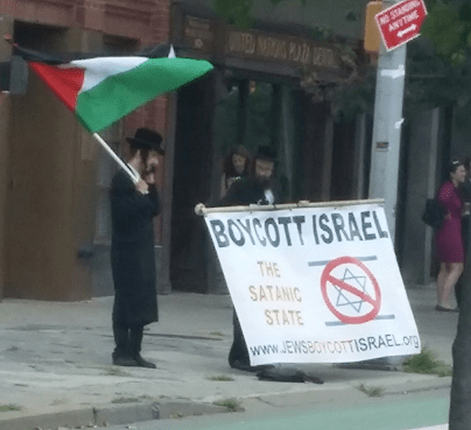
But the crowning jewel in Hamas’ arsenal, a weapon so powerful it managed to drag me out of my silence and back onto my blog, is far and away the Niturei Karta (Lit. Guardians of the City; They are of the belief that the State of Israel has no right to exist until the Messiah comes and establishes it). I’ve read about them in news articles and magazines, and seen pictures of their infamous meetings with terror leaders in Palestine and Iran, but it was different seeing them up close, on my turf. I was driving by the UN, stopped at a stop sign, looked out of my window to the left, and there they were by the Sharansky Steps, two chassidim (Hassidic Jews), one waving a Palestinian flag, and the other a sign beseeching people to boycott the “Satanic” State of Israel.

That hurt. More than the hundreds of rockets I knew had fallen and the millions forced into bomb shelters, seeing them hurt me. I expect an enemy of Hamas. I expect them to try and hurt me. I don’t expect it of my fellow Jew. And yet, there they were. And in that moment, what made it hurt even more, was imagining a terrorist seeing that image and laughing with glee and triumph because he knew that he had managed to reach across the world and hurt more Jews without even trying, through a proxy that makes him even happier for the irony—A chassidic Jew.

And you know what? The two of them there was worse than a whole protest. I’ve been to protests. They’re fun. You go not only because you believe in the cause, but because your friends go; they’re there to support you. Protests feel lonely when they’re poorly attended, and you start to lose your resolve, and you feel silly standing there with your sign, shouting at passersby who at best don’t care and at worst hate you for your message. Seeing only two of them standing there told me that they believe so strongly in and are so committed to their message that they were willing to stand there alone delivering it. That takes a special kind of commitment—it not only drove the knife deeper, it twisted.

I know unity is a little too much to ask from the Jewish people. We’ve been fighting for as long as we’ve existed. It’s too much a part of who we are. What I can ask, though, is that we fight like a couple who love each other very much; they fight, but they never hit as hard as they could. They keep what hurts the most on the tip of their tongues but never let it out because, while fighting may be part and parcel of being in a couple, that doesn’t mean it has to hurt more than absolutely necessary. They fight in a way that makes it possible for them to still love each other in the morning. And I suppose that’s the best I can hope for the Jewish people—that we only fight like we love each other.

Standard

The Monster on My Bed

Theres a certain degree of scrutiny to which you open yourself as a writer, a certain understood and assumed lack of privacy which you invite into your life when you make so much of yourself public. There’s always a reason and everyone’s is different. For some it’s fame. For some, money. For others it’s a cause, a catharsis, or a little bit of both. Every writer has their reasons for what they publish and even better reasons for what they don’t. Certain things are private; certain secrets, struggles or hardships or beliefs which, for one reason or another, they feel will do more harm than good to either them or people that matter to them. We keep these secrets because the potential benefits don’t outweigh the potential fallout. Sometimes, however, there’s a sort of grey area where the cost-benefit analysis isn’t quite as clear cut as we’d like, but we write it anyway, over the cries of protest from our better judgment.

I don’t always make the best company. I make people uncomfortable sometimes. My friends reading this are probably smiling and rolling their eyes because they know I’m a fan of understatement. I’m either cracking an inappropriate joke, seeing how much I can get away with saying, or broaching a subject that people would rather avoid. I discuss abuse a lot. Mostly the abuse of others, open and public cases, how the public responds, proper awareness, debunking abuse myths—things that rank up there with politics and religion on the list of topics one should avoid as dinner conversation. Sometimes I talk about what happened to me in public, but I try not to because it makes me more vulnerable than I’d like to be. You can’t control the opinions that fly at you in public the way you can on a blog.

Even when I do discuss what happened to me, and even when it’s on my blog, I try not to talk about the effects abuse had on me; I prefer to let my readers draw their own conclusions. I have to live in the real world, a real world where people know me, associate me with what I write on my blog, a real world where what I say on this blog can affect my chances of landing a client, or, more importantly, someone with whom I can hope to share my life.

Sex worries me. I know that as a man I’m supposed to—expected to—want sex, crave sex, desire sex more than anything else—that it is supposed to be the center of my existence and the focal point of all my goals, but it’s not. I talk about it plenty; I joke about it plenty; I think about it plenty, but sex, actual sex with another person, as in not hypothetically, but actually contemplating having sex with someone worries me. Worries is perhaps the wrong word to use. Worried is the word people use when their erections don’t stand up quite as proud and tall as they’d like them to, or when they’re worried they’re lacking in the experience department. Lack of experience is the least of my worries. Scared, perhaps. No, scared sounds a little wimpy, like I’m worried I won’t be able to please my girlfriend. What’s the word…terrified. That’s the word—terrified.

Sex seems nice on paper, sometimes on the screen (God, I hope my rav isn’t reading this), depending on what I’m watching. My friends all do it, enjoy it, rave about it, tell me it’s nice, feels good, bonds them and their significant other in ways I’ll never understand unless I have sex, and while I can understand the appeal, feel the physical drive, want, on a base level, to have sex with someone, either significant or just for the sake of it, I can’t bring myself to actually, consciously, want to have sex.

I suppose it’s lucky that I subscribe to a religion that demands celibacy of me until marriage. It means that whichever girls I spend my time with will not only never pressure me to have sex, they’d be horrified if I asked for it. There was a time in my life when religion meant nothing to me, when I’d just as soon have broken my obligation to maintain chastity until marriage, but I never did. I never even tried. The thought never crossed my mind. Religion came in handy, in that sense, even when I didn’t believe in it; it was an excuse I could fall back on for being a 19 year old virgin. I’m 22 now and still a virgin, and while I take my liberties here and there, the one thing I’m happy to keep, the one thing I’m glad to be obligated to keep, is my obligation to stay a virgin until I’m married.

Everything I know I learned by negative example. I know how to treat people by having been abused. I know I would never want anyone else to experience what I did, certainly not by my hand. I learned how to have a relationship by seeing so many bad ones. I learned how to educate myself by seeing the cost of ignorance. The problem with learning by negative example is that there’s a steep learning curve when you try to infer positive from negative and apply it practically. Everything I know about sex I learned by negative example.

Age four, I watched my mother have sex with a man I barely knew from the foot of the bed they were having it on. Age 10 I had to beg my mother to come home and take care of me when she ran off and shacked up with some man she hardly knew for a few days, and told me it was because she wanted to have sex with him. Age 16, I heard my mother tell me that she wished I was dead because my not existing would benefit her sex life. There’s plenty in between that I’m not ready to talk about.

And that’s what I know about sex firsthand: I know that sex hurts, that it tears families apart, that it causes irrevocable damage—that I still suffer because of it. I know that every time I so much as think of actually having sex with someone I experience physical anxiety. I can’t count the number of times I’ve considered finding someone with zero interest in sex and just settling down with that person, resigning myself to a life which, while devoid of what I’m told is something wonderful and pleasurable, would also, thankfully, be less one more thing that could hurt me or anyone I love. I’d be secure in the knowledge that I could never be hurt, nor could I ever hurt someone in the ways I and so many of my friends have been hurt.

That doesn’t make me happy, though. I know that my experiences aren’t the only truth out there. I know that abuse, and pain, and suffering are not all the world, that relationships, that sex has to offer. I know that there are people, many if not most people, who live happily, have happy relationships, happy sexual relationships, happy sexual relationships which in no way involve anyone getting hurt. I just don’t even know what that looks like, and I am absolutely terrified of letting myself find out whether or not I can have that. Maybe I can; but what if I can’t? What if I hurt someone the way I’ve been hurt? I know I don’t want to, but does everyone who hurts someone else want to? What gives me the right to take that risk?

I faced something similar when I stopped being shomer negiah. I was scared of touching someone else, especially girls I dated. I was scared I’d do something wrong. I learned a lot from not being shomer negiah (shomer negiah is the Jewish law prohibiting men and women who are not either married or immediately related to each other from touching). I learned boundaries, what I like and what I don’t— I know I like cuddling, I know I like holding hands, walking down the street hands around each other’s shoulders or waists, and I imagine I’ll enjoy kissing and touching. I learned when to initiate and when to back off. But I don’t feel that’s enough for me to let myself consider sex with someone else. It seems like there’s so much more at stake—so much more potential for pain. I know one day I’ll have no choice, but…

Help?


Standard

If At First You Don’t Succeed

Some people just can’t be wrong. They can’t just take the criticism, admit they were wrong, apologize, and move on. Early on in blogging I learned that being wrong is a good thing—it means you learned something new. Knowledge is power. Well, I suppose no one could accuse George Will of being power hungry.

Following a Washington Post oped piece in which he called sexual assault “victimhood a coveted status that confers privileges,” George Will appeared on C-SPAN’s Q&A to respond to the outrage expressed over his article. Anyone hoping for an apology, or at the very least a clarification, had another thing coming.

Will opens by calling the people who vocally disagreed with his piece “the rabble.” I had a response prepared for that remark, but one commenter, ModerateRepublican, in the response section of The Blaze article, took the words right out of my mouth:

 So one thing is certain: the “rabble” he talks about probably includes virtually every woman on the planet earth.

Try this: [T]ell a female that you think women want to be raped because of the status and privileged they get by being raped, and see how she responds.

Next he incorrectly quotes a New York Times article citing the “1 in 5” statistic, stating that “The [Obama] administration has said that 1 in 5 women experiences sexual assault.” Using that statistic, he then goes on to discredit it by extrapolating from the 12 percent reporting rate mentioned in the Times article that were the two statistics correct, either the number of assaults—at the one college from which he too numbers, Ohio State—should be higher, or the number of reports should be lower. Had Will checked the New York Times article off of which he built his straw-man argument, he would have noticed that on April 30th, the Times printed a correction on the article stating that the 1 in 5 statistic it had quoted had not applied to assaults on college campuses, but to experiences over the lifetimes of women in general. Will’s Washington Post article was published on June 6th.

Moving along, Will then contends that new evidence standards set by the administration for college disciplinary hearings—preponderance of evidence—is too low, and will therefore result in false accusations. He argues that the evidence standards should be, as it is in the criminal justice system, beyond a reasonable doubt. The new evidence standards in question were suggested by the Department of Education in a “Dear Colleague” letter sent on April 4th, 2011 to colleges across the country. Interestingly, these new standards George Will is complaining about, have been standard practice for more than a decade in college disciplinary hearings. A guide published in 2003 by the Foundation for Individual Rights in Education (FIRE) states that “The vast majority of schools employ, at the very least, a ‘preponderance of evidence’ standard.”

College disciplinary hearings are not court cases; they do not bear the same penalties, do not adjudicate the same crimes, and do not have any bearing on the criminal justice system. Therefore, the criteria for adjudication are, and have always been, much lower. Either Will is advocating for “beyond a reasonable doubt” to be adopted for all disciplinary matters because he truly believes that such a high standard is required for any disciplinary matter, or because he’s jealous of the status and privilege conferred on sexual assault victims, and wishes to minimize the number of people who can officially claim that privilege.

Actually, the only thing George Will got right in the whole interview, was when he said that sexual assault cases should not be adjudicated by colleges at all, and should instead be handed over to the criminal justice system. The Rape Abuse and Incest National Network (RAINN), in a February, 2014 recommendation letter to the Obama Administration’s White House Task Force to Protect Students from Sexual Assault, recommended that instead of internal disciplinary hearings, colleges should “use the criminal justice system to take more rapists off the streets.”

There is no reason why crime should carry a different penalty or process simply because its perpetrator had the good fortune of committing his crime on a college campus. College campuses should not play haven or sanctuary to people who deserve to be prosecuted to the fullest extent of the law. Internal hearings instead of proper trials only serve to encourage abuse and discourage reporting. It should be noted that the reporting rate off college campuses, as reported by RAINN, is 40 percent. Compared to that, the 12 percent reported on college campuses is a horrifying pittance.

Ever the advocate for unfortunate young men who wouldn’t know consent if it slapped them in the face, Will blames a “sea of hormones and alcohol” for what will, when coupled with these “new” disciplinary hearing guidelines and recommendations by the Obama administration, result in “charges of sexual assault, and…young men disciplined, their lives often permanently and seriously blighted by this, and…litigation of tremendous expense as young men sue the colleges for damages done to them by abandonment of the rules of due process that we have as a society[.]”

Will seems to have a hangup with the fact that women drink on college campuses, and still have the gall to expect sex not to be forced upon them while in a state in which they are unable to consent. Perhaps, instead of worrying so much about the money that college campuses may lose as a result of disciplinary actions which may or may not be based on allegations resulting from accusations some feel are ambiguous since the notion that a person too drunk to stand straight is somehow able to give consent to sex, to them, is laughable, colleges should instead focus on educating its students on what constitutes clear and affirmative consent. The fact that men on college campuses never have to worry about being raped if they consume too much alcohol at a party should attest to not only the existence of a problem, but a pervasive rape culture which permeates college campuses.

Lest you think for a second that George Will doesn’t care about sexual assault, he assures us all that he cares even more than we do. He cautions against “defining sexual assault so broadly…that it begins to trivialize the seriousness of it,” thus implying that a case where a man as sex with a woman who is too drunk to consent, is somehow too trivial to be considered rape. The FBI disagrees.

The new Summary definition of Rape is: “Penetration, no matter how slight, of the vagina or anus with any body part or object, or oral penetration by a sex organ of another person, without the consent of the victim.”

Seems to fit pretty handily into the legal definition of rape.

Finally, he concludes by bemoaning the death of civil public discourse and trying to invalidate all of the outrage at his public display of ignorance, by holding up a few examples of people who said they wanted him dead for what he had said, or that he should be raped to know what it feels like. This is a common political trick in avoiding very real issues by focusing on the crazies on the sidelines, and projecting their extremes onto any intelligent and legitimate disagreement.

Honestly, I don’t know why I expected better of George Will. There are an unfortunate number of people who believe, as he does, that rape must fit a very specific template to be considered valid, thereby subscribing to a culture which not only discourages victims from coming forward by telling them that what happened to them was their fault, but also creates a climate in which an abuser feels comfortable and secure in the knowledge that even if his crimes are reported, he will likely receive no punishment. Rape culture fosters abuse, and environments which breed abuse. Columns and interviews like George Will’s attest to a complete unwillingness to dispel the ignorance and backward opinions that women’s rights and anti-abuse activists have worked decades to eradicate. Apparently abusers are more worthy of support and erring on the side of caution than victims. And he wonders why only 12 percent come forward.

Standard

No Means No Has Got To Go

I came across the following comment on an LA Weekly article responding to George Will’s characterization of being a rape survivor as a privilege:

[I]s “survivor” really the correct term for girls who get wasted at parties and are too drunk to remember whom they had sex with?

I’m only all too familiar with the atmosphere at this campus.  The majority of the women at UCLA are Asian girls who have no interests other than having their face between a book in their dorm room.  Even though they make up the majority, I would be willing to bet they’re almost never victims of “rape”.

The “victim” will always fit this profile: girl from a small town, too young to drink but ends up at a party where she gets wasted, ends up with a guy she thought was cute and then wakes up to regret. Instead of taking responsibility for her actions, learning and moving on now she’s told that she is a “survivor” of rape.

Taking responsibility for your actions would be the first step in getting on with life, but that’s not what society wants.  It wants you to feel eternal shame, regret, misery, self loathing.  Then they can get you the number to a nice, expensive therapist who’ll prescribe some effective drugs for your depression and now you’re now perfectly inserted into the matrix.

Really, to group these women in with real victims who are kidnapped at knife point and brutally assaulted is insulting, to say the least.

I couldn’t help but respond.

First, the “stranger in the dark alley” attack, is largely a myth in the US.

Second, your comment is a perfect example of rape culture; thank you for bringing up every commonly held misconception about rape and what constitutes rape. You made it easy to address. Rape culture, simply put, is a societal attitude of entitlement toward sex. Rape culture is telling a rape victim that she brought it on herself by dressing provocatively, by drinking more than one or two beers, by being a “tease.” Rape culture is the sense of entitlement to sex behind the resentment someone in the “Friendzone” feels at not having his “kindness” and time rewarded with the sex he figured he’d get if he logged enough hours being a friend. Rape culture is every time he says “she was asking for it.”

Rape culture is an attitude that believes that sex is something every man (generally men, but not always. I use men vs women in this piece because that scenario is most prevalent, but the dynamic exists in other forms as well.) is inherently entitled to, especially if a woman, in a man’s opinion, does more to indicate that she wants sex in general than she does to protest when a man initiates. Thus the unfortunate joke: Is it shoplifting or rape if you force sex on a prostitute. Mode of dress, how attractive a girl is, how drunk she allowed herself to get at a party—which is completely irrelevant since someone who is drunk lacks the mental capacity to consent— how overtly sexual she is in general, are all excuses used by society and people who subscribe to rape culture in trying to diminish the severity and validity of rapes which don’t conform to their mental image of what a rape victim to be. The stranger in the dark alley myth does a lot to reinforce rape culture. To someone who subscribes to rape culture, only the victim of a stranger in an alley, or a similar situation, can call themselves a true rape victim. Everyone else is either exaggerating, or seeking privileged status as a survivor.

I’ve learned a few things about rape culture, through discussion, that I’ve found interesting.

The question of prudence always comes up in discussions on rape culture—which precautions is it reasonable to ask a woman to take to avoid sexual assault, while simultaneously not blaming them for their rape. An example I like using in framing this discussion is walking at night, alone, in a neighbourhood known for crime, and getting mugged. While the mugger has absolutely no right to mug, there were precautions the victim could have taken to possibly avoid being mugged. That’s not to say that the victim is at fault for the mugging, but it leaves what to be said for prudence. It’s the same rationale behind advising women not to drink heavily at parties, or not to dress too provocatively on campus, or handing out straws which can detect date-rape drugs in drinks.

I always feel a mixed reaction toward women’s safety seminars. On the one hand, as I said, there is what to be said for prudence, but putting the focus on women protecting themselves rather than on men controlling themselves, has always seemed, to me, wrong. That mugging victim wouldn’t have to worry about being mugged if the neighborhood was cleansed of its criminals. Rape victims wouldn’t have to worry about being raped if men were better equipped by society to control themselves. What makes these discussions so difficult is a pervasive lack of education focused on teaching young men how not to be rapists, rather than teaching women not to be raped.

A perfect example of this is “No Means No.” No Means No was meant to raise awareness of rape on college campuses, and set a standard by which rape could be reduced: If you hear no, stop. Don’t ask again, don’t “just finish,” don’t back off and then start again—just stop. At the time—back in the eighties—it seemed like a good idea. Recently, however, there has been a push to redefine the way we view consent. The problem with No Means No, is that it places the onus on the woman to say no, rather than on the man to receive consent. Therefore, consent is not an affirmative process, just a tacit understanding until the woman says “no.” It’s kind of ironic how a slogan meant to fight rape culture instead promoted it by—almost certainly unintentionally—implying that one is entitled to sex without receiving prior affirmative consent, as long as they believe they have consent.

The problem with that is that it often becomes a debate over what constitutes no. Often the media perpetuates the notion that when a woman says no, she’s just playing hard to get. Rape cases have been lost because, despite the fact that there was no consent, the victim did not fight back hard enough. The onus was on the woman to protest instead of on the man to receive affirmative consent before initiating. Rape culture goes so far in its sense of entitlement toward sex unless the woman protests just the right amount, that there are still those who believe that partner rape (also known as spousal rape or marital rape) is not a crime! The rationale being that marriage itself constitutes overall consent, and therefore, consent is not required to initiate sex with your partner. I have a friend who was repeatedly raped by her husband, despite her protests. He believed, as do an unfortunate many, that marriage, by dint of the institution itself entitled him to sex whenever he wanted, regardless of his wife’s opinion on the matter. Even after she left him and demanded a divorce, he had no idea that he had done something wrong. Again, he felt entitled to sex, for whatever reason, and therefore required no consent.

There are people who will read all of this, and still fail to understand the validity and prevalence of rape culture and its terrible effects. They will continue to deny the validity of rape claims by people whose rapes do not fit into their idea of what rape should be to be valid. For their benefit, I’d like to explain what rape is. Rape, and the reason why its effects are so severe, is a violation of what it is that makes a person a person. It violates the sovereignty of a person’s body and sexuality. All we really control in this world is our body and what we choose to do with it. We choose what we eat, we choose what we wear, we choose whom we have sex with. Sexuality is the most intimate and personal function of our bodies. We exercise control over our bodies and sexuality when we give consent to sex and sexual activity. Rape violates the control a person has over what is most intimate and personal to them. It violates a person’s sovereignty over his or her body. It is one of the most traumatic things one person can do to another, and it often results in Post Traumatic Stress Disorder, addiction, complete destruction of self-image and self-worth, inability to form lasting, healthy relationships, depression, even suicide.

I’ve dealt with enough rape cases to know that regardless of how valid other people think a survivor’s claim of rape is, the effects are always the same, and always devastating. The PTSD, etc, is the same whether the rape happens in a dark alley by a stranger, in a little girl’s bedroom by her father or brother, or at a party by some bro who thinks it’s cool to take advantage of the drunk chick. Again, consent cannot be given by someone who is drunk because they lack the mental ability to consent. The violation is real regardless of the circumstances, the effects are real regardless of whether or not an opinion poll says they should be. The act of forcing or coercing someone to have sex with you without first obtaining consent is rape, and it is devastating. Period. The squabbles over whether or not the victim was at fault only highlight a serious problem that we as a society must address: Changing consent from something passive to something active.

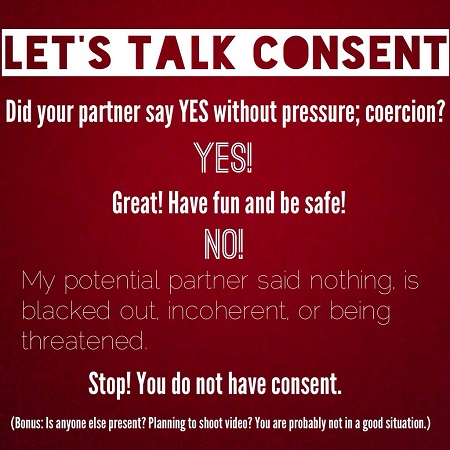
It’s time for Yes Means Yes. Consent should be affirmative and constant. It should be understood that unless she actually asks for it, she isn’t “asking for it.” That skirt she’s wearing is not an invitation for sex unless she actually invites you to have sex with her. There can be no room for ambiguity with Yes Means Yes because sex cannot be initiated unless consent is affirmative and understood. The onus is placed on the man to receive consent rather than on the woman to protest. Therefore, operating under Yes Means Yes, questions of how loudly or how violently a victim protested against her own rape, or whether or not she actually consented of she doesn’t fight back at all, will be irrelevant. Unless consent is obtained, it’s rape. Yes Means Yes should be an integral part of sex education programs in schools (many of which currently lack even basic consent as part of their curricula), promoted through popular culture and media, and enforced legally. Yes Means Yes would effectively end rape culture because consent would no longer be a matter of assumption or entitlement, implied unless a woman protests enough—it would be affirmative and clear with no room for ambiguity.

Standard