Sex Segregation Gone Mad

Update – 7/10/2015: Presumably after seeing the attention this story got, the person whom I had this conversation with called and left a message saying that the call was a prank. I’m leaving it up with this disclaimer because I find the fact that many parts of this story, particularly the extreme sexism and racism, are plausible very telling. 

Author’s note: I wouldn’t ordinarily post something like this on my blog. I try to keep this blog away from anything that could potentially be used to bash any group without offering any constructive criticism. The reason I’m posting this is not to imply that this is at all the norm. As noted below, this was the first time in the history of our driving school that such a thing happened. That said, the fact that such a thing could happen indicates that we’ve reached a point in our obsession with tznius (modesty) and sex segregation that can create the feelings expressed by the customer. 

“I had a problem with my road test yesterday, one you scheduled for me.”
“Ok,” I replied. “What happened?”
“When I came there to the road test site, a woman got into the car.”
“Ok…”
“I didn’t want to be in the car with a woman, so I asked her if there were any men I could take the test with, and she said there weren’t any available.”
“Ok…”
“So I asked to speak to her supervisor, and she said that he wasn’t available.”
By this point my right eyebrow was already working its way up toward my hairline.

“I asked her if she had a towel,” he continued, as if the words coming out of his mouth made perfect sense, “I wanted to put it up between us as a mechitza (partition used to separate the sexes). She gave me a funny look.”
At this point I’d covered the receiver with my hand, and was failing miserably at controlling my giggles.
“She looked at me funny, and said that she wouldn’t be able to see me. That was the point, I told her. She gave me a dirty look and told me I couldn’t take the test.”
I fought back the laughter as I blurted, “Hold on a second, please,” and put the customer on hold.

I ran over to my boss’ desk, laughing uncontrollably, face beet red, tears already forming around my eyes. My boss saw me laughing and started laughing himself. He motioned with his hand, asking what had happened. We’ve gotten enough weird calls in the past that he knew something was up.

After about a minute I regained my composure enough to tell him what I’d just heard, punctuated by more giggles of course. “Can you please do me a favor and talk to this guy?” I asked him, “I don’t think I can control myself.”
“Sorry,” my boss replied through his own belly laughs, “you take care of this.”
He ran into the front office to tell the secretary what had happened, closing the door behind him.

I composed myself and lifted the receiver.

“It’s the three weeks, you know, you shouldn’t have the music on the phone.”
“Huh?” I replied, not quite sure what he was referring to.
“The music when I was just on hold. It’s the three weeks; you should change that.”
“That’s a good point,” I replied. I hadn’t considered that.
B’kitzur (in short),” he continued, “I want a refund. She didn’t let me take the test.”
“Hold on, please, let me ask my boss.”

I put the receiver down again and went into the front office. My boss was telling the secretaries about the phone call. I interrupted him to finish the story, laughing as I told it. I told my boss that the customer wanted a refund, and he said absolutely not.
“Tell him they only have men in Monticello,” My boss said. They don’t, but why not make him drive.

“Hello?” I said, picking up the receiver, “I’m sorry, but we won’t be able to give you a refund.”
“Why not?” he demanded, “It isn’t right that I should have to take a road test with an isha (woman) and a tumadikeh goy (unclean non-Jew) that I should have to sit in a car with a tumadikeh goy!”
Flustered at hearing such vehemence against someone whose only crime is not being Jewish I said, “You live in a goyishe country. Do you cross the street every time you see a goy (non-Jew) coming toward you?
“No, but in the street I can look down at the sidewalk, I don’t have to see them.”
“Well,” I said patiently, although I was reaching the end of my tether, “We live in a goyishe (non-Jewish) country, and if you want to get a license in this country, you’re gonna have to take a road test with a goy who might also be a woman.”
“You don’t understand,” he replied, “she was so anti-Semitic! She looked at me like I was crazy, just because I’m Jewish and I needed a man to give me the test!”
I’d been patient, but this was pushing it. I have very little tolerance for people crying ‘anti-Semitism’ when it plainly isn’t. “No,” I shouted, “it wasn’t anti-Semitism. She had literally never heard anyone ask for that before, and found the request strange! You are the only person who has ever, in the history of this driving school or any other, who has asked a road test examiner if they could have a man replace them! It’s not even yichud (a law prohibiting two people of the opposite sex who are not married or immediately related from being alone together) at all! It’s an open car, with clear windows, driving around in a busy city! Ask your rav (rabbi), there’s absolutely no problem with it! All the rest of our students are just as frum (religiously observant) as you are, and none of them have ever had a problem with this! It’s not anti-Semitism; it’s just you!”
“The problem is you, and your whole driving school,” he shouted, “you’re all choteh umachti es harabim (one who not only sins, but drives others to sin)!”

At which point I hung up on him.

You can’t make this stuff up, people.

Standard

Looking Past Politics and Seeing Humanity

On April 17, I attended a protest outside the UN, the purpose of which was to to demonstrate our belief to the UN Security Council that withdrawing their (embarrassingly paltry) peacekeeping force from Darfur would leave Darfurian refugees with nothing to protect them from the Sudanese military. The sign I carried, which read “To NCP: Rape is not a weapon of war,” was in reference to the Darfurian village of Tabit, where the Sudanese army following government orders systematically raped over 200 women. The genocide, to date, has killed 500,000 people, and within Darfur alone, displaced an estimated 2,500,000 people. As causes go, you’d think that’s a pretty good one, right?

As we were standing there, holding our banner and listening to a speech from one of the leaders of the protests, three counter-protesters showed up and tried to shout us down. They were shouting something about western imperialism and intervention in internal African affairs, when one of them, the whitest white man I have ever seen, completely lost it. Literally shaking with anger and spitting with rage, he got in the face of the man giving the speech (a Nigerian man), and raged about how we were western imperialists who were promoting the destruction and murder of Africa and its people. So deep was his hatred of anything Western, that he wouldn’t even begrudge a protest asking for a UN peacekeeping force comprised entirely of African soldiers, because he truly believed that the UN was an American puppet organization.

But what was really incredible, was when the counter-protestor got into an argument with a Sudanese man who now lives in New York, a man who lost family to the genocide, a man who would still have that family if someone—anyone—had intervened to stop Omar Al Bashir, the political Islamic genocidal president of Sudan, and told that man that the intervention he was begging for, the intervention that would have saved his family, 500,000 people, and millions of people from being displaced, raped, maimed, and herded into displaced persons camps, was wrong because no one has any business telling an African nation what to do. Not only that, but he equated the desire and request for intervention with Hitler herding Jews into cattle cars for transport to death camps (Don’t ask me how he arrived at that conclusion; I have no idea). Godwin rolled over in his grave.

I wonder if once—just once—that idiot ever sat back, shut his stupid mouth, and really put himself in the place of a Darfurian rape victim, or the lone survivor of a family butchered by genocidal murderers. I wonder if he ever let his ideology, his political preconceptions, take a backseat for a second, and just thought about what it would mean to be in such a position. To be in the position of that Sudanese man he equated with Hitler. It may not have led him to the same conclusion, but I doubt he would have ever let himself rage like that in public against a man begging for the lives of his people.

This callous disregard for the humanity of a problem in favor of its politics is unfortunately common among discussions of social and human rights issues. I was talking to a woman who had been abused by her ex-husband. She told me that when she asked her rabbi for advice, he told her to, “Go home, wine and dine him, look good, and get pregnant.” The idea being that their marriage and relationship could be saved through the mutual bond of a child to care for. What would that rabbi have said if he had paused for a moment before responding, and put himself in that woman’s position. What would he have felt had he considered, just for a moment, what it must feel like to be beaten by the man who is supposed to love you most. Would he have told her to go back, prepare food for him, and have sex with him, if he had instead pictured himself ostensibly being told to reward his abuser for his abuse?

Would anyone tell a survivor of sexual abuse to just “get over it,” or stop “using it as an excuse to justify their sins,” or call them “attention seeking” or “drama queens” or ostracize, shun, or publicly humiliate them if they just stopped for a second and put themselves in the shoes of a boy or girl, man or woman who survived sexual abuse and is now suffering with depression, PTSD, or eating disorders, who, by necessity, became addicted to drugs and alcohol just to escape the horrifying reality of what happened to them, who daily has to fight just to give themselves a reason not to kill themselves and end the endless pain—would anyone who really empathized with a survivor ever let those words pass their lips if they really understood? Would anyone every tell an LGBT person that they were a damaged, disgusting, loathsome, unnatural abomination if they, even for just a second, truly felt the pain that LBGT people experience every day that they’re forced to deny who they are for fear of what their family and community would do if they found out?

None of this is to say that everyone must agree on exactly how to solve these problems. There will obviously always be differences of opinion on how to fix any problem, from how to solve inner city poverty to raising awareness about child sexual abuse. What does need to change is the focus on the politics of the problems rather than the problem itself. Politics need to come secondary to the needs of the people in pain. Extending or eliminating the statute of limitations for child sexual abuse might open yeshivos to more litigation? Ok, there may be a solution to that problem for yeshivos, but shouldn’t an organization claiming to have the best interests of klal yisrael in mind have as its primary focus the physical and mental wellbeing of its children rather that sacrificing them on the altars of their constituent organizations’ reputations? Shouldn’t ensuring that child sexual abuse ends and that survivors can get the help they need and bring their abusers to justice without fear of retribution take precedence over anything else?

The resulting problem is not only stagnation on finding real solutions to these problems, but a widespread refusal to even discuss problems for which solutions don’t seem readily available. Homosexuality is considered an abomination by the Torah, so why even discuss it? Never mind that our children are suffering, harming themselves, being sent to traumatic reparative therapy programs, and killing themselves when the pain becomes too much to handle. Let’s not discuss it because the Torah says that gay sex is an abomination and therefore a solution isn’t readily apparent. Let’s not discuss the plight of agunot because Halacha is Halacha, this is how it works, and there don’t appear to be any solutions that will satisfy everyone, so why even bother? I’ve encountered this attitude far too often, and it is what is holding us back as a community from coming up with real solutions to help those among us who have been ignored for years and most need our attention and support.

I’ve always been of the firm belief that even if we don’t see a solution, it is still our obligation to discuss these problems as a community, and it is still our obligation to feel the pain of those experiencing these hardships. Necessity is the mother of invention. If we truly felt their pain, we would move heaven and earth to help them. We would move mountains to ensure that not even one woman is chained to a marriage she doesn’t want. We would bend over backwards to ensure that not a single LGBT member of our community contemplates suicide. We would do everything in our power and then even more, to prevent another child from ever being raped or molested, and that if by some unfortunate circumstance they were, they would be believed, accepted, supported, and given the help they needed, and see their abuser, whether he or she be yeshivish, chassidish, modern orthodox, secular, or non-Jewish, prosecuted to the fullest extent of the law.

The next time you hear someone telling you that they’re in pain, instead of dismissing them—listen. Take a second to feel their pain with them; let them know that you’ll be there to help carry their burden and that you won’t rest until they have justice—until they have peace.

Standard

After 20 Years I’m Finally Free

A few weeks ago, I wrote a post about life in my house. I detailed the abuse I was experiencing. Over 50,000 people read that post, and it was shared over 1,500 times. I received an enormous outpouring of support, both in the form of sympathy, and actual offers of help from lawyers willing to take my case pro bono, invitations for Shabbos, and advice based on personal experience. More people than I can count shared their own stories and experiences in dealing with an abusive family member with a mental illness. Honestly, readers, you humbled me; you showed me the power of social media, and the significance of the words “me too.” Thank you so much for being there for me.

It’s been a couple of weeks, and there have been a couple of developments I’d like you all to know about. But let me back up 20 years, and explain exactly how significant these developments are.

My mother has been in and out of the psych ward at Maimonides hospital since I can remember. The first time I can remember, I was four, and it was after she had a “manic episode” and took me, on Shabbos, to a man’s house where I witnessed them having sex. I wasn’t quite old enough at the time to understand the significance of what they were doing, but I do now. The weekend ended with my mother and that man getting into a physical altercation; my grandmother had to come over to break up the fight and make sure I got home safely. The police were called and she was committed. That’s the first time I remember.

The rest were a blur, happening every three years like clockwork, as she cycled between long periods of depression, followed by long periods of stability, followed by her deciding that stability meant she was cured, ceasing to take her medicine, rapidly decompensating, culminating in her involuntary commitment. I was too young at the time to really understand what was going on, but I knew it was bad, and I knew it was stressful. I didn’t have to handle it back then, though; that’s what my grandfather was for. Unfortunately, he died when I was 11, and my grandmother was left to be the disciplinarian in the house, and she became the one to call the police when it was time for my mother to be committed.

The two months my mother would take to decompensate would be different for me every time. Sometimes it wasn’t half bad. She would take me to interesting places, spend all her money on me, and make me feel like the most important person in the world. Sometimes it was all about her, and I had to watch every word I said to her, lest I send her into a rage. Sometimes she just left and shacked up with some guy for a while until I’d find out who he was, call his house incessantly, cursing him for taking my mother from me, until the guy would decide that the annoyance I posed was not worth the sex he was getting, and send her home. Sometimes it involved a diet that my mother decided she had to try. But it’s no fun doing a diet alone, so she would force me to go on that diet along with her. These diets usually ran along the lines of the starvation diets to which models, actresses, and people with eating disorders subject themselves—totally unsuitable for an adult, let alone a child.

But there was always a running theme, a way for me to know what was coming. It was always religion, and a focus on my biological father. I am the result of an affair my mother had with her hairdresser while married to her then husband. I don’t judge her for having that affair; her husband was an abusive man who I don’t doubt did many horrible things to her. When I was born, I posed a problem to the family; a mamzer is not something you want to have around when there are shidduchim (matchmaking prospects) to consider. My family asked a rav (rabbi) and a psak (ruling) was give: I was to be considered not a mamzer, since my mother was still married to then husband and possibly still having sex with him, and I was given her husband’s surname. For all halachic intents and purposes, I was her husband’s son. Understandably, she did not like this.

But she never really made a point of mentioning it unless she was on her way to the hospital, so to speak. Then she would bring it up at any opportunity. She would call me by my full name, and use her hairdresser’s surname rather than my given surname. She would make a point of the fact that to her I was a mamzer (illegitimate child), and be quite cruel about it. I know better now than to care, but back then it was not pleasant hearing that I could never marry anyone who wasn’t also a mamzeres (fem. illegitimate child). It was very important to her that I know the truth.

Another recurring theme was religion. My mother has never been particularly religious, but she would become incredibly devout right before having a complete breakdown. She would cover her hair, pray all day, often uttering God’s name as it is spelled out, rather than the accepted name for God in prayer (Ye-ho-vah rather than Ado-nai), which to me at the time was akin to desecrating God’s name. She would continue with this extremism until she realized she wasn’t going to get what she wanted from God, by which time she would be hospitalized. She would always come back barely religious again. In some way seeing her irreligious was a comfort; it meant that she was stable.

The final harbinger of her breakdowns was always the list of grievances she had against anyone and everyone she felt had ever wronged her, no matter how slightly. She is a master at bearing grudges and laying guilt trips. From $35,000 my grandparents supposedly stole, to her failed marriage, which she claims my grandparents pushed her into (which may very well me true), to all the times she “sacrificed” for me and I hadn’t reciprocated. As a ten year old. How selfish.

So life was not easy growing up for me. Aside from all that, there was always an undercurrent of conflict between her and my grandparents over who was truly responsible for parenting me. When my mother was first hospitalized, shortly following her divorce, my grandmother sued for custody and won. Her argument was that if my mother was too unstable to care for me, someone else had to have custody and be responsible for me. To be honest, I was always quite pleased that my mother didn’t have custody of me. I never really trusted her like that.

My mother was not pleased at all, however. When I was around 11 years old, she sued for custody from my grandmother, and being that she was stable at the time, the judge granted her full custody rights. Mind you, the entire time we were all living in the same house—my grandparents, my uncle, my mother, and I. Despite winning custody, there were constant arguments over who had the right to a say in what was best for me, from the books I read, to the shows I watched, to the food I ate. Everything was a conflict between my mother and my grandparents. And I was always caught in middle, often prompted to choose a side. The problem was, I generally preferred my grandmother, but was too afraid to say so. To be honest, there were times when the conflict confused me. I remember one time, after spending a weekend hearing my mother tell me all the horrible things my grandparents had supposedly done to her, picking up a knife and running at my grandfather with the intention of stabbing him.

This continued for the first 16 years of my life. It was difficult, but I always had my grandparents to lean on (after age 11 it was only my grandmother). At age 16, my grandmother fell into a deep depressing following a hospitalization which was a result of a side effect of an anti-depressant she’d started taking when the situation became too much for her to handle. That’s when things really got bad. My grandmother could no longer act as a buffer between me and my mother, and my mother was free to do whatever she wanted to me. That’s when the beatings started. The verbal and emotional abuse was worse than ever. I still have the marks on my doorframe where the posts were splintered by my mother’s attempts to break down my door. I never got around to fixing that.

It was harder dealing with my mother on my own, especially after I stopped talking to her. That really sent her over the edge. My mother has a son from her ex-husband, a son who was taken from her at the end of the marriage and placed with an adoptive family which has raised him like their own. My mother tried for years to get custody, but every time she got close, she had a breakdown and the judge ruled against her. Losing my brother hurt her deeply, which made what I was doing to her by not talking to her that much worse: she had lost both her sons. Unfortunately, rather than self-examining and coming to understand why she had lost me, she turned that hurt into rage directed at me.

For the first time, I was left to fend her off myself, and it was much harder then than it had been when I was younger. I was older so I could take more, and boy did she dish it. In lieu of my grandmother, I was the one who had to have her hospitalized, which made me the consummate bad guy. She would come back fro the hospital angry that I had sent her away, and the cycle of abuse would start all over again.

These past few months have been the hardest months of my life. The abuse was the worst I’ve ever experienced. It wasn’t physical, because she knows full well I would fight back, but there are other ways of hurting people. She deprived me of sleep, abused my grandmother knowing full well there was nothing I could do about it—my grandmother refused to let me take any action—she threatened my life and safety, damaged my property, and let no opportunity to let me know exactly how worthless I was go to waste. But none of that compared to the anxiety her instability caused me. I was constantly on alert, my fight or flight reflex screaming at me 24 hours a day, 7 days a week, always ready to spring into action should she do something really harmful to my grandmother or me. Months of constant anxiety. That was the worst.

She was in and out of the hospital 4 times in the past 5 months, each time they would keep her until she was stable enough that they could no longer justify keeping her against her will, and each time she would come back and immediately become unstable. The problem was, there was a little bit of a catch-22. I had a life to move on with, but I couldn’t move on until I knew my grandmother was safe, but it seemed that I was always the catalyst that set her off. So I was at once the solution and the problem. The only person who could solve that problem was my grandmother, but she refused to kick my mother out of the house. Every time my mother was hospitalized, my grandmother would take her back in, no matter how vehemently the rest of my family and I protested.

The problem was, that as bad as my mother was, and as much as she made my grandmother suffer (I believe my grandmother suffered much worse than I did these last few years), my grandmother refused to throw her out unless she knew for a fact that my mother would not wind up in a state mental hospital. My mother had been sent to one before for 6 months, and it had been a very unpleasant experience. Nothing anyone said to my grandmother could convince her that my mother would not wind up in a state hospital if thrown out of the house, so my grandmother kept allowing her back, regardless of the suffering she knew she was accepting.

But what was different this time than all the other times, was the fact that my grandmother finally spoke up to us and said that she hated how she was suffering. She actually told us that had she her way, she would be rid of my mother, as long as she could know for sure that my mother would not be sent to a state home. The last time my mother was released from the hospital, a social worker was assigned to her case to stay on top of her treatment compliance and work with her toward a supervised living arrangement away from our house through Ohel. My grandmother was skeptical because Ohel had never wanted to accept my mother before due to how unstable she could be, and the supervised living arrangement never went anywhere.

After the incidents I wrote about in my last piece about it, my grandmother realized that this couldn’t continue. I made sure my family was putting as much pressure as they could on her without outright forcing her to make a decision. About three weeks ago the hospital held a family meeting. They had tried to hold one a month prior, but I refused to show up. I was told later, that it’s very possible that my mother was allowed home because I didn’t show up at the meeting and make my case. As reluctant as I was to be in the same room as my mother, I forced myself to go to this family meeting.

We got to the hospital and rode the elevator up to the fourth floor. My mother was waiting to greet us, and she seemed happy that we had all come. She proudly pointed me out to all of her ward-mates. “That’s my son!” I just kept my eyes on my phone. I wasn’t there to see her or be shown off; I was there to make sure she never came home again. Her social worker and psychiatrist then met us, and the meeting began. The psychiatrist laid out the situation, with comments from the social worker. They told us that she was ready to be discharged, and that we had to make a decision what to do with her, whether to let her come home, or push her into an Ohel supervised apartment.

When we had walked in, my mother had made a point of asking my grandmother in front of all of us whether or not she would be allowed home. My grandmother said yes for lack of a better option, and my mother genuinely believed that my grandmother meant it. As the meeting progressed, it became my turn to speak. I had a lot of things I wanted to say to her doctors. I detailed the abuse she had put me through, and asked them how they didn’t feel responsible for any of the damage my mother had caused as a result of being released when she was clearly a danger. The psychiatrist took slight offense at my tone, and told all of us that it was not his responsibility, but ours to decide whether or not to allow her back home despite their warnings to the contrary. The point was well made, and it was time to decide what to do with my mother.

My mother started about me to the doctor. “It’s not my fault, it’s that bastard! He doesn’t talk to me! He provokes me! He does things to me! If he weren’t home, everything would be fine; he should be the one to move!” The doctors tried to calm her down, but she would not stop. She was escorted out of the room, and stood by the glass looking in. The meeting continued, and the doctors explained to us that his recommendation was to tell her that she was no longer welcome home and that she was either going to Ohel, or a homeless shelter. We asked some questions, made sure my grandmother was satisfied that Ohel would be a safe place for her, and then it came time for the decision: My grandmother was finally put on the spot and asked whether or not she would tell my mother that she couldn’t come home.

My mother was called back in. Immediately, she asked my grandmother whether or not she would be allowed back home. “I’m sorry, it won’t work out. You can’t come home.”

“But you said I could! You told me I could when you walked in!”

“I’m sorry, but you can’t. It won’t work out.”

“I took care of you for years! I too care of you after tatty died! You let Moishe (one of my uncles who married late and lived with us until that time) live there until he was 39 years old; why can’t I live with you?”

“I’m going to be moving into a smaller apartment, and I won’t have room for you.”

“That’s ridiculous! I want to live with you! Anywhere you go I want to go!”
“I’m sorry, it won’t work out.”

At that point the doctor took over, and explained to my mother, forcefully, that it was over. That she was never coming back home. My aunt chose that moment to tell my mother that it was because she was so unstable that this was happening. My mother didn’t like that, and grabbed my aunt’s wig off her head and flung it across the room. The psychiatrist yelled at her to calm down.

“I DON’T WANT TO GO TO OHEL!”

“Well,” said the psychiatrist levelly, “It’s either Ohel, or remember what we discussed?”

“Yeah. The shelter.”

“You don’t want to go to the shelter, do you?”

“No!”

“So then you have to go to Ohel. I’m sorry, but that’s the way it is. Your mother can’t take care of you, and this is the best solution.”

“FINE, BUT I NEVER WANT TO TALK TO ANY OF YOU AGAIN, ESPECIALLY YOU, BASTARD!” she yelled, pointing at me, and stormed out of the room.

I have never been prouder of my grandmother.

The house has been quiet and safe for the first time in years. I cook dinner for my grandmother when I can, take care of the grocery orders, and make sure she eats. For the first time I can remember, my grandmother sat with me in the kitchen with me while I cooked dinner, and watched Netflix with me. We talked about the show, and what I was making, and for the first time in years, I felt connected to her again, like I finally had a family. She’s still severely depressed and it’s very hard to get her to open up and talk, but there’s the start of a relationship, and it feels so good, honestly. I feel happy to have a family for the first time in my life. They all stood up for me, they all finally listened and took my side, and they finally made it safe for me and my grandmother. I actually think I love them.

I’m writing this as I fly to Chicago to see my friends, and I’m trying to hold back the tears, but it’s not really working. On the way out this morning, my grandmother smiled at me and wished me a safe trip. I think it was the most beautiful thing I have ever seen in my life. I look forward to seeing it many more times.

Hi, my name is Asher, and I have survived.


Standard

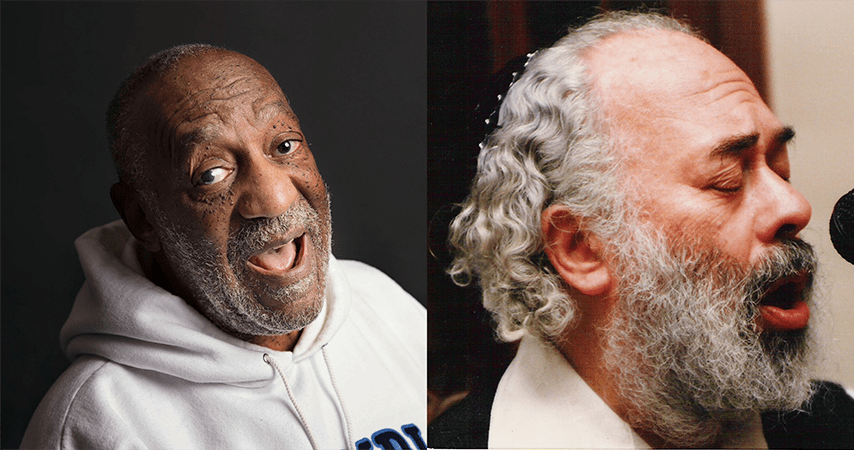
Carlebach, Cosby, and Separating Art from Its Artist

UPDATE 12/8/2014 6:30 PM: Since posting this article last night, I’ve been contacted by quite a few people with firsthand accounts of Carlebach’s abuse, specifically, inappropriate phone calls, inappropriate flirtations, and most seriously, molestation of minors. 

A few weeks ago, my shul (synagogue) held its annual Carlebach Shabbos. Benzion Miller, the Aron Miller Memorial Choir, and roughly 1,500 people showed up to sing, and dance, and celebrate the life, music, and legacy of Rabbi Shlomo Carlebach. There’s no question that Shlomo Carlebach touched the lives of tens of thousands with his music, his passion, and his apparent utter devotion to God and the Jewish people, and returned souls to Judaism at a time when religion seemed on the decline. But there was a darker side to the legend, a side that forces the uncomfortable question: Can we separate the man from the legacy—the art from the artist?

So there I was, sitting in my pew, 1,500 people around me, all singing Carlebach. I couldn’t help myself. It’s impossible not to sing along. The melodies are beautiful in their simplicity, saturated with soul, and electrifying in crowds. It’s impossible not to be swept up in the frenzy. My fingers drumming along to the melody, my feet tapping, a smile tugging at the corners of my mouth despite my best efforts to the contrary, I sang along with everyone else. How could I deny it? In a room filled with people from the far-right to the far-left to the non-observant, all singing the same music, all united in a way they have never been before, and will likely never be again, how could I not be swept up by the crowd? Men in shtreimels (circular fur hats worn by Hasidic men) with long, untrimmed beards, dancing with their fellow Jews, some wearing knit kippot (skull caps), some with ponytails, some in suits, some in jeans and a t-shirt; has anything, in the history of the Jewish people, ever united people so different, than the music of Shlomo Carlebach?

Following the service was a Carlebach dinner held at a local catering hall, with our scholar-in-residence, Rabbi Sammy Intrator, Carlebach’s long time right hand man. He started the night off with a song, and once the crowd was warmed up, he began to talk about Reb Shlomo. He told us story after story about Reb Shlomo’s compassion, his love for his fellow Jew, how deeply his desire to foster peace and love in this world ran, and how in-tune his soul was with God and the world. In true Carlebach style, he told us some of the stories that Carlebach used to tell, singing them exactly as Carlebach used to, bringing them to life with as much of the emotion and heart as he could. Carlebach’s stories always make me cry. As hard as I try not to, they always manage to get me.

Carlebach had an amazing gift for touching the souls of people with his stories of Chassidus (a more spiritual and mystical approach to Orthodox Judaism), and how the simplest Jew could have the greatest impact; his stories keep alive the memories of fallen communities and dynasties that perished with time and in the Holocaust, and the memories of the great men and women that would otherwise be forgotten. You would have to be lacking a soul not to tear up at the story of Chatzkele Lekavod Shabbos. And as I sat there listening to Sammy Intrator reincarnate Carlebach so beautifully for his very captive audience, I felt a little dirty. My holy brothers and sisters, I remember—I REMEMBEEEEEEEEEER—the Shlomo Carlebach that I grew up hearing so much about, the great man who reunited Judaism in the Diaspora, but I also remember the Shlomo Carlebach who fondled women who came to him for guidance, who masturbated on women who worshipped him, and who covered it all up by telling them that they were holy, and special. I remember the stories I’ve heard firsthand from people who experienced the darker side of Carlebach. And as I sat there laughing and crying as Sammy Intrator spoke, I felt myself tearing apart.

A battle was raging in my head: How can you sit there and listen to this when you know what he really was, and what he did to those women? But, but, look at the holiness he brought to this world, the people he united, the masses he returned to Judaism, the power of his music, and the strength of his enduring legacy! Yeah, but his legacy was built on the backs of an endless string of victims! But, but look! Look at all these people, singing, and crying, and laughing, and loving, and opening their hearts to one another! Surely that must count for something! Maybe, but who will remember the victims, and how is it right to sit there and tacitly support a man who caused so much damage?

I don’t know.

Honestly, Carlebach is a difficult subject for me. My inner conflict was punctuated by the recent resurgence of rape allegations against Bill Cosby. I loved Cosby. I loved his show, I loved his comedy, I loved his smile, I loved what he represented. Just like I loved Carlebach. It’s always this way. It’s always the people you love the most who hurt you the worst. Of all the people who had to be sexual abusers, of course, it had to be Shlomo Carlebach, and Bill Cosby. Right in the childhood. Right in the heart. Cosby is easier for me to throw under the bus, because while I’ve enjoyed his work, it’s never touched my soul. Carlebach is special to me. Carlebach represents a Judaism I’d love to see in this world. I mean, I suppose he would, if not for the small matter that he was a sexual abuser. Why does it have to be so difficult.

Both Cosby and Carlebach got away with what they did for so long because of how loved and cherished both they and their work were. But can their work stand alone? Is it possible to separate the art from the artist? It’s an ongoing question for me. On the one hand, I see the beauty that Carlebach brought into the world, and I don’t want the world to suffer the loss of what Carlebach gave it because of his sins. Perhaps the beauty, and holiness he facilitated was there already, waiting only to be discovered and brought to light, and he was only a conduit. Perhaps we would have had it through someone else, someone less flawed. Perhaps we should therefore allow what he revealed to stand while we leave him to rot.

On the other hand, as blogger Elan Morgan pointed out on a friend’s Facebook page:

IMPORTANT: We cannot separate the men from their art when they used their status from that art both to commit and conceal their violent behaviour. To continue to share their art is to continue to share one of the weapons they used to commit their crimes.

Perhaps we do more harm than good by perpetuating the tools of these people’s abuse. Perhaps we are contributing to the pain felt by Carlebach and Cosby’s victims, who for so long were denied justice, by touting the instruments of their abuse as something worthy of praise and enjoyment. Perhaps we make those men that much more acceptable by refusing to give up what they created simply because our lives are enriched by the fruits of those poisonous trees.

Or maybe there’s a baby to be saved somewhere in the putrid bathwater. Maybe there’s a message, some truth, a little good that can be salvaged from these men’s abominable lives. Might the message not be valid regardless of its source? Can we not keep the moral values Cosby preached while damning the damaged he caused to 17 (and counting) women, or the love and acceptance exhorted by Carlebach while distancing ourselves from the man himself and his actions.

There are a million answers to these questions, and frankly I haven’t found mine yet. It’s something I struggle with every time I hear one of Carlebach’s songs, or see the popularity people like Eitan Katz, or Yehuda Green have because of their similarities in musical style to Carlebach. I still feel dirty and conflicted when I sit in shul and hear one of Carlebach’s tunes used for lecha dodi (Song to greet the Sabbath sung by Friday night prayers), finding myself at once moved and repulsed. To be honest, I still use those tunes myself when I lead the prayers, because I know the congregation likes them and will sing along. I don’t know what the balance should be, or if there even is one to be had. Maybe you people can help me out; what do you all think?

Standard

Unesaneh Tokef Through The Eyes of a Survivor

I find it hard to pray for myself. I always feel unworthy. I feel like a hypocrite standing before God, imperfect as I am, a sinner set in his ways, asking God to do me yet another favour I know I’ll never return. I’ve heard the speeches. I’ve heard my rav (rabbi) tell me over and over again, that regardless of what I believe will happen after Yom Kippur (Day of Atonement), one moment of pure teshuva (repentance), one moment of repentance, a single instant in which I tell God that were every moment that moment, I would never sin again, is enough to constitute repentance and earn me forgiveness in the eyes of God. No matter how many times I hear it, I can never accept it. Afar ani b’chayai (I am like dirt in my lifetime—taken from the Yom Kippur liturgy)—what right do I have.

So I spend my Yom Kippur doing other things. I focus on the Avodah (litany of the service in the Temple), I cry during eileh ezkerah (litany mourning the death of the Ten Sages by the Romans), I sit quietly in my seat and stare at the choirmaster as he conducts his choir. I pray for other people because I can’t pray for myself. I pray for my friends, for (some of) my family, for the countless victims of abuse and suffering, for the dead who can no longer pray for themselves, both those whose lives were taken by others, and those who took their own lives. I pray for other people, and in doing so, I pray that God sees fit to help me a little bit, too.

For the past five years, Unesaneh Tokef (litany composed by Rav Amnon of Mayence—recounted in part below) has been the hardest prayer for me to utter throughout the entire liturgy of the High Holy Days. I always end up crying bitterly. Thus far, thank God, no one has come over to me and asked me why someone so young cries so hard during a prayer that confronts mankind with a mortality that youth should find, at most, abstract. I have my answer all prepared in case someone asks me: For some of us it’s just more real. I’d like to share my thoughts on a few parts of the Yom Kippur prayers, and what they mean to me. Not all of the things apply to me, but they are all things I have come across since I started hearing people’s stories.

The story goes that Rav Amnon of Mayence, Germany was friends with the Archbishop of the town. The two would converse often, sometimes, and increasingly, about religion. The Archbishop very much wanted Rav Amnon to consider converting to Christianity. After wearing him down enough, Rav Amnon, to buy himself a little time, and to get the Archbishop to leave him alone, requested three days during which to consider the Archbishop’s request. Upon returning home, Rav Amnon was devastated by the fact that he had seemingly given the impression of even considering apostasy. He locked himself in his house for three days, repenting, begging forgiveness from God for even the slightest hint of heresy.

At the end of the three days, the Archbishop sent for Rav Amnon, to hear his decision. Rav Amnon refused to come. Eventually, the Archbishop ordered Rav Amnon forcibly brought to his residence. When confronted about his apparent disobedience, Rav Amnon told the bishop to cut off his tongue for saying he would return after three days, despite his having no intention of doing so. The Archbishop responded that he should instead cut off Rav Amnon’s legs, for it was his legs which were responsible for not bringing him after three days.

The Archbishop ordered Rav Amnon’s limbs amputated, joint by joint. Following each little amputation, he asked Rav Amnon if he would agree to convert. Rav Amnon refused. When both his arms and legs had been cut off, the Archbishop sent Rav Amnon back home on a stretcher, his severed limbs beside him. A few days later, on Rosh HaShana (Jewish New Year), Rav Amnon requested that he be brought, weak, bloody, and dying, to the synagogue. Right before the chazzan (cantor) recited kedusha (holy prayer recited by the cantor), Rav Amnon requested that he be brought before the ark. With his last breath, he recited Unesaneh Tokef, and passed from this world. I read the story every year before saying Unesaneh tokef; it never ceases to amaze me how a man so broken, so forsaken by his God, could hold onto faith so strongly. And with that in mind, I begin: Unesaneh tokef kedushas hayom.

 It is true that You alone are the One Who judges, proves, knows, and bears witness; Who writes and seals, Who counts and Who calculates. You will remember all that was forgotten. You will open the Book of Chronicles — it will read itself.

You alone, God, know; You alone bear witness when the door is closed; You alone bear witness when a child is too afraid to speak; You alone can attest to the atrocity that tens of thousands of Your children experience every day, every week, and every year. You alone record it, and reckon it, remember it, and judge it. You alone can see the truth even if everyone else calls it a lie. That book of yours records and reports all those times a child cried alone, begging someone, anyone, to help.

 All mankind will pass before You like a flock of sheep. Like a shepherd pasturing his flock, making sheep pass under his staff, so shall You cause to pass, count, calculate, and consider the soul of all the living; and You shall apportion the destinies of all Your creatures and inscribe their verdict.

Please, God, let this be the year we get justice.

 On Rosh Hashanah will be inscribed and on Yom Kippur will be sealed…who will live and who will die.

Who will survive, and who will try their hardest, but eventually let go.

Who will die at his predestined time and who before his time.

How many more will be added to The Wall.

Who by sword?

Who will cut just a little too deep.

Who by beast?

Who will run afoul of their dealer.

Who by famine, and who by thirst?

Who will die as a result of an eating disorder.

Who by upheaval?

Who will be forced out onto the street to escape an abusive home.

Who by plague?

Who will contract HIV from a rapist who didn’t wear a condom.

Who by strangling?

Who will hang themselves.

Who by stoning?

Who will jump.

Who will rest?

Maybe this year he’ll stop.

 Who will wander?

Maybe these foster parents won’t be as bad.

Who will live in harmony?

Maybe my husband won’t force me tonight.

Who will be tormented?

My friend gave me a number to a shelter.

Who will enjoy tranquility?

Will he finally give the Get.

Who will suffer?

Will we ever see our children again.

Who will be impoverished?

Will anyone ever hire us again if we go to the police.

Who will be enriched?

How many more hundreds of thousands of dollars will be raised to help some child rapist while we have to literally beg for money.

Who will be degraded?

Maybe we really were asking for it.

Who will be exalted?

When will they finally celebrate a criminal going to prison instead of celebrating his release.

Fast forward to the close of Neilah (lit. closing [of the gates]), the very last time we’re given on Yom Kippur to beseech God for the coming year:

May it be your will, God, who hears the sound of our cries, that you place our tears in your flask to remain; and rescue us from all cruel and harsh decrees, for to you alone do our eyes look.

ISN’T THAT DAMN FLASK OF YOURS FULL ALREADY?! HOW MUCH LONGER! HOW MANY MORE YEARS! HOW MANY MORE THOUSANDS, HOW MANY MORE MILLIONS, HOW MANY MORE DEAD CHILDREN , HOW MANY MORE CUTS, HOW MANY MORE PILLS, HOW MANY MORE NIGHTS SPENT IN THE EMERGENCY ROOM, HOW MANY MORE THERAPY SESSIONS, HOW MANY MORE FLASHBACKS, HOW MANY MORE PANIC ATTACKS, HOW MANY MORE FINGERS DOWN HOW MANY MORE THROATS, HOW MANY DIVES OFF THE EDGES OF BUILDINGS, HOW MANY BODIES SWINGING FROM HOW MANY MORE ROPES, HOW MANY NIGHTS SPENT SOAKING HOW MANY MORE PILLOWS—HOW MANY TEARS WILL IT TAKE FOR YOU TO REALIZE THAT THAT DAMN FLASK OF YOURS IS ALREADY FULL?

Enough. Please. Enough. One day, I hope, my, and everyone else’s prayers will be answered.

Standard

The Gift of Pain

Tisha B’av (Fast of the Ninth of the Month of Av), 2013 was the day I started this blog. I remember it. I was sitting on the floor of my bedroom, bawling, writing what would become my first post on this blog, the words swimming in an out of focus through the tears. I had a lot to mourn for last year. I was just coming to terms with some things about my past that I’d recently discovered, my best friend, the person I love most in this world, was raped on her birthday, and, overall, the enormity of suffering in this world was just hitting me particularly hard. I was almost looking forward to Tisha B’av last year; I was looking forward to the crying, the catharsis. I was looking forward to screaming at God for the evil allowed in this world. The words of Eicha (Lamentations) still felt fresh on my lips:

The Lord has become like an enemy; He has destroyed Israel; He has destroyed all its palaces, laid in ruins its strongholds, and He increased in the daughter of Judah, pain and wailing.

I was exposed to suffering I’d never experienced up close before. I’d read about how people suffer, but I’d never seen it firsthand. I’d never actually heard someone say the words “I was raped last night” before. I’d never felt the rage, the all-consuming bloodlust, the powerlessness, the simultaneous desire to hold the person I love most close while we both watch the world burn for its crimes. I’d never seen the effects of domestic violence, the terror and confusion in the eyes of a wife at once petrified but still protective of her husband. I’d never been the person to whom other people turned when life violently flung them out of their element. It was all new to me. So raw. So abhorrent and aberrant. It was so far outside of the standard deviation of my life, and it needed to go somewhere. Tisha B’av couldn’t come too soon last year.

When I was finished writing, I knew I had written something special—something that should be shared. It felt like an opportunity for a new beginning, to do something that could actually make a difference.

It’s a year later, and I’m sorry to say that it’s no longer raw, no longer unusual—it no longer has that effect on me. These issues are common, almost foregone conclusions. While hearing people’s stories of abuse and hardship used to throw me for hours, sometimes days, rendering me incapable of functioning properly, it has become, in this past year, just another day in the life. I used to cry when I heard about terrorist attacks in Israel; now I keep scrolling down my news feed and laugh at something funny from 9gag. Every once in a while something comes along which arrests my attention and violently awakens my empathy, but those instances are becoming fewer and farther between.

Last year I wrote that I was mourning for the conscience that died in those who made us suffer. I cried as I wrote those words. I meant them with all my soul. I don’t feel that way anymore, and honestly it scares me. I sat on my floor this year and read Eicha just as I did last year, and I found myself counting pages until I could go back to checking Facebook. The things I had cried for last year didn’t even register this year. That scared me. It almost made me cry. Almost. And that scares me even more. I feel myself beginning not to care. Tonight I mourn the empathy inside of me that I feel slowly ebbing away with each passing tragedy.

There is what to be said for becoming jaded. We have to cope somehow. Holding on to every ounce of grief is unhealthy. We need to forget, let go, move on, and stop caring. We need that to live. By the same token, however, we can’t afford to entirely lose the pain we feel when we see a fellow human being suffer. Tonight I pray that God grant me the strength to live with the pain, the fortitude to accept it without giving up, the ability to process and let go of the excess, and gift of always being able to feel it.

Standard

The Monster on My Bed

Theres a certain degree of scrutiny to which you open yourself as a writer, a certain understood and assumed lack of privacy which you invite into your life when you make so much of yourself public. There’s always a reason and everyone’s is different. For some it’s fame. For some, money. For others it’s a cause, a catharsis, or a little bit of both. Every writer has their reasons for what they publish and even better reasons for what they don’t. Certain things are private; certain secrets, struggles or hardships or beliefs which, for one reason or another, they feel will do more harm than good to either them or people that matter to them. We keep these secrets because the potential benefits don’t outweigh the potential fallout. Sometimes, however, there’s a sort of grey area where the cost-benefit analysis isn’t quite as clear cut as we’d like, but we write it anyway, over the cries of protest from our better judgment.

I don’t always make the best company. I make people uncomfortable sometimes. My friends reading this are probably smiling and rolling their eyes because they know I’m a fan of understatement. I’m either cracking an inappropriate joke, seeing how much I can get away with saying, or broaching a subject that people would rather avoid. I discuss abuse a lot. Mostly the abuse of others, open and public cases, how the public responds, proper awareness, debunking abuse myths—things that rank up there with politics and religion on the list of topics one should avoid as dinner conversation. Sometimes I talk about what happened to me in public, but I try not to because it makes me more vulnerable than I’d like to be. You can’t control the opinions that fly at you in public the way you can on a blog.

Even when I do discuss what happened to me, and even when it’s on my blog, I try not to talk about the effects abuse had on me; I prefer to let my readers draw their own conclusions. I have to live in the real world, a real world where people know me, associate me with what I write on my blog, a real world where what I say on this blog can affect my chances of landing a client, or, more importantly, someone with whom I can hope to share my life.

Sex worries me. I know that as a man I’m supposed to—expected to—want sex, crave sex, desire sex more than anything else—that it is supposed to be the center of my existence and the focal point of all my goals, but it’s not. I talk about it plenty; I joke about it plenty; I think about it plenty, but sex, actual sex with another person, as in not hypothetically, but actually contemplating having sex with someone worries me. Worries is perhaps the wrong word to use. Worried is the word people use when their erections don’t stand up quite as proud and tall as they’d like them to, or when they’re worried they’re lacking in the experience department. Lack of experience is the least of my worries. Scared, perhaps. No, scared sounds a little wimpy, like I’m worried I won’t be able to please my girlfriend. What’s the word…terrified. That’s the word—terrified.

Sex seems nice on paper, sometimes on the screen (God, I hope my rav isn’t reading this), depending on what I’m watching. My friends all do it, enjoy it, rave about it, tell me it’s nice, feels good, bonds them and their significant other in ways I’ll never understand unless I have sex, and while I can understand the appeal, feel the physical drive, want, on a base level, to have sex with someone, either significant or just for the sake of it, I can’t bring myself to actually, consciously, want to have sex.

I suppose it’s lucky that I subscribe to a religion that demands celibacy of me until marriage. It means that whichever girls I spend my time with will not only never pressure me to have sex, they’d be horrified if I asked for it. There was a time in my life when religion meant nothing to me, when I’d just as soon have broken my obligation to maintain chastity until marriage, but I never did. I never even tried. The thought never crossed my mind. Religion came in handy, in that sense, even when I didn’t believe in it; it was an excuse I could fall back on for being a 19 year old virgin. I’m 22 now and still a virgin, and while I take my liberties here and there, the one thing I’m happy to keep, the one thing I’m glad to be obligated to keep, is my obligation to stay a virgin until I’m married.

Everything I know I learned by negative example. I know how to treat people by having been abused. I know I would never want anyone else to experience what I did, certainly not by my hand. I learned how to have a relationship by seeing so many bad ones. I learned how to educate myself by seeing the cost of ignorance. The problem with learning by negative example is that there’s a steep learning curve when you try to infer positive from negative and apply it practically. Everything I know about sex I learned by negative example.

Age four, I watched my mother have sex with a man I barely knew from the foot of the bed they were having it on. Age 10 I had to beg my mother to come home and take care of me when she ran off and shacked up with some man she hardly knew for a few days, and told me it was because she wanted to have sex with him. Age 16, I heard my mother tell me that she wished I was dead because my not existing would benefit her sex life. There’s plenty in between that I’m not ready to talk about.

And that’s what I know about sex firsthand: I know that sex hurts, that it tears families apart, that it causes irrevocable damage—that I still suffer because of it. I know that every time I so much as think of actually having sex with someone I experience physical anxiety. I can’t count the number of times I’ve considered finding someone with zero interest in sex and just settling down with that person, resigning myself to a life which, while devoid of what I’m told is something wonderful and pleasurable, would also, thankfully, be less one more thing that could hurt me or anyone I love. I’d be secure in the knowledge that I could never be hurt, nor could I ever hurt someone in the ways I and so many of my friends have been hurt.

That doesn’t make me happy, though. I know that my experiences aren’t the only truth out there. I know that abuse, and pain, and suffering are not all the world, that relationships, that sex has to offer. I know that there are people, many if not most people, who live happily, have happy relationships, happy sexual relationships, happy sexual relationships which in no way involve anyone getting hurt. I just don’t even know what that looks like, and I am absolutely terrified of letting myself find out whether or not I can have that. Maybe I can; but what if I can’t? What if I hurt someone the way I’ve been hurt? I know I don’t want to, but does everyone who hurts someone else want to? What gives me the right to take that risk?

I faced something similar when I stopped being shomer negiah. I was scared of touching someone else, especially girls I dated. I was scared I’d do something wrong. I learned a lot from not being shomer negiah (shomer negiah is the Jewish law prohibiting men and women who are not either married or immediately related to each other from touching). I learned boundaries, what I like and what I don’t— I know I like cuddling, I know I like holding hands, walking down the street hands around each other’s shoulders or waists, and I imagine I’ll enjoy kissing and touching. I learned when to initiate and when to back off. But I don’t feel that’s enough for me to let myself consider sex with someone else. It seems like there’s so much more at stake—so much more potential for pain. I know one day I’ll have no choice, but…

Help?


Standard

Why I’m Not Shomer Negiah Anymore

They taught us in writing class that there’s no such thing as writer’s block. They taught us that it’s a complete fabrication made up by people who were too lazy to write. There are, however, times when the creative juices just seem not to flow. “Just write about anything,” my teacher said. “Write about getting out of bed in the morning, or the birds that chirped outside your window as you got dressed, or the fly that jumped into your oatmeal while you were looking away at the morning Times. Write about your writer’s block. Write about anything as long as you write, and that block will disappear.” That’s kind of what I did with this opening paragraph. It’s not that I’m too lazy to write; honestly, the fact that I’m writing this scares me a little.

I put myself out there with my writing in a way that most people wouldn’t be comfortable doing themselves. Being a religious Jew living in my community, I should be terrified of what this blog does to my shidduch (suitability for marriage) prospects. When I started writing, I gave up any hope of shidduchim. Instead of depending on shadchanim (matchmakers), I chose to meet girls on my own. So I don’t have that hanging over me. Still, though, I try to keep the objectionable stuff to a minimum here, especially when it comes to things that can come back and bite me, but I think this is something that enough abuse survivors struggle with, that the discomfort I may experience from writing this and dealing with the resulting judgment of people who don’t understand is outweighed by the potential benefit.

Growing up, touch was always a touchy subject for me. My family isn’t one of those touchy feely ones where hugs and kisses are a normal thing people do. Everyone, I assume, knew that everyone else loved them; they didn’t need physical signs of affection to understand that. The only one who ever hugged or kissed me was my mother, which to most people will seem normal, but it never felt normal to me. The way she touched me was stifling, constantly kissing me, hugging me, almost possessively, as though she were marking me as hers. I could tell her to stop, I could tell her I was uncomfortable, but she wouldn’t stop.

I hear those eyes rolling, those mothers in my audience groaning because it reminds them of when they try to kiss their own children despite cries of “Oh my God, mom, you’re so embarrassing!!!” My mother abused me for years in ways so subtle I didn’t even realize it. Every time she touched me it was possessive and dominating, not loving. She was the only one who ever touched me as a kid. That coupled with what she did resulted in me having an extreme aversion to touch. I can’t even handle too many people standing around me, even if they’re not touching me. Just yesterday, I was in a restaurant at a table behind a large family on their way out. One of them passed a coat over me to another, and the coat brushed me. I had to clench my jaw and ball my fists to prevent myself from screaming or hitting one of them.

For most of my life I couldn’t handle anyone touching me. They did anyway, and I didn’t say anything, but I hated it. Both men and women. I reacted viscerally any time someone touched me. Then I met Melanie. Melanie came to me at a time in my life when everything was coming to a head. I had pretty much dropped out of high school because of what was happening to me at home. I had lost the ability to feel any emotion at all. The abuse at home required a certain cruelty of me, a callousness that left no room for any other emotion. It had gotten so bad that I slept with a belt near my bed in case my mother came in and tried beating me. I had to be willing to fight back against my mother, and hurt her if necessary, if she tried hurting me. It’s no easy thing for a son to injure his mother, to hear her cry and know he caused it. This was happening almost daily when I met Melanie.

She was a member of a forum I was very active on. I say met, but we only ever interacted online. I never actually met her in real life. It’s amazing, really; someone who had such an integral role in making me who I am now never actually met me. She was an Irish Protestant aspiring divinity student from Hawaii with a strong interest in religion, theology, philosophy, and politics. We instantly became best friends; we were as inseparable as two people living six thousand miles from each other could be. We spent every waking moment Skyping, IMing, texting, or calling each other. She somehow saw past my surly, caustic, sarcastic, heartless exterior. Somehow she saw that cowering version of me, hiding in some dark recess of my soul, terrified to come out for fear of being hurt even more. She saw the secrets I kept and how much they were hurting me, and she offered to help me carry them. She’s the first person I’ve ever told everything to. I think she’s the first person I ever loved.

It was she who showed me that I could feel again, that the cruelty I’d been forced to feel toward my mother didn’t have to become who I was. She helped me trust again.

Writing is what ultimately helped me start healing. An article I wrote for Ami magazine about what I’d gone through sort of opened the floodgates, and I’ve been writing ever since. It’s an amazing catharsis, and it has really helped me sort through things. Sometimes you just need to get all that conflict and inner turmoil out on paper before you can stare it down and tell it to jump in a lake. I started writing a memoir. It’s no easy task, writing a memoir, and it helps to have people around you, other writers who understand how difficult writing can be, cheering you on.

Every November is National Novel Writing Month, worldwide. Thousands of aspiring authors shake off the cobwebs, dust off their typewriters, and write a novel in a month. Living in New York City is great during NaNoWriMo. There are writing meetings all over the city where you can sit with other authors and bounce ideas off each other, discuss which way would be best to kill off your characters, which characters should fall in love with each other, how to accurately describe a freshly severed head, get drunk, and write until your fingers fall off. Most of them aren’t Jewish, and the ones who are generally aren’t religious, which means that sooner or later you’re going to get touched, whether it’s a hug, handshake, pat on the back, or arm around the shoulder. It happens so fast and so naturally that you don’t even have time to object if you’re shomer negiah (careful not to touch the opposite sex unless you’re either married or immediately related to them).

At the time I was still shomer negiah, and I would protest if I could, but more often than not it was over before I could begin to protest. I found myself liking it. They were a great bunch of people who knew the parts of my story I’d given as a synopsis for my plot and were very supportive of me, and I trusted them. It felt great to be touched by people and not feel like I had to run; to be hugged by someone I thought of as a friend and not have a panic attack. I never initiated any kind of physical contact; I just sat there waiting for one of the girls to come and hug me, or just pat me on the shoulder, hoping that they did it fast enough for me to get away with not protesting.

Funny enough, I still hated being touched by the guys. I’d cringe every time one of them so much as came to close to me. I’ve discussed it with my therapist because it seems counter-intuitive. I was abused by a woman and not a man, and yet, for some reason, if I trust them I’ll let a woman touch me, but no matter who the man is and how much I trust him, I can’t stand being touched by him. She says it’s because of Melanie, that since she was the first person I opened up to, I’m open to trusting women more than I’ll ever trust men.

I knew I liked being touched by women, but I still believed that it was wrong. I was still shomer negiah, which made life very difficult for me. Before this, I had resigned myself to the fact that I’d never like being touched by anyone, but now I knew that it didn’t have to be like that for me. The fact that I had options made the idea of going the rest of my single life without any physical contact very scary. People take physical contact very much for granted because they, thank God, have it in their lives, even people who are shomer negiah. That “bro hug” or clap on the shoulder is huge. It’s almost like breathing. You take it for granted until you can’t have it. Being touched by men gave me panic attacks and being touched by women was forbidden. That scared me. A lot.

It took me a year to finally decide to stop being shomer negiah, and it was not an easy decision. A year of hoping someone would touch me before I had to object. A year of feeling both guilty and pleased for wanting that basic human need fulfilled. Finally I couldn’t do it anymore. One day I just messaged a friend of mine that I had been spending a lot of time with and told her that I wasn’t shomer negiah anymore. She wasn’t shomer negiah either, and while she found my sudden decision strange, she was pleased that she didn’t have to be careful around me anymore. She could hug me if she wanted to. She could tap me on the shoulder to get my attention. She could hold my arm when we walked. I was pleased that she was pleased, because I wanted all those things too.

I felt so guilty for the first two months, like I was headed down some slippery slope to premarital sex and unintended paternity. It took some time to rid myself of that guilt and come to terms with the fact that touching the opposite sex does not have to be sexual. I literally sat in coffeshops watching the way secular people interacted with each other as friends to get some sort of feel for what was normal and acceptable physical contact between friends and what wasn’t. A hand on the back is ok, but only if it isn’t too low on the back. Too low means you want something else. A kiss on the cheek is ok as a greeting, but only if it doesn’t linger. A hug is ok but only for a second or two. Past that gets uncomfortable.

 It may seem odd, but there was a very steep learning curve for me, a rather religious boy from a rather religious family in a rather religious community. What I was doing was unheard of. Scandalous. God forbid anyone saw me. I’d become an instant kiruv (religious outreach) case. Boys who touched girls were almost certainly having sex with them, and sex before marriage is strictly forbidden. I had to be careful lest anyone think I was having sex.

It’s been a little over a year since I stopped being shomer negiah, and I can’t say I regret my decision. I honestly don’t think I would have lasted being shomer negiah, knowing that I would have to go until I got married without so much as a high five from someone that didn’t give me a panic attack.

That being said, the fact that I’m not shomer negiah does not mean I believe I’m doing the right thing. More to the point, I still believe in the rationale behind being shomer negiah. I still believe that premarital sex is wrong, and that being shomer negiah is the best way of heading it off. To that end, I set limits for myself. I may not be shomer negiah, but I still keep as much of the spirit of that law as I can. I don’t do anything sexual. I’ve never kissed a girl, nor do I intend to before I’m married. I don’t touch parts of the body that are sexual. I don’t touch a girl’s chest or genitals, or get close to either. I’m not looking to get away with more than I think I need.

It’s not easy. Honestly, if I could be shomer negiah I like to think I would be just because of how complicated it is to toe that thin line between what I need to satisfy my need for basic physical contact and going any further. It’s very hard to just stop myself, especially when the other person really wouldn’t mind me going further, but I have a very clear idea of why I don’t want to go further, a clear understanding of the law, and a desire to keep halacha (Jewish law) stronger than my desire for sexual satisfaction. (That being said, have I mentioned how difficult it is? Because let me tell you…)

I’m not recommending what I do to anyone, nor am I looking for anyone to tell me that what I’m doing is ok. I know it’s not ok. I know it’s not halachically permissible. I choose to do it anyway. This post is meant to help anyone who experienced what I did, to validate the feelings they may be having, to let them know that they are not bad people for wanting something forbidden. I know there are people going through the same struggle and I want you to know that whatever you choose to do, whether you stay shomer negiah, choose not to be but with the same boundaries as me, or choose to do away with it entirely without any boundaries, no one can judge you, no one can criticize you, and no one can make you feel bad about your decision. Anyone who does has never walked a minute in your shoes, and anyone who has would never judge you.

I hope this post can help people, and to anyone reading this who is going through the same struggle, I wish you luck in your healing, a long and happy life devoid of pain, and the courage to transcend whatever was done to you.

Standard

There and Back Again

It’s not easy having a relationship with God, especially if you never had a good relationship with your parents. That’s the comparison generally used when explaining the mystery of God’s plan, to a parent making decisions for their child that the child is too young to understand. Of course, children tend to rebel against their parents; it’s all a part of growing up. But they usually come back when they realize that their parents loved them all along and had only their best interests at heart. It’s a lot harder, though, when it’s God you’re dealing with, because parents respond more overtly and clearly than God does. With God, all you have is faith, and your belief that everything He does is ultimately for the best. It’s so easy to lose sight of that.

Life had fallen apart. After months of trying to play peacekeeper between my abusive mother and me, my grandmother broke down and was hospitalized. When she left the hospital, she was severely depressed, nearly catatonic. The only way for me to get money for daily necessities was to sit with her and try to coax some emotion out of her. If I could get her to talk–to feel–then I could connect with her enough to make her understand why I needed money. I was 17 years old, hardly a trained psychologist. It was torture to have to do that every day. She would sit there telling me why she had given up on life, how everything that had happened was her fault, and how she had felt in the moment she had given up.

I would run out afterward, after I had gotten the money I needed, and scream. Just scream. And punch the walls, and curse God and demand to know why–why I was being subjected to my life. All those years in a dysfunctional family, and then the abuse, and then having to get my heart ripped apart every day just to survive. God was torturing me and I hated Him for it. According to the Torah, the penalty for cursing God is death. Personally, I didn’t care; I wanted to die anyway.

I went to shul every day, three times a day, but the words I was saying felt wrong on my lips. I was praying to a God who would never answer, asking for mercy I’d never receive. I choked out shacharis, mincha, and maariv through tears and sobs, and every day it got harder and harder. Eventually I stopped crying. Like a child who is told that Santa Claus doesn’t exist, I got over the fact that God wasn’t there and tried to move on with my life. Sure, I went through all the motions, but it was only because that was the life I knew. Until I found something else I could believe, I wasn’t quite ready to abandon my lifestyle.

God was gone, and in His absence was a void. I started looking for something to fill it. First I looked for a way to maintain my beliefs in the absence of God. I had always been taught that what separated the Jewish people from the atheists and idolaters of this world was their morality. No longer believing in God made me feel amoral. I started studying moral philosophy, trying to find a way to maintain a belief in absolute morality while still eschewing the idea of absolute morality requiring a deity, or higher entity. Kant’s moral philosophy, based on the categorical imperative, appealed to me at the time, especially since it acknowledged the practical need for the idea of some higher power to exist in order to maintain any absolute truth, but allowed for no higher being to actually exist. To quote Voltaire, “If God did not exist, it would be necessary to invent him.” In short, “Act only according to that maxim whereby you can, at the same time, will that it should become a universal law.”

So I had morality, which made me feel somewhat better, but I felt something still lacking in that void left by God’s departure. My life became a war between the two sides of me, the part that wanted Judaism and the part that wanted to reject God entirely. Though I had given up on God and religion, I felt sad doing so, as if an important part of me had just been lost. I started debating anyone who would accommodate me. Usually, I would take the side of Judaism against any opposition, but my heart wasn’t in it. I was trying to convince myself as much as my opponents. Instead of feeling vindicated after winning a debate, all I felt was shameful, and frustrated. I read every hashkafa book I could get my hands on, watched every video about atheism I could find, argued about both with whomever would give me their time, and none of it helped fill that void.

The more I searched, the more I kept seeing that there really is only one truth when it comes to belief in God: There is no proof; there is only faith. That’s what emuna p’shuta means to me now. Not blind, unquestioning faith, but the understanding that after you’ve questioned, after you’ve searched high and low for proof, all there really is, is faith. Confronted with this truth I had to decide: Do I, or do I not, believe in God?

It’s not a question you can answer in one day, so I took my time. I sat back and examined my life as it unfolded, trying to honestly determine if I could believe in God or not. It’s always the little things. The money I would make here and there when I needed it most, the opportunities that seemed to arise from nowhere, the people who came into my life when I had no one. Little things, but to me they were signs of some divine intervention. Grudgingly I accepted the existence of God, but that didn’t put Him back in my good graces. I hated Him just as much, but I couldn’t deny His existence. I just couldn’t see any good or purpose in my suffering.

That autumn, I wrote a draft of my memoir. Two weeks, fifty-thousand words. I barely ate or slept. After it was finished, I labored over it for a few days, correcting spelling and grammatical errors, until it was, for a rough draft, perfect. That night, I went to a FedEx store and had it printed and bound. While I knew I was supposed to be feeling elation at having accomplished something so incredible in such a short time, what I actually felt was sadness and emptiness. I nearly jumped in front of a train that night. That book had been my purpose, and there it was, in my hands, printed and bound–finished. My purpose, finished.

On a suggestion from a friend, I started volunteering at a drop-in center for kids at risk. I felt that perhaps others could benefit from my experience. In doing so, I discovered a purpose, a silver lining, almost, to everything that had happened. I still didn’t like the process, or the fact that I had to experience any of it, but God’s purpose started making sense–the good I had been looking for was beginning to make sense. It may seem odd for me to call the fact that I have the benefit of such unfortunate experience a good thing, but, to me, there is nothing more beautiful than that first smile breaking across a face stained by too many years of crying. If my experience means that I can be the cause of that smile, then that’s the purpose–that’s the good.

I don’t think I’ll ever understand why I was chosen for the life I was given, but I don’t think I need to know that anymore. Not yet, anyway. I will one day, after I’ve lived my life, and I move on to the next world. For now, though, I have my God, I have my purpose, and that’s all I need. Don’t get me wrong, my relationship with God is anything but easy, but it’s the fact that there’s a relationship that I enjoy so much. I feel that, after everything I’ve been through, and after losing and then finding God again, I am much closer to Him than most other people. I feel that closeness every day, and I have no doubt that God loves me. I see His kindness in my life every day. I am a proudly Orthodox Jew, and I love my God.

Standard

This Is My God

For the longest time I haven’t been able to bring myself to say the name “Hashem”. It feels wrong to me, like I’m forcing myself to utter the name of a being I know to be something entirely false and contrived by people with whom I would never want to associate. Don’t worry, this article isn’t a renunciation of my religion. No, I believe with all my heart in “Hashem;” I just can’t bring myself to utter that word, or even think it without cringing. When I need to refer to my Creator in conversation, I call Him God. That’s who I feel my bond with: God. Hashem makes me want to run and hide; God makes me feel safe and loved and protected. I feel God, not Hashem, watching over me. God is who I pray to, not Hashem.

Until this morning I couldn’t understand why Hashem is so objectionable to me. I thought about it because it’s bothered me for the longest time; I couldn’t say the name of my God without feeling dirty; I’ve really felt guilty about it. I thought about situations in which I would be inclined to discuss Hashem and, for the most part, they’re all with people who use Hashem to their own advantage. People discussing the “kids at risk” crisis, or the latest “falsely accused rebbi” or hateful discussions about how gay people are the scum of the earth and intend to destroy us one male sexual encounter at a time.

I realized that any time I have ever been spoken to about Hashem, barring a few exceptions, it’s been a discussion I wanted to run away from, with a person I wanted to berate for their ignorance. They were twisting my God into something so horrible that I couldn’t even say His name as it is accepted in my religious circles. Hashem is a disgusting idea to me because the people who claim to worship Him and embrace His law made their idea of Him so reprehensible.  

God, though…God is entirely my own construct. No one refers to God by that name in my community. In fact, most find it a bit uncomfortable when I do, like I’m an outsider trying to sound intelligent about a subject with which I couldn’t possibly be familiar. But God is my understanding of my chosen deity and religion. God is someone who loves me, protects me, and gives me a better way to live my life. God is something I want to be closer to. God is something I can work toward. God is the deity of my bible, the savior of my nation; Hashem just makes me cringe.

Someone once asked me an interesting question: Does someone who has an easy life have an easier time with faith than someone who has a difficult life? As I was trying to come up with an answer, someone listening in on the conversation interjected and said “It’s two sides of the same challenge.” On the one hand, the person who has a hard life is confronted with so much evil and pain that he may lose sight more easily of God, because the God he knew and loved seems so heartbreakingly absent. On the other hand, The person who has an easy life never has to confront the question of God’s existence because, in a sense, he never really needs God for anything. God is incidental in his life, and therefore, he may forget that God even exists and is the Master of Creation.

I had a hard life. Have a hard life. I’m only 21. I’m having a hard life. My mother abused me, physically and emotionally, for years. My grandmother tried to hold things together and keep the peace, but eventually she fell into her own depression. Life went to hell. We had money but no way to access it because my grandmother needed to sign the checks, and she was, effectively, catatonic. I was a high school kid, suffering through my abuse, not sure how I would pay for food or clothes, never feeling safe because my grandmother could no longer protect me from my mother.

At first I cursed Hashem. I cursed Him for the life I had been promised by all my rabbis and teachers, and the life He had given me; I cursed Him for letting my abuser go on unchecked, as she pleased, while my grandmother and I suffered; I cursed Him for the things I had to do in order to live day to day; I cursed Him for not just taking my life and letting it all end. Then I prayed. Every day, with tears in my eyes, I prayed, begged Hashem to help me. I stopped going out very much because I didn’t want people to see me crying.

I begged my family to help. Some of them knew what was going on, but for one reason or another, always had more pity for my mother than for me. My grades plummeted. I started skipping school and staying home, online, where my real friends were. My family told me that I had to go to yeshiva and rebuked me constantly for my “sins”. They seemed to think that if only I would be the perfect yeshiva boy they had envisioned, my life would somehow perfect itself.

All I saw were people who knew, but did nothing—who would only judge me, and focus on my spiritual shortcomings, rather than help end my abuse and help me heal. Hashem wasn’t there for me, and those who worship in His name only used Him to make me feel worthless and guilty. Regardless of what I needed to do to survive, it always seemed contrary to what they believed Hashem wanted. If I skipped school in order to earn money so I could pay for things like food and clothing, things that most teenagers have provided for them, I was sinning. I was expected to conform to everyone else’s norms even though my life was falling to pieces. All this in the name of Hashem. This wasn’t the life I had been promised; this wasn’t the Hashem I had been told about. I stopped believing in that deity.

For a while I had no god. I tried finding proof for the existence of the one I’d abandoned, proof that He had never existed, or proof of some other truth entirely. The more I searched the more I realized I would never find proof: It always came down to faith.

I examined my life and the course it had taken, and I couldn’t deny the hand of some intervening being. Hashem and His worshippers had never helped me, but there were those who did, and situations which somehow managed to work in my favour that I couldn’t explain logically. I had to finally admit that something was intervening, some sort of deity, but which one?

I started learning more about this deity I had once known as Hashem, but now He seemed different, more like a God I could connect to rather than the Hashem from which I felt so removed. I began to understand His law, His will, the way in which he governs our world, His mercy, His judgement, His anger and kindness. I still wasn’t seeing His plan as ultimately good, but at least I could begin to understand the rules—the method to His madness.

This deity I was getting to know needed a name. He was the god of the Judaism that I had accepted, but the feel of Him, and of my understanding of Him, was so radically different from the way I felt and understood Hashem that I couldn’t refer to Him by that name any longer. Hashem to me was synonymous with unfettered, blind, zeal, to the point where it superseded His actual will. I named Him God. I still can’t say Hashem without cringing, but I am an Orthodox Jew and I love God, because he is the God I chose, instead of a god I was forced to accept. His law is the law I embraced, not the laws that had previously been imposed on me. He is, in every sense, my God.

Standard