Safety, Respect, Equity Network Compromised by Malfeasant Member

For those of you unfamiliar, the SRE Network (Safety, Respect, Equity) was founded in 2018 in response to the #MeToo movement which swept through the Jewish private and nonprofit sectors as well, exposing many well-known abusers and finally allowing the stories of their victims to be told. The goal of the SRE Network was to documenting their testimonies, develop robust organizational policies for Jewish institutions, support respectful workplace training, improve hiring and advancement practices, and further gender equity in the rabbinate.

Since then they’ve done incredible work, pouring funding into efforts that have led to measurable improvements in currently accepted best practices across those sectors, and creating a space for dialogue and development of best-practices based policy recommendations for member institutions.

With a couple of notable exceptions.

One in particular.

In 2019 I was made aware of sexual harassment committed by a now-former board member of a prominent SRE member organization. Following complaints by staff of this organization to the board, the employees who complained were retaliated against and were made to sign NDAs as a condition of their severance. At the time I approached the new executive director of that member organization and attempted to convince her to resolve the outstanding claims to the satisfaction of the victims. On the advice of experts in the field, a number of recommendations were made to this executive director on how to resolve the outstanding issue. While this executive director had originally shown good faith on the issue, she very quickly started pushing the company line, so to speak, secure in the knowledge that the victims of the harassment were muzzled by the NDAs they’d been made to sign.

This organization then joined SRE.

Mind you, by the time they joined, what had happened with their former board member was a somewhat open secret within the Jewish nonprofit world, including within other SRE members. This resulted in a conflict within SRE which led to this organization staying and an SRE advisor leaving in protest.

Since then, anytime anyone has mentioned SRE to me I’ve told them this story to explain why I’ve never sought to join SRE, accept any of their funding, or seek any of their promotion. Also since then, as this story has become more well known, I’ve been finding it increasingly frustrating to see how many organizations whose leadership knows exactly what that organization did to its former employees nonetheless continue to enthusiastically work with them.

A few months ago, an SRE advisor I’m friends with connected me with SRE leadership and we began discussing a way forward for SRE in light of their malfeasant member’s unrepentant refusal to resolve what they did to their former employees. For the most part I’ve been polite if forceful with SRE leadership on this issue.

However, while I understand that expecting institutions like SRE to move quickly to resolve anything may be like watching Titanic and expecting the ship to turn away from the iceberg if the audience yells loudly enough through the screen at the captain, I don’t need their money, and I don’t need to have patience. The fact that they knowingly have a malfeasant member that has shown no interest in making restitution to their former employees makes me wholly unsympathetic to the realities of the glacial pace of institutional movement.

People were hurt, and those people continue to be hurt by the presence of the institution that hurt them and did nothing to make amends for it remaining the member of a network purportedly constituted to promote Safety, Respect, and Equity.

I would therefore encourage those friends of mine who are either members of the SRE leadership team, leadership of SRE member organizations, or grant recipients from SRE, to insist that SRE adopt a mandatory policy requiring that SRE members immediately cease any use of nondisclosure agreements for anything other than proprietary trade secrets, retroactively void any NDAs already issued to current and former employees, and publicly commit to not enforcing any previously issued NDAs. Failure to do so should result in expulsion from the SRE network.

Given how many stories we’ve seen of lives destroyed, victims silenced, and abusers protected by the use of NDAs, there is no excuse for their continued use. There never was, but now there are no longer any excuses to pretend they don’t know better. It would be wildly hypocritical to stand on the shoulders of those who led the #MeToo movement while clinging to the instruments that necessitated the movement in the first place.

Any SRE member that refuses to comply with this policy should rightly have a lot of explaining to do as to why they’re reluctant to adopt this policy.

Standard

When Weeping Is Not Enough: A Walder Survivor Speaks Out

The following letter was sent by a survivor of Chaim Walder to Rabbi Ron Yitzchok Eisenman, rabbi of Congregation Ahavas Israel of Passaic. It was sent in full to the shul’s mailing list. I’m sharing it here so it can reach a wider audience. The survivor, whose name has been changed for this letter, is using the pseudonym Rena Solomon. The only edits that have been made by me are in formatting. Below is her letter as translated from Hebrew by Rabbi Eisenman

When Weeping Is Not Enough

by Rena Salomon

Dear Rabbi Eisenman,

My name is Rena Salomon, and I am a victim of cw.

I say this is in the present tense because even though he is dead (may the name of the wicked rot), he still terrorizes and victimizes me. I have never been to Passaic, New Jersey, and I am sure we don’t travel in the same circles.

Why am I writing to you?

I could pander to you and tell you that I am writing because “you get it.” However, that would be a lie. You may want to get it and try to get it, but you can’t, and you will never “get it.” My great grand-parents both did a stint in Hell on Earth. The world knows it as Auschwitz. They passed away when I was a child. My grandmother told me that her parents never spoke about being incarcerated in Hell.

The first time she asked her mother about the strange numbers on her forearm, her mother cried, pulled down her sleeve to the wrist, and through her tears said only, “mein baliebte tochter, vet keinmal nisht farshteyn” (my beloved daughter, you will never understand). Much later, my grandmother understood why her mother never spoke about it. Survivors such as my great-grandmother were embarrassed to speak about Auschwitz for the first few years. They always felt as if the listener blamed them for being in Auschwitz or never fully believed what they endured and how painful and life-changing it was.

Later in life, when the street narrative changed and holocaust survivors became heroic people who you should seek out for Brochus, my great-grandmother still chose to remain silent. When asked by her daughter, who by then was herself a grandmother, “Why, Mama, do you still remain silent?” My great-grandmother answered with a wave of her hand, “ich darf nisht kein rachmonus” (I don’t need anyone’s pity).

So too, Rabbi Eisenman, there are still many people who blame me for being molested. They ask me (or I can tell that they at least want to ask me) the same question as they questioned (or wanted to question) my great-grandmother, “Why didn’t you fight back?” Certainly, those people don’t get it as they persist in their belief that most victims are either lying, exaggerating or loshon hora mongers who have thinly-veiled agendas to destroy Orthodox Jewry. Thankfully, as time has gone on and more people have come forward, and the realization is beginning to take hold that sexual abuse occurs, the reaction of some people towards the victims has changed. Just as people began to change in their reaction to Holocaust survivors, people are also changing in their response to abuse survivors.

The reaction varies from disbelief at worst to pity and compassion at best. As much as compassion is better than feeling repulsed, rejected, tainted, and not believed, I say to you Rabbi Eisenman as my alter-bubbe told my grandmother, “ich darf nisht kein rachmonus.” I, and survivors like me, are not interested in being looked at as pitiful, stained misfits who now deserve your “deepest sympathies.” Rather, we need people to believe us and in us. And we need people to treat us as true survivors who have withstood the horrors of abuse and molestation and are still functioning human beings.

You want to commiserate and validate my pain. However, you have never done a stint in Hell on Earth on the folding cot in cw’s warehouse while being raped between stacks and stacks of books whose themes were helping, protecting, and empowering children. You have never lived a day in Hell where the daily schedule consisted of being violated and humiliated by the man (whose horrid breath I smell every day of my life) who was regarded by hundreds of thousands of admirers- as the ultimate protector of children. I appreciate your compassion, but never think Rabbi Eisenman (or any other rabbi) that you “really get it.” Unless you too were incarcerated, battered, humiliated, and wounded for life by the recipient of the 2003 Magen LeYeled (Defender of the Child) award from the Israel National Council for the Child- you don’t get it.

Would you ever tell someone who was in Auschwitz, “Yes, yes, I understand your pain? I, too, went through hard times.” That statement would be laughable cruel, and insensitive. Just as you can never understand imprisonment at Auschwitz, you can never understand being a caged twelve-year-old girl enslaved and subjugated by an evil, pernicious pedophile.

This pedophile is the embodiment of brutality and heartlessness. For me and hundreds of others, he was the most demonic creature to walk the face of this Earth. Therefore, you can never fully understand as sympathetic as you are, although I appreciate your sincere desire to understand.

There is something; I, too, will never understand. I will never understand how any sane individual, much less a rabbi, could allow cw’s books to remain part of a home or school library. If your grandmother was medically experimented on by Josef Mengele Yimach Shemo, would you ever think to allow his medical books in a Jewish home?

I and dozens if not hundreds were sexually experimented on by cw Yimcah Shemo.

The debate surrounding the retention of his books speaks volumes of the insensitivity of our Tzibbur to sexual molestation. Yet, my optimistic, hopeful self tells me to write with the hope that words that emanate from the heart will enter the heart of my readers. After encouragement from my own Rav and therapist, I have decided to put into words my story.

Why now?

There has been much discussion and analysis in the Jewish world regarding the cw debacle. I have read and heard it all. Everything I have read and heard has been from people commenting on the events from the outside. I have been obsessed with the demise of this putrid, fetid monster ever since he did the greatest favor to the Jewish people (if only he had done so decades ago) by bringing to an end to his thirty-year reign of terror. Which I must add, was known about by much more people than you can ever imagine. How embarrassing it is and how ironic it is for our Tzibbur that a left-wing anti-religious newspaper was the savior, hero, and true defender of Chareidi Jewry, as it was their exposé that finally stopped the monster.

I’ll leave the message Hashem wants us to take from this to the rabbis.

Since, as mentioned, everything printed or posted has been from outsiders, namely, people who were never abused and certainly not by cw, I have decided to take my rightful place on the platform. Why should only those with outside knowledge comment, analyze, critique, and in some cases even justify cw?Should I not have a place at the table? After all, I spent more nights than I care to admit in the company of the embodiment of Satan himself. Who else has the right to be heard if not me?

Before I write about my feelings about how we should react, I want to tell you about myself to understand where I am coming from. I am the youngest of a large Hareidi family in Bnei Brak. When I was twelve years old, I began to act out in school. My parents took me to the Center for the Child and Family in Bnei Brak to be evaluated. A week after the evaluation, a phone call informed us that I had an appointment with a therapist for that Wednesday.

When I arrived, I was told to wait in an office for the therapist. To my amazement and the joy of my family, cw himself entered the room, introduced himself, and said he was going to be my therapist. I silently thanked Hashem for my good fortune of having the privilege of cw himself being my therapist. At first, he encouraged me to talk about myself and my family. Sometimes the questions he asked about the relationships between family members were strange to me. However, I was sure that cw knew what he was doing; after all, he was cw.

Soon his questions focused on me and my personal life. He asked me questions that I could not believe a man – much less a rabbi, much less a person such as cw who our family and almost every family we knew listened to him on the radio every week- would ask. He asked me if I had reached menarche. I was shocked and embarrassed by this question. I was going to tell my mother. However, I was too ashamed to say anything; after all, my mother was thrilled that cw had picked me to “treat.”

Soon he began to touch me. My body froze in horror when his maniacal hands touched my body. I was a twelve-year-old Hareidi girl brought up with “Kol kevuda bas Melech penima”- “The royal daughter is all glorious within the palace.” Meaning I should be quiet and obedient to my elders and not assert myself. I was taught to be submissive, especially to rabbis and cw was a great rabbi. “Hisbatlus”- to subordinate yourself to rabbinic will was the creed and doctrine of my upbringing.

The touching continued, and cw became progressively more aggressive. I told my best friend that I see cw every week. As can be predicted, soon, every girl in the class knew that I met one on one with cw every week. Girls would ask, “Does he give you free books? He must be so kind and understanding.”

Do you know what it is at twelve years old to have every girl in your class know that you know cw and be reminded of this daily? Can you imagine what it feels like to be raped at ten in the morning and then return to school, and all the girls crowd around to ask, “How did it go?” Do you know what pain and anguish it is to return to class after being assaulted by this monster only to discover that the Morah is reading aloud from Yeladim Mesaprim (Kid’s Speak) as a reward for good behavior?

Why didn’t I tell my mother? You must be joking.

My mother proudly asks, “How was it seeing cw today?”

Do I tell my mother, “That’s exactly the problem, I am seeing too much of cw”!

Can I tell my mother he did things that I have no facility to understand and process?

Do I tell my mother I need to see a therapist to speak to as the therapist’s therapist two hours ago assaulted me and left me to cry myself to sleep alone as I wonder if what happened in that warehouse made me pregnant?

Can you understand the loneliness, isolation, sense of abandonment, alienation, and desolation that a twelve-year-old girl from Bnei Brak feels as she cries herself to sleep nightly and quite often still does?
As a girl from Bnei Brak, I knew that we call out to Hashem in times of pain, and He will take away the pain.

Whenever his horrific hands touched my body, I cried and cried to Hashem to take away the pain. Yet, as I once heard my great-grandmother utter in a rare moment of complete candor, “Hashem forgot about us in Auschwitz.” So too, Hashem forgot about me in that warehouse in Bnei Brak, where a cot is sandwiched between the stacks of “inspirational books empowering children.”

I quickly dispelled that heretical thought from my mind and settled on a more acceptable explanation: “I am bad, and I am stained, and people like me are not worthy of Hashem’s kindness.” I appreciate your concern and validation; however, recognize the reality that your validation and empathy are limited to your life’s experience, and you were never a twelve-year girl being raped weekly by cw.

I knew it was wrong.

I knew a girl my age was not allowed to be alone with another man in a warehouse. But, a great rabbi was doing this, a person who I was taught to obey as he can do no wrong. It was drilled into me since I could walk that “we obediently listen to the rabbis’ without questioning. I knew from school, from home, from the streets of Bnei Brak, that we obediently listen to the rabbis’ without questioning. The great rabbis, and only they, possess this secret, mysterious, nebulous, amorphous power called Daas Torah.

I was raised with the dogmatic belief that women cannot decide important life-changing issues. Important issues are decided by those who have Daas Torah. If not considered the actual depository of Daas Torah, cw certainly had the backing and stamp of approval of Daas Torah. At the beginning of his books, there are glowing approbations and letters of validation from those who possess Daas Torah. Therefore, when cw told me we were taking a little trip to his warehouse, I obeyed; after all, obedience to those who represent DaasTorah is paramount.

Nobody ever told me that “all the glitters is not gold?”

Not once in all my years of education did a Morah, Menhales, Mechaneches, or anyone else in school inform me that Rabbis can be bad and do very bad things to little girls. We received no warnings of what to do if a man touches you. No one ever said, “If a man ever touches you in a way that makes you feel uncomfortable, no matter who he is, even a great rabbi, run away as fast as you can.” Not once did any educator tells us that all people can be bad.

We were taught rabbis are good, and greater rabbis are perfect. What was drilled into us was obedience without question to rabbinic authority.

So I lived in two worlds. At school, I was a Bais Yaakov Maidel, saying Tehillim and acting like any other girl. Yet, when cw had me, I became a sex slave, a Zonah, a harlot, a tramp, and a concubine to Satan himself.

Take a breath, Rabbi Eisenman. I know it’s painful to hear. But, I need to vent and pour out my pain. I would imagine that it’s not often that a woman who has a family of her own, a woman who no man besides her husband has ever seen one lock of her hair, talks like this. However, the same little girl who learned to compartmentalize life at age twelve and live simultaneously in two worlds is now a grown woman who still lives a double life. When I see my husband put on his Shtreimel Friday afternoons and he walks with our boys to Shul, I am filled with gratitude to Hashem for a wonderful, understanding husband and beautiful children. Yet, when I go light Shabbos candles and must face Hashem alone, my thoughts wander back to that warehouse of books in Bnei Brak.

I tremble as I light the match, and I begin to shudder and convulse. Every week for years and years, the same scenario repeats itself. I am ashamed and feel stained and sullied and most of all unworthy to light the Shabbos candles, which bring light when so much of my life was a black hole of darkness. You have no idea of what I (and many other survivors) experience when we are expected to enter the purifying water of the mikveh.

The destruction this satanic figure wrought in his thirty-year reign of terror will never be quantified or properly understood.

I know Rabbi Eisenman; you don’t have to defend or answer for anyone. I write these words not expecting you to answer, but rather as a crucial and essential cathartic exercise which I pray will help me one day achieve a true catharsis and relief for my troubled soul. I ask Mechilla in advance for any words that may seem disrespectful or disparaging. However, my goal is not to foster Machlokes; my goal is for all of us to come to a greater mutual understanding of the pervasive yet, currently silenced and swept-under-the-rug-problem of sexual molestation in our camp.

My goal is to be honest, raw, and real.

If I cannot reveal my true feelings, am I not still in the confining clutches of cw? Who inhibited and squelched me from speaking for so long. Can you deny a survivor her right to have her say after years of communal confinement? Is “our Tzibbur” so fragile that honest, heartfelt questions cannot be put forth?

I pray that is not the case.

Rabbi Lopiansky writes, concerning sexual abuse, ” if you prefer truth over enjoying life, you will discover a Gehinnom that exists here in our world.” I know the truth, and I saw a Gehinom that exists in this world. I “discovered” it lying on a cot between the aisles of a dust-filled warehouse as a man I had once idolized forced me to live in Hell. I discovered Gehinom in a hotel room in Ramat Gan as I was painfully violated and sentenced to live a Hellish existence until the day I die.

Rabbi Lopiansky, you are correct in referring to it as Gehinom. I prefer the English word Hell as it conveys the filth and nightmarishness of the experience. When we use Hebrew words, too often we sanitize and euphemize what should be explicit and clear. As a Bais Yaakov graduate and a victim of cw, I feel qualified to comment on how the “outside” world interpreted and explained (away) the infamous and vile debacle of cw.

For the first time in my life, you allow my voice to be heard. You are allowing me, in my own words, to tell my story.

I am tired of hearing my story told by others, especially those who never experienced Hell on Earth. I am tired of being told how I should feel, and I am tired of keeping my innermost pain buried deep in my Neshama.

I have a right to speak.

I have a right to have my voice heard.

I recently read an article by Rabbi Aaron Lopiansky titled, “For This, We Weep.” (It was originally featured in Mishpacha, Issue 893; January 4, 2022) Rabbi Lopiansky, who I have heard is a very gentle and understanding person, presented a hypothesis to explain the almost pandemic problem of sexual abuse within the Chareidi world. Rabbi Lopiansky never mentions cw or any other known abuser by name, although he alludes to them. Rabbi Lopiansky is a man of integrity, and I am sure (as he says) he would encourage me to write the following piece.

He states the critical importance of hearing from survivors. Here are his own l words:

[“]A few years ago, I was involved in the publication of an issue of Dialogue on the topic of molestation and abuse. Included were lengthy interviews with professionals in the field and other related articles.
One article was written by a survivor. It is a person known to me whose every word is to be believed, someone who leads an extremely honorable and chashuve life. After the person opened up to me, I was shocked. He seemed to live such a fine and happy life. And only then did I discover what kind of Gehinnom he lived in. Decades after the events, he still lives with the trauma and has occasional suicidal thoughts.

To quote an adam gadol who read the article, “It has changed my understanding of what abuse and trauma are all about. I’ve turned from an agnostic to a fervent believer.”[‘]

https://mishpacha.com/for-this-we-weep/

If I can change people’s understanding of what abuse and trauma are all about. And convince one more agnostic to (become) a fervent believer- I will be satisfied.

Rabbi Lopiansky deals with why abuse is so prevalent in our community- or as he calls us, “our Tzibbur”?Rabbi Lopiansky contends, “there is another reason why our tzibbur keeps falling into this situation time and again, and that is the “halo” effect. We have the misguided notion that “if it glitters it is gold,” all the way through. We feel that if a person is doing good in one area, he is perfect in every area. In order to move forward, we need to first rid ourselves of a fatal flaw.

The most fallacious statement in our misguided thinking is, “someone who does good, cannot possibly be bad in any way.”

This is flat-out wrong”

I, of course, know first hand that the above point is true. However, with complete deference to Rabbi Lopiansky, I must ask, where does he think we came up with (as he calls it) the “misguided notion that … if a person is doing good in one area, he is perfect in every area.”?

Rabbi Lopianky, forgive me, but I must ask, “Who implanted in “our Tzibbur” this “fatal flaw” in our “misguided thinking?” Why does “our Tzibbur” (as opposed to a secular or non-Jewish community) have this “fatal flaw” in our “misguided thinking?”

Did it fall from heaven?

Why do we think “someone who does good, cannot possibly be bad in any way.”? Do non-religious Jews better understand human nature than “our Tzibbur”? I believe that you and I both know the answer. However, it is too uncomfortable and politically incorrect to verbalize. However, as a survivor, I have no hesitations or reason to be politically correct. I did my time in the trenches of cw and was exposed to things a twelve-year-old should have never seen or experienced.

Perhaps you were anticipating and waiting for me to come forward. I believe b’emunah Sheleima; it is my calling to say what is in my heart. We possess this “misguided thinking” because our teachers instructed us in this manner. Where else could it come from?

I was taught in Bais Yaakov that rabbis are good people, basically flawless individuals. Excuse me for being audacious, however, when you wrote, “The most fallacious statement in our misguided thinking is, “someone who does good, cannot possibly be bad in any way.” Are there exceptions to this rule, namely people who we must accept as a truth that they “cannot possibly be bad in any way?”

You stress that we have the misguided belief that “if it glitters it is gold”. And you continue to point out, “In order to move forward, we need to first rid ourselves of a fatal flaw.” We are a Tzibbur which prides itself on “Moshe Emes V” Soraso Emes”. If so, where and how did our Tzibbur come to embrace such a fatally flawed, misguided way of thinking? Your average ignoramus, which you will find on any street corner, knows that all that glitters is not gold. How can it be that such a simple, self-compelling truth is not part of our Tzibbur’s collaborative thinking?

The obvious answer as to why our Tzibbur is stricken with the halo effect is because the halo effect is part and parcel of every Bais Yaakov girl’s education. Some evil spirit did not fall from the Shomayim and smitten us with “misguided thinking.” Indeed, embracing the “halo” effect and believing the misguided thinking that all that glitters is gold signifies a successful Bais Yaakov education.

Please forgive me, and cut me some slack. However, you hit a raw nerve in my Neshama. Thousands and thousands of Bais Yaakov girls are being programmed as we speak to believe rabbis are the correct address for proper counseling.

Emunas chachomim is a bedrock principle in Bais Yaakov. No Morah in any Bais Yaakov adds the caveat when she speaks about rabbonim, “But, girls, beware, even the good rabbis can be bad. Even good rabbis can be rapists, sexual predators, narcissists, mafia-chieftains, crooks, philanderers, debauched and depraved perverts who may attempt to rape you?”

If “our Tzibbur” has this “misguided thinking,” it came from the educators in the classrooms of “our Tzibbur!”

I can confidently say that in no Bais Yaakov classroom in Bnei Brak are the girls informed that good rabbis can also be very wicked people. And I doubt there is a Bais Yaakov in the world where the Moros make sure to impress upon the girls that they should know, “Even the great Tzadikim who we tell stories about- might assault you and traumatize you for life. Therefore girls, remember, even the good people who seem to glitter may have a dark side to them.”

You write, “In order to move forward, we need to first rid ourselves of a fatal flaw”. How do you propose “ridding ourselves of this fatal flaw” if it is being taught as a fundamental dogmatic principle in Bais Yaakov’s around the world?

Rabbi Lopiansky, are you a maverick and are proposing radical curriculum changes to our Bais Yaakov program? (I hope you are) Are you saying that Bais Yaakov Moros begin to start to warn their charges that not all rabbis are what they seem to be?

If you are, then you are my hero.

If such is your intent, you hit the nail on the head.

The only way to rid our Tzibbur of misguided thinking that all that glitters is gold is to proactively educate girls about life’s “real” facts from a young age. Namely, all men (and even women) can be bad people and hurt you very badly. If such had been my chinuch, I would have never fallen into the clutches of that fetid receptacle of fecal matter feigning to be human. If I were told this fact from the age of seven and retold it every year, when cw brought me into his office to place his putrid paws on me, I would have been prepared and protected. If only we knew (as you so eloquently write), “Even if one has bright and dazzling light radiating in his soul, it is not at all to the exclusion of him also having patches of darkness”- many girls and women would have been spared pain and suffering.

Rabbi Lopiansky, you are so right. This “everyone is always good” approach has worn out its usefulness.
If we want to rid our Tzibbur of this plague of molestation, an overhaul of girl’s Chinuch is step number one.

Rav Chaim Shmuelevitz taught, “Ohr v’chosech mishtamshim b’irbuvya” [lit. light and darkness are concomitant] we must embrace his deep insight. We must begin to teach our girls to be vigilant and unafraid to stand up for themselves. We must tell them that everyone, a rabbi, a therapist, a morah, and even a family member, has no right to touch you in a way that makes you feel uncomfortable. If real change is to be had, we must expunge from our girls the misguided thought that all that glitters is gold.
Our girls must know the truth, namely, that everyone, literally everyone, can be bad.

Our daughters need to be drilled in the ugly truth that they must protect themselves from anyone who tries to violate them sexually, even if that person is in their own home.

Rabbi Lopiansky, I am sure you know that the overwhelming occurrence of sexual molestation occurs in the home where the perpetrator is a family member. Attend any support group of female survivors of sexual abuse, and you will quickly realize that the overwhelming majority of them were attacked and molested by brothers, step-fathers, cousins, uncles, sisters, and unbelievably shocking but true, even their father.

The “bad” therapist and the “bad” Rebbe or rabbi account for less than 10% of molestation.

Too often, a girl’s own bedroom is her Hell on Earth.

We must instill in our daughters this information. They must have the necessary tools to fight back.
Misguided thinking leads to fatal flaws in life. Educating our girls, especially at a young age, leads to empowerment and resistance to abuse. Our girls must know that if they are touched by a family member or a therapist, Rebbe, or whoever, they should immediately yell and scream. They should scream at the top of their lungs and claw and bite their molester if needed. Most molesters are spineless cowards who melt away at first sight of resistance.

The proof is in cw. As soon as he was exposed, he did the spinless act of shooting himself in the head.

The best weapon in our arsenal is our ability to shame and expose the molester.

The molesters best friend is the Sefer Chofetz Chaim. They rely on the fact that their victim will be silent.

The first step in eradicating molestation in our community is, as Rabbi Lopiansky states, ridding our Tzibbur of the misguided thought that all that glitters is gold. Once we have purified the minds of our daughters with the knowledge that anyone is potentially a molester, we can arm them with tools to fight back and protest. When molesters realize that their formerly meek and submissive victims are now fortified fighters of abuse, who refuse to go down without a fight and refuse to remain silent, they will crawl back into their private den of iniquity.

We should supply every Bais Yaakov girl with the reporter’s phone number from Haaretz as they alone seem up to the task of being brave enough to take down a monster. Hope is on the horizon once we have finally rid our daughters (and sons) of these fatal flaws of thinking all is good and glittery.

When I finally told my mother, and she told the local rabbi, I was violated again, this time emotionally. I was not believed, and even if finally, some local rabbis did, believe me, my pain was minimized, swept under the rug, and I was never validated. That is why I had to move from Bnei Brak. The approach of complete denial or minimization of the abuse, always lacking any validation of my pain, drove me far, far away from the environs of my hometown.

Rabbi Eisenman, I have taken too much of your time already. I end with a few closing remarks.

Rabbi Lopiansky writes, “Yes, you will righteously declare, “the rabbanim ought to do x, y, z.” I need to break the news to you: There is no organization called “the rabbanim.” There are thousands of rabbanim, rebbeim, ramim, each inundated with the needs and demands of their communities and talmidim. But each one is a yachid, overwhelmed by the particular needs of his charges.”

https://mishpacha.com/for-this-we-weep/


I must ask Rabbi Lopiansky, “Yes, of course, there is no organization called “the Rabbanim,” but please don’t play me the fool by claiming that rabbis never act in unison or as an organization. You know better than me that as we speak, high-stakes politics are going on In Israel involving the religious identity of the Jewish State.

I have seen numerous proclamations signed by many well-known and high-profile Rabbis taking a stand TOGETHER condemning an individual minister or an Israeli government policy. I have yet to see the same signatures on a joint proclamation condemning cw (or Eliezer Berland, who you allude to in your article), notwithstanding the clear danger of these people to vulnerable Jewish children.

When it comes to supporting the oppressed and abused, namely victims of sexual assault, they are overwhelmed and have no time? Can they not find the same time to issue a proclamation supporting victims of cw? Does this respectful question not deserve an honest answer?”

I conclude with my revulsion to the most painful post I have ever read. I must react and protest as the truth must be revealed, and sheker must be called out!

A noted female educator, Tzipora Heller, shockingly wrote,

“Chaim Walder’s 53 books were inspiring, sensitively written, and sold 2 million copies, a record for Israel. He lost his balance. I didn’t stand in his shoes. Hashem is called The Place in which the world exists. Pirkei Avos tells you not to judge anyone until you stand in their place, where something pure remains.”

http://www.tziporahheller.com/from-the-rebbetzins-desk/the-chaim-walder-parsha

Mrs. Heller’s remarks are too painful to believe that a Jewish mother wrote them. Suffice to say, they trigger strong flashbacks and are so hurtful I will limit myself to one comment.

Mrs. Heller, you wrote,

“I didn’t stand in his shoes. Hashem is called The Place in which the world exists. Pirkei Avos tells you not to judge anyone until you stand in their place, where something pure remains.”

http://www.tziporahheller.com/from-the-rebbetzins-desk/the-chaim-walder-parsha

Mrs. Heller, I did stand in chaim walder’s shoes; I did stand in his place, too many times that I care to remember.

Let me make one thing, Mrs. Heller, crystal clear.

There is no purity in the place of chaim walder. Instead, there is filth, wasted seed, abuse, rape, violent humiliation of a twelve-year-old girl, evil in its worst form. In his place, there is trauma and destruction of souls. In his place, the only thing pure which remains is pure persistent perpetual pain and anguish.

Shame on you, Mrs. Heller!

You prove Rabbi Lopiansky’s thesis that the belief that “someone who does good, cannot possibly be bad in any way… is flat-out wrong.” I am sure you have done good; however, the bad that you did with your post is a shameful culmination of your life in Jewish education.

Mrs. Heller, you mentioned, “I didn’t stand in his shoes.”

I did stand in his shoes.

I was forced to stand in his shoes and forced to be in his place. As a person who has a right to judge cw, after all, Pirkei Avos tells you not to judge anyone until you stand in their place, and I did stand in his place; I judge him to be a wicked evil man. A man who was allowed by cowardly and spinless people to continue assaulting boys, girls, and women for decades. Ultimately, I judge him worse than a murderer. A murderer kills your physical body while the soul remains pure. The pedophile not only abuses and humiliates the body, but it also kills your soul forever.

I judge him as a man who stole my innocence, girlhood, adolescence, and naivete.

I judge him for taking away from me the excitement and anticipation every Kallah deserves the day of her wedding and replacing it with dread and horrible flashbacks.

I judge him for stealing my love of life and love of all aspects of marriage.

He caused me horrific spiritual and emotional damage, which is irreparable and continues to haunt me. May his name rot, and may his name be blotted out through the eradication of his books from this world forever.

I conclude with gratitude for finally allowing me to have a voice.

I conclude with an appreciation for helping me carry my burden.

Knowing that my voice is heard makes me optimistic that tomorrow will be better. The more you hear my voice, the more I know that Hashem has indeed listened to my voice.

And that knowledge is comforting.

With pain and gratitude,
Rena Salomon,
formerly of Bnei Brak currently living in the United States

Standard

Hayim Nissim Cohen, Father of ‘Our Unique Family,’ Sued & Charged with Sexual Abuse of Child

Hayim Nissim Cohen, formerly known as Jeffrey Lujan Vejil of Odessa Texas, is the subject of both a civil suit and a criminal indictment for sexual abuse of children. Cohen gained some notoriety for being a Chassidic, single, adoptive father of 9 in Houston Texas. He has been written about in many Jewish and non-Jewish media outlets, and runs a website about his family called Our Unique Family. Cohen has presented in recent years. For starters, in a 2019 Jewish Press article Cohen seems to have represented himself as a Williamsburg native who moved to Texas in his 20s and had a brief stint in social work. He represented himself in the same way in an interview for the Adath Israel of San Francisco blog. Neither of those things is true.  

According to the civil suit filed against him, Hayim Nissim Cohen was born Jeffrey Lujan Vejil in 1984 in Odessa, Texas. This is confirmed by a quick Google search finding only one Jeffrey Lujan Vejil in the state of Texas born in 1984. According to the Odessa High School website Jeffrey was part of the graduating class of 2002. In 2005 a picture of him was featured in the Odessa American assisting in relief efforts at a Red Cross shelter set up at UTPB in Odessa, Texas following Hurricane Rita. While he is listed as having attended high school from 1998-2002, I couldn’t find any records online of which college he may have attended to study social work. I was also unable to find any social work license, current or expired, for either Hayim Nissim Cohen, or Jeffrey Vejil. Given the image in the Odessa American, Cohen was not a Williamsbug native, and definitely was born, raised, and lived in Texas until 2005.

By presenting himself as a Williamsburg native to the Jewish press Cohen was no doubt trying to avoid discussing his conversion to Judaism, which, if it happened, would have had to happen after 2005. There are other inconsistencies as well. In a 2017 interview with Houston Family Magazine, Cohen says that his children, who at the time numbered 6, were either able to speak or write Hebrew. However, in a 2019 Jewish Herald-Voice article he claims that 7 of his 9 adopted children were originally from Yiddish speaking families, and two were from Hebrew speaking families. In the different interviews he’s done he seems to tailor the narrative of himself and his family to suit the outlet’s audience.  

In October of 2019, Hayim Nissim Cohen was charged with Indecency with a Child related to Sexual Contact, a third-degree felony in the state of Texas. According to the Texas penal code:

A person commits an offense if, with a child younger than 17 years of age, whether the child is of the same or opposite sex and regardless of whether the person knows the age of the child at the time of the offense, the person:

(1) engages in sexual contact with the child or causes the child to engage in sexual contact;  or

(2) with intent to arouse or gratify the sexual desire of any person:

(A) exposes the person’s anus or any part of the person’s genitals, knowing the child is present;  or

(B) causes the child to expose the child’s anus or any part of the child’s genitals.

On the 28th of October, 2019 Cohen surrendered himself to police. Following his arraignment, he was released on 25,000 bond. This was later raised to $75,000 after a failure to appeal resulted in the revocation of his original bond. The case is still active with the next hearing scheduled for February 10th, 2022.

In April of 2021, a civil complaint was filed against Hayim Nissim Cohen for the abuse charged in the criminal complaint. According to the complaint, Plaintiff was a foreign exchange student from Spain participating in a foreign student exchange program facilitated by Estudiar en USA on the Spanish side, and Educational Resource Development Trust’s (ERDT) Share! High School Student Exchange Program on the American side. According to ERDT’s Share! website, they perform background checks on all parents who apply to host foreign exchange students. According to the complaint, Cohen had applied in 2014 and then again in 2018 to be a host parent for foreign exchange students. Detailed in the complaint are the numerous lies Cohen told on his background check application.

First, according to the complaint, Cohen listed an incorrect date of birth. He allegedly listed his work as “foundation” and his position as “rabbi” and provided his own cellphone number as his work number. The complaint further alleges that Cohen had stated that neither he nor anyone in his household had ever been arrested or convicted of any offense greater than a minor traffic offense. This was a lie. According to a criminal court search of the Ector County court records, Cohen, while still Jeffrey Vejil, had been arrested and convicted three times between 2005-2006 for misdemeanor theft.

The complaint further alleges that when asked for two character references within the Houston area, Cohen provided two names of people outside Houston, and that the phone numbers he provided for those people not only weren’t theirs, but actually belonged to Cohen and one of his children. The complaint also alleges that Cohen lied on the background check about never having received public assistance. According to the complaint, the background check didn’t turn up any information about his arrests or convictions, or even his name change from Jeffrey Vejil to Hayim Nissim Cohen, and many other claims Cohen had made which were allegedly lies. Nevertheless, according to the complaint, ERDT approved Cohen to be a host for foreign exchange students.

The complaint alleges that following his approval Cohen was provided with applications and photographs of foreign exchange students by ERDT, and that Cohen selected Plaintiff. According to the complaint, ERDT’s policies required that their staff remain in contact with foreign exchange students placed in host homes and regularly check in with the. Plaintiff alleges that not only did ERDT staff not keep in contact, but that Cohen had confiscated Plaintiff’s phone to prevent him from communicating with ERDT staff or his family. Despite this, ERDT allegedly continued to place foreign exchange students with Cohen.

According to the complaint, on numerous occasions between September 2018 and April 2019, while Plaintiff was between 15 and 16 years old, Cohen sexually abused Plaintiff by forcing him to spend hours in Cohen’s bedroom alone, forcing him to get into Cohen’s bed, forcing him to rub Cohen’s stomach and chest for the purpose of arousing him, forcing him to touch Cohen’s penis both inside and outside his clothes, and forcing him to masturbate Cohen until climax. The complaint further alleges that aside from the sexual abuse, Cohen psychologically abused Plaintiff by threatening to tell his parents about other minor infractions and threatening to have Plaintiff dismissed from the student exchange program, which would have caused Plaintiff to lose a year of his education. According to the complaint, unable to endure Cohen’s abuse any longer, Plaintiff made an outcry to representatives of his school. Shortly thereafter Cohen was arrested for the charge detailed above.

Standard

We Are Facing a Mental Health Crisis This Pesach

As we get closer to the impending three-day Yom Tov, I’m getting more afraid. I’m becoming increasingly terrified of coming back from Yom Yov to find that there has been a rash of suicides in the community committed by people who could not handle the isolation of a three-day Yom Tov alone. While this pandemic has been jarring for all of us and we’re all still caught up in the whiplash of a world changing ever more rapidly for the worse, I’m afraid that we’re forgetting about some of our most vulnerable community members.

A three-day Yom Tov is dangerous for people who live alone or are otherwise suffering with the isolation of social distancing and quarantine. It presents an actual, life-threatening risk to many singles, seniors, people living in abusive situations, and people who struggle with mental health. While there have been some efforts to figure out ways to account for those risks and mitigate them through various halachic accommodations, not enough is being done at the moment by our rabbis and community leaders.

On March 22 the RCA sent an email to its members with a brief directive from Rav Hershel Schachter regarding the use of electronic communication for vulnerable people on Yom Tov. The directive was very broad in its application, and was intended to give rabbis very wide latitude to issue heterim to members of their community who might be in danger due to isolation over a three-day Yom Tov. Because the directive was shared with me in confidence and was never meant for public dissemination I won’t quote its contents, but suffice it to say this directive was broad enough to address virtually every situation a rabbi might encounter dealing with this issue.

The basis of this directive was, of course, the idea that we have to take pikuach nefesh very seriously, that in such cases we must err on the side of saving lives, and that issues relating to mental health must be taken as seriously with regards to pikuach nefesh as physical dangers to human life.

When I found out about this directive, I immediately started contacting RCA member rabbis urging them to make some kind of public statement to their communities about the potential halachic considerations available for vulnerable people. Additionally, I wanted the RCA to make its own public statement about the issue, as well as establish a dedicated collection of rabbis who could serve as public consultants for questions related to the use of electronics on Yom Tov.

I wanted this for three reasons:

  1. People might feel embarrassed to ask their rabbis questions about their mental health. In many communities there is still a stigma associated with mental health, and people may feel too embarrassed to reach out to their rabbis.
  2. Not every rabbi is suited to this purpose. Not every rabbi is understanding of mental health challenges, or knowledgeable enough to render accurate piskei halacha on this subject. Not every rabbi fosters the kinds of relationship with their community members that would lend itself to that kind of discussion. Loathe as they may be to admit it, we need to account for the possibility that some rabbis may be unsympathetic, or inclined to incorrectly err on the side of observance, so to speak.
  3. Not everybody has a rabbi. There are many otherwise observant Jews who don’t have any kind of relationship with a rabbi, whether that’s because distance prevents them from being part of a Jewish community, because they are young and haven’t yet found a rabbi of their own, or because they had a negative experience with their previous rabbi and haven’t yet found a replacement.

My efforts were met with mixed results. Some of the rabbis I spoke to did start immediately speaking about it with their community members. Some went a step further and pushed their colleagues to do the same. Some felt uncomfortable addressing the issue publicly at all, but after some coaxing did so anyway. Some haven’t responded.

Meantime, the issue picked up steam. On March 24 Five Sepharadi rabbis in Israel made international headlines within the Jewish press for issuing a ruling allowing members of their community to use Zoom for the sedarim under certain circumstances. Much of the coverage took the psak out of context, and immediately resulted in backlash by many prominent rabbis.

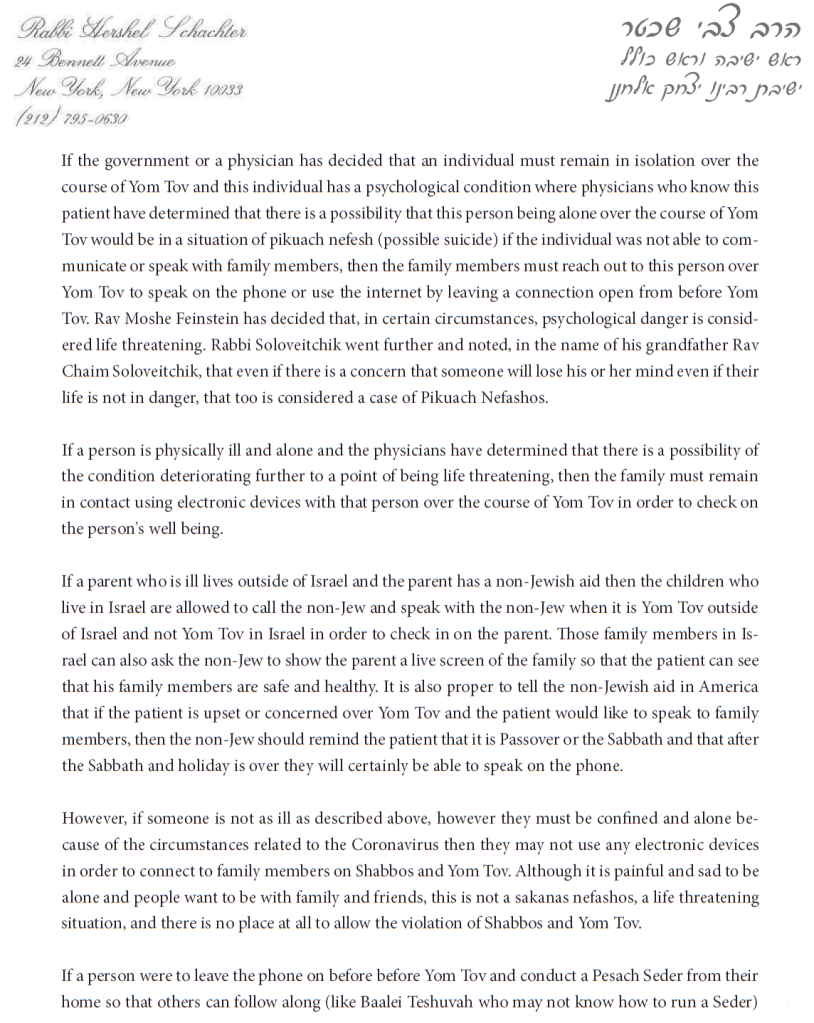
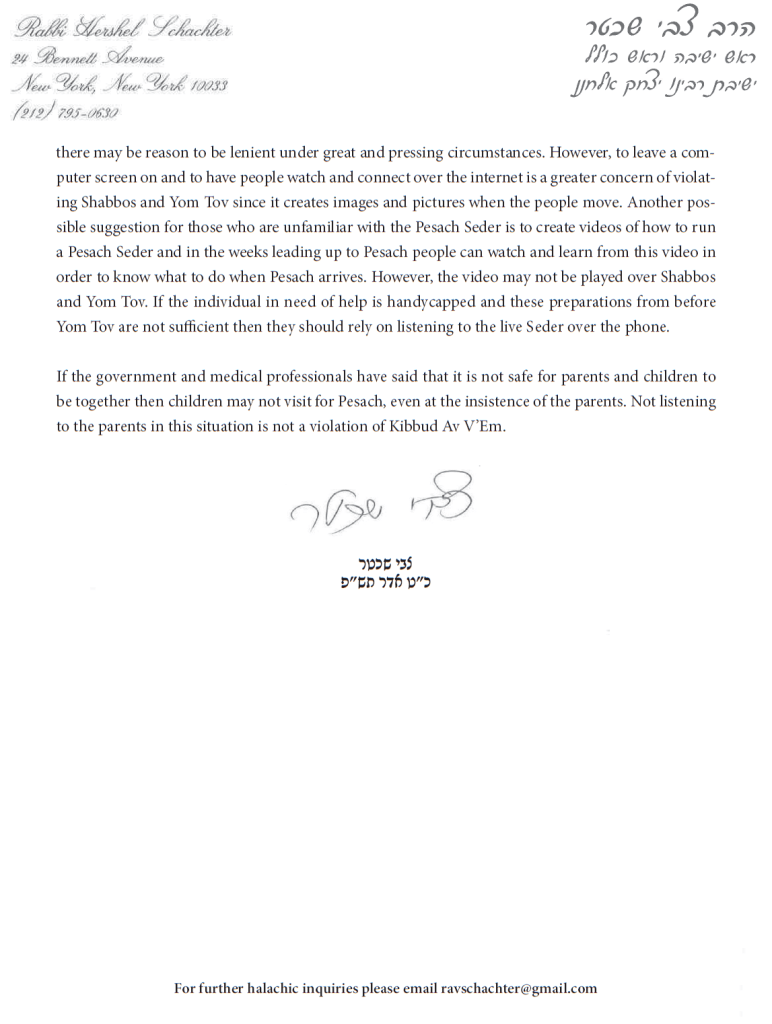
The next day, Rav Hershel Schachter issued the following public psak on the use of electronic communication on Yom Tov:

While the fact that he made such a psak publicly is certainly commendable, and the psak does acknowledge that mental health is just as important when discussing pikuach nefesh as physical health, this psak was made in the shadow of the controversy over the Sepharadi rabbi’s psak, and it shows. While it’s also understandable that a private guidance issued only to rabbis intended to give them the tools they need to then issue their own piskei halacha would be far broader than a psak intended for the general public to apply at their own discretion, the degree to which this psak is guarded and qualifies seems to be a result of the controversy.

The RCA included this psak on its website in a list of general halachos for Pesach during COVID-19.

And while that is significant and commendable, it’s still not enough. We are not doing enough. Our rabbis aren’t doing enough. Our communities are not doing enough.

Some rabbis have been proactive about sending emails or other communications to their community members directly addressing the concerns of vulnerable people in their communities. Some of these messages explicitly state that mental health dangers are considered pikuach nefesh equal to physical health dangers and encourage community members to reach out before Pesach to discuss options for coping with isolation over a three day Yom Tov. Some even went as far as to encourage community members to call them on Pesach itself if they feel they’re in distress and need someone to reach out to.

Other rabbis have opted instead to hold shiurim on the topic and address it during those, no doubt assuming that whatever gets discussed during the shiur will filter out to those who may have missed it. Recordings will likely be made available.

Still others have opted to address the issue very obliquely, asking community members to reach out to them if they have any concerns about their mental health during isolation over the three day Yom Tov, but giving no background or accompanying information.

Many other rabbis have said nothing to their communities about the issue, opting instead to wait until contacted by a community member concerned for their safety over Yom Tov, or are proactively but privately contacting community members they believe to be in potential danger over Yom Tov.

Overall there doesn’t seem to be much of a coherent response by the community at large to address this issue. There’s a psak here, a psak there, some are comprehensive, some are minimal, and some are clearly operating with a complete lack of understanding of the realities of the challenges faced by members of their community.

For example, in his psak Rav Schachter opened by saying that if an “individual has a psychological condition where physicians who know this patient have determined that there is a possibility that this person being alone over the course of Yom Tov would be in a situation of pikuach nefesh (possible suicide) if the individual was not able to com-municate or speak with family members, then the family members must reach out to this person over Yom Tov to speak on the phone or use the internet by leaving a connection open from before Yom Tov.”

The qualification requiring that the person have a diagnosed condition in order to avail themselves of electronic communication on Yom Tov is flatly ignorant of reality. Many people who struggle with suicidal ideation have never been diagnosed. Many have never even seen a therapist. Whether that’s due to stigma, internalized shame, lack of resources, lack of access, or any other reason, the reality of the danger is no less pressing. Furthermore, waiting until someone is experiencing active suicidal ideation before allowing them to avail themselves of electronic communication on Yom Tov is irresponsible.

Additionally, addressing suicide as the baseline for leniency is itself irresponsible. There are many other mental health concerns for which allowances may be issued. For example, exacerbation or relapse of eating disorders, self harm, exacerbation of severe anxiety disorders, severe depression, potential triggering of manic episodes or cycling in a person with Bipolar Disorder, potential triggering of psychosis, and so on. These are complicated issues that can’t be lumped into the category of diagnosed potential risk of suicide.

The issue of course when approaching this kind of public psak is how to balance the need to be inclusive of everyone who may need to avail themselves of the psak against a desire to not give an overly broad public psak which will either be misapplied or dismissed as too lenient. Rabbi Aryeh Klapper wrote a very detailed article laying out the various considerations that go into this process and how they might best be balanced against each other.

There are a number of problems I’m seeing as I examine more and more of the communications sent to different communities.

  1. There is no coherent response to this problem. There is no organizational effort to centralize the response. It’s happening piecemeal and haphazardly.
  2. The politics and meta-halacha of the issue is getting in the way of addressing the actual problem.
  3. There is a fundamental lack of understanding about the realities of the mental health issues faced by many of the vulnerable people these piskei halacha are meant to address, and an apparent lack of will or desire to either become more educated or contact trusted experts on the subject.
  4. There is a lack of self-awareness on the part of many rabbis of how their communities interact with them. This is especially true of many larger congregations and communities.
  5. There is a fundamental lack of trust that laypeople, if actually given the details of the halacha, might apply it reasonably.
  6. There is very little consideration being given to the infrastructure necessary to actually put these piskei halacha into effect.

To that end, I suggest the following:

  1. There needs to be a group of rabbis and mental health professionals put together to address these concerns. These professionals should be available not only to consult on and put forth halachic policy, but also be available for consultation by those who may not have a rabbi or mental health professional of their own.
  2. There should be a guidance issued to community rabbis to proactively discuss the issue with their community members. This guidance should be issued by the group mentioned above. This way there is uniformity in the message, and community rabbis who might feel unequipped to address this issue with their congregation have some materials to help them.
  3. Community rabbis must have access to mental health professionals in the group to consult about the shailos they receive. Not every rabbi can be expected to understand the nuanced realities of mental health issues, and may need help issuing these piskei halacha.
  4. If piskei halacha are going to be issued to people that they may use electronic communication on Yom Tov, there must be someone available to pick up on the other end when they reach out. A psak allowing electronic communication is meaningless if there isn’t anyone for them to communicate with. Community rabbis should either designate themselves as contact people or designate someone else as a contact person (ideally a mental health professional), and should make sure that members who receive an allowance for electronic communication have someone that they’re comfortable talking to when they’re vulnerable, whether that’s the appointed central contact person, a friend, or relative.
  5. Because a rabbi, no matter how well connected to their congregants and no matter how large or small their community, can’t be certain what their congregants may be going through with regard to their mental health, they should make sure to include resources in their communications for crisis intervention services like the National Suicide Prevention Lifeline, and encourage their community members to call those resources if they feel their lives are in danger.

We are living through a crisis the likes of which most people haven’t experienced in their lifetime, and that calls for for extraordinary measures. I urge laypeople reading this to contact their rabbis and impress upon them how seriously this must be taken, and urge them to discuss this openly with their communities.

Standard

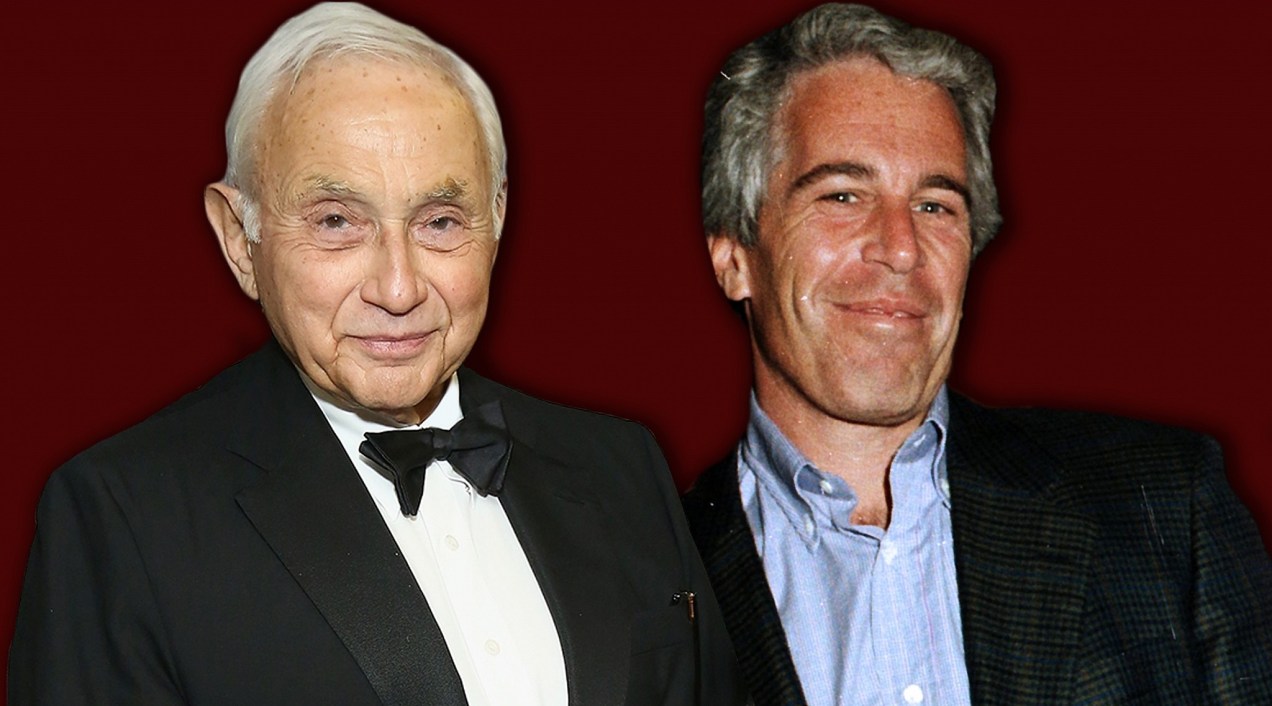
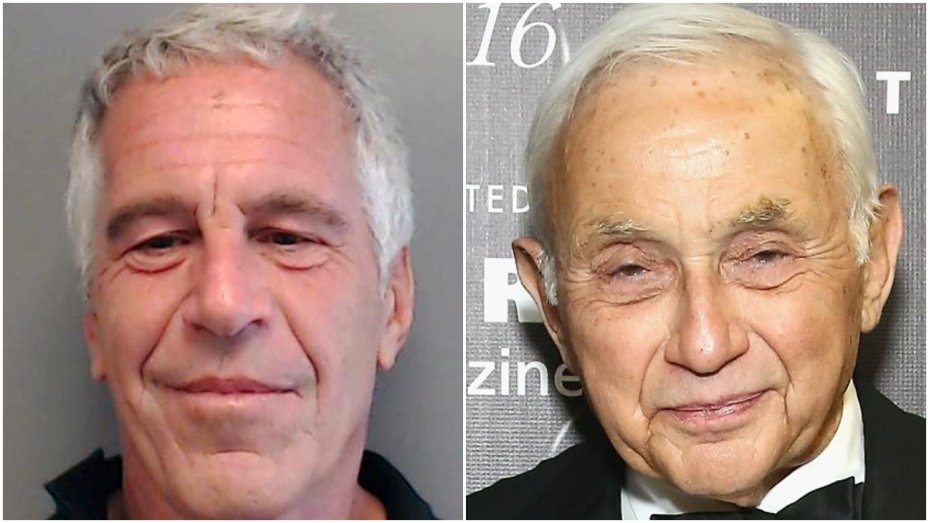
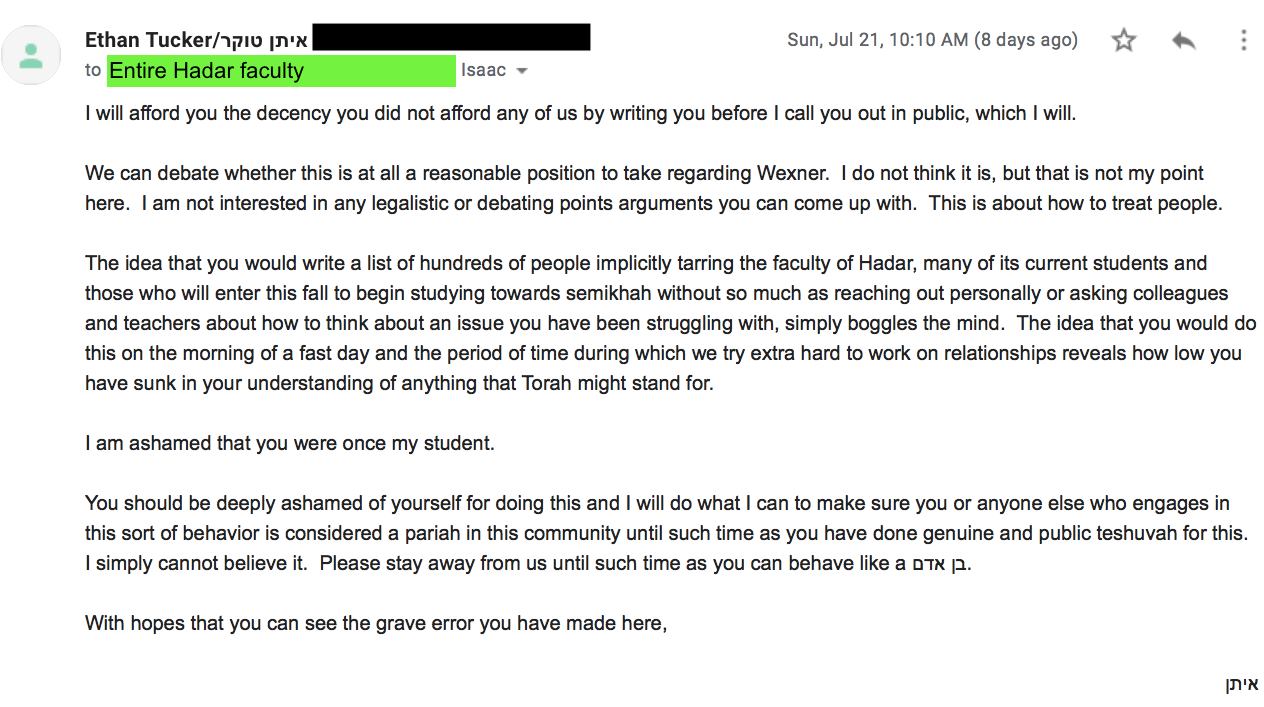
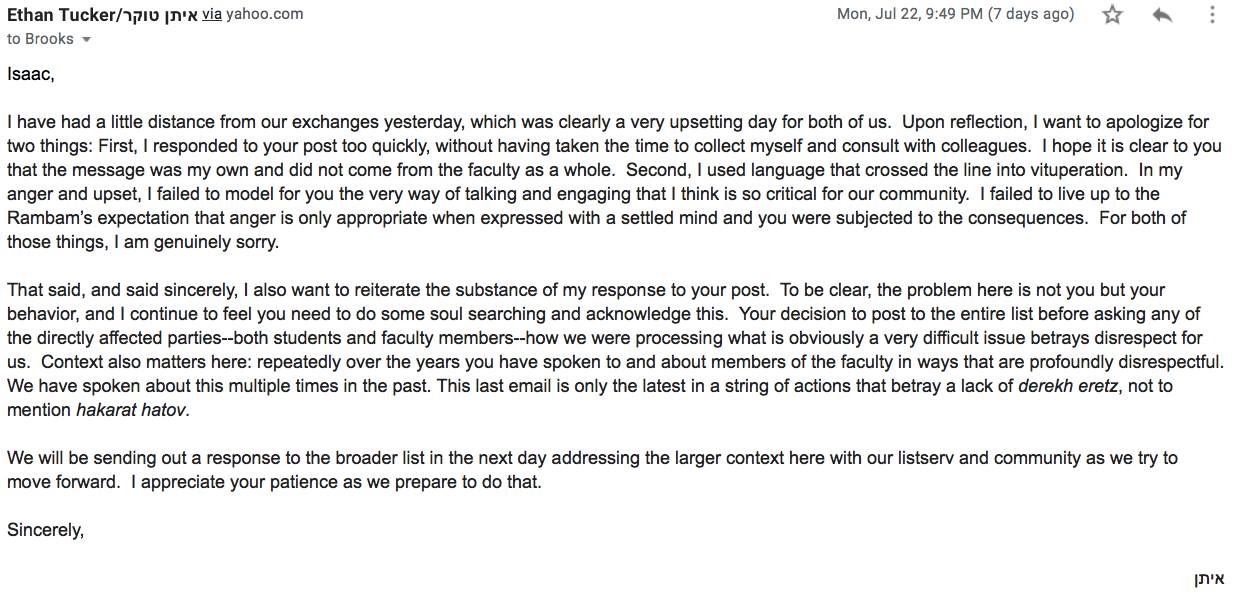
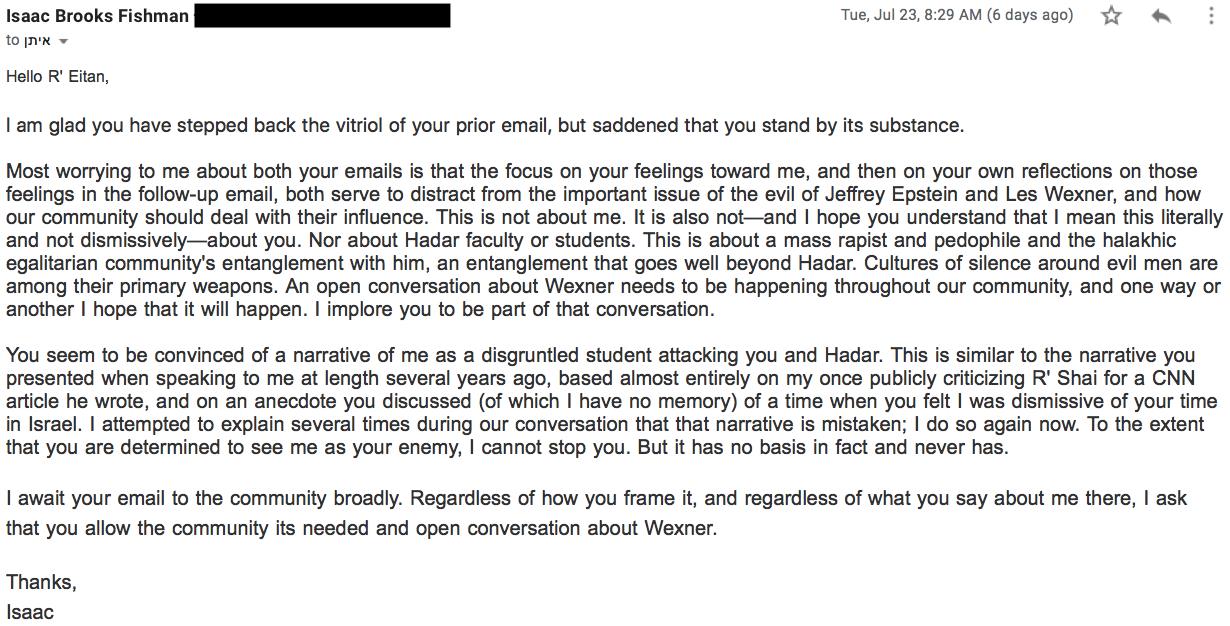
Wexner Independent Review Deliberately Misses the Point

Author’s note: Full text of the investigation report can be found at the bottom of this post. For a previous post with more detail on Wexner’s connections to Epstein, and what Wexner is alleged to have enabled, check out my last blog post on the subject.

Yesterday the Wexner Foundation released the findings of its independent review of its connection to Jeffrey Epstein. Ever since Epstein’s arrest, there has been fierce conversation and debate within the Wexner Foundation’s internal listserv, Wexnet, about how the foundation should proceed, and how Wexner Fellows should react in the wake of the revelations.

The focus of the report, attached below in full, was on three primary questions:

1) What was the nature and extent of Epstein’s relationship and interactions with the Foundation?

2) Did Epstein make any financial contributions to the Foundation and, if so, how did the Foundation use any such contributions?

3) Did Epstein use his ties to the Foundation to commit any crimes?

Unsurprisingly the report’s answers to those questions boiled down to 1) no, 2) no, and 3) no, but let’s break that down.

First the report details the scope of the Foundation’s charitable contributions and the hundreds of millions it’s paid out over the years. It then goes on to claim that white Jeffrey Epstein was a trustee of the Foundation, he had nothing to do with the day-to-day operation of the Foundation, or with the selection of Foundation Fellows. Not that anyone was expecting Epstein to have been ordering the Post-Its and paperclips anyway.

What comes next in the report we can leave to actual reporters, lawyers, and accountants to sort out, but the general gist of it seems to be a series of donations that started with Epstein and ended with Wexner, that the report explains away as being Wexner money to begin with, or technically donations made indirectly to the Wexner Foundation after passing through other charities and foundations. In other words, it’s OK that the Wexner Foundation received money from Epstein because it was just indirect enough to make it plausibly deniable.

The report ends with a statement that Epstein never used the Foundation to commit any of his crimes, and that the Foundation had no contact with Epstein since his resignation in 2007.

But what’s important to note here is not so much the findings of the report but its limited scope. The concern for many advocates was never just whether or not Jeffrey Epstein was using the Wexner Foundation as an entity to commit or enable his crimes, but whether or not Leslie Wexner, the guy whose name is on the Foundation, whose money funds 90% of its work, and whose personal reputation is laundered through the reputation of the Wexner Foundation was complicit in or aware of Epstein’s crimes.

Wexner’s relationship with Epstein goes back to 1986 when Epstein was introduced to Wexner and became his financial manager. By 1991, Epstein had power of attorney over Wexner’s assets, and was in full swing managing them on the L Brands billionaire’s behalf. For two decades Wexner was Epstein’s only publicly known client.

During that time Epstein allegedly used his connection to Wexner to pose as a talent scout for Victoria’s secret, enticing models, many of whom were children, back to his house to talk about their futures at which point he sexually assaulted them. L Brands was allegedly made aware of these assaults, and did nothing to stop them. Epstein was told to please stop claiming he was a talent scout, but was never penalized at all.

This continued for 11 years, from 1995 to 2006.

He allegedly was also sent underage models to be sexually assaulted by a modelling agency used by Victoria’s Secret. Victoria’s Secret continued using that modelling agency despite allegedly being made aware of those allegations. Wexner is also alleged to have done nothing after Epstein allegedly assaulted Maria Farmer at his Ohio home.

Throughout all this time Epstein was developing a reputation for “liking” young girls, and people were starting to take notice. At no point did Wexner indicate any inclination to fire or at least discipline Epstein even though he continued claiming to be a modeling scout for years after the initial complaints were made to L Brands.

Recently there has been increasing coverage of accusations of sexual harassment at Victoria’s Secret, a part of the L Brands company. According to reporting by the New York Times, Ed Razek, an executive at L Brands, was the subject of repeated complaints about how he tried to kiss models, get them to sit on his lap, or touched their crotches, as well as fostering a general atmosphere within the company that was hostile toward the women who worked there and made Victoria’s Secret the money making brand Wexner was making his millions off.

Wexner is alleged to have been well aware of these complaints have is also alleged to have even made inappropriate comments himself. Women who spoke to the Times described being subjected to personal and professional retaliation after disclosing the harassment they’d experienced.

Earlier in February Wexner announced he would be stepping down as CEO of L Brands amid new criticism over this history of sexual harassment.

Along with this independent review released by the Wexner Foundation, its president, Rabbi Elka Abramson, released the following statement to its membership:

Dear Members, Fellows, Alumni and Partners,

As you know, given the concerns expressed by this community, we initiated an independent review of Jeffrey Epstein’s involvement in The Wexner Foundation. The review represents what is widely regarded as best practice in cases like this and is part of our ongoing effort to be transparent and appropriately responsive. Completing this work in a thorough fashion required time.

The Columbus law firm of Kegler Brown was selected by the Foundation to conduct the review, with attorneys Chuck Kegler and Loriann Fuhrer leading the review team. Neither the Foundation nor Wexner family has worked with the Kegler Brown firm previously. The specifics of the process are detailed in the report, which is available to download here.

Listed below are several key findings from the report which, after my own reading, I believe are worth highlighting:
Epstein served as a trustee of the Foundation from 1992 to 2007 when he was terminated by the Wexners and resigned as a trustee of the Foundation.

Epstein was never involved in determining Foundation policy. He never had any role in the Foundation’s day-to-day leadership or activities. He did not have any role whatsoever in screening, identifying or selecting participants for any of our leadership initiatives. Rather, he merely acted as a functionary executing documents and facilitating the required financial support from the Wexners.

Foundation leadership have no recollection of seeing Epstein in the Foundation offices or ever attending any Foundation program or events.

There is no connection between the Foundation and any Wexner-related entity except for the bookkeeping and accounting services provided to the Foundation by the Wexner family financial office.

As previously stated, Epstein never contributed even a single dollar to financially support the work of the Foundation.

The facts regarding the YLK monies, while more complicated, are also clear. As the Wexners have stated publicly, they terminated Epstein in 2007 and severed all ties completely. At that time, a foundation, YLK, was created upon the advice of counsel.

There is no evidence that any Epstein personal, business or philanthropic funds were ever used to support the Foundation’s work.
While not included in the report, I personally asked Abigail Wexner why legal action was not pursued against Epstein once his financial misappropriation was discovered. She explained that given the financial discoveries and what the Wexners were learning about the allegations of sexual misconduct against Epstein being raised in Florida, the Wexners concluded it was in the best interest of their family to avoid ongoing litigation entanglements and to terminate all association with Epstein immediately.

You are encouraged to review the report in its entirety. Other more recent press unrelated to and not intended to be addressed by this report has generated additional conversations and questions from some of you that we are considering. We also are taking time to reflect on the report and review and assess best practices of philanthropic governance. We continue to seek and appreciate your patience even as we welcome all of your feedback.

Finally, together with the entire Foundation team, I thank you for your impassioned belief in our work, your high expectations of us as an organization, and most of all for your continuing leadership in your Jewish communities and the State of Israel.

Let us all move from strength, through every challenge and back to even greater strength,

Rabbi B. Elka Abrahamson
President
The Wexner Foundation

Again, this statement and the report as a whole ignores the actual point here. This isn’t about whether or not Epstein himself used the foundation for his crimes, this is about whether a man who allegedly enabled the wholesale trafficking of children for sex, allegedly deliberately turned a blind eye against Epstein’s Victims when made aware of how Epstein was abusing his position to facilitate his crimes, and who allegedly deliberately ignored rampant sexual harassment and retaliation against its victims within his companies, should be allowed to launder his money through the fantastic work done by the incredible leaders funded by the Wexner Foundation.

Because there is no separating the donor from his actions. Many rich philanthropists use the money they donate lavishly to charity to mask the real harm they’re doing or enabling to real people every day. The Sacklers did it for decades, and are only very recently being held to account. But an important thing to note about the dangers of this reputational laundering through Wexner money: Given how many of our current and future leaders are being funded by Wexner money, it’s safe to wonder whether or not these people who might otherwise be inclined to speak out against the enabling of child sex trafficking, and rampant sexual harassment are equally inclined to decry it when doing so would bite the hand that feeds them?

The issue is not whether retroactively we have to worry about whether or not the money ever touched Epstein, but whether or not going forward the money the Wexners give through their foundation will silence those who want to hold them accountable for what they’ve allegedly enabled.

I have spoken to many Wexner Fellows in the months following the renewed controversy, and many of them have mixed feelings about how to relate to their own participating in the fellowship in the past, and whether or not to accept money in the future from them. I’ve had many similar conversations with beneficiaries of similarly controversial organizations in the past, with varying degrees of discomfort, but what makes the conversation around Wexner and the Wexner Foundation different is the sheer avalanche of money involved. It changes people, changes their attitudes, and changes the ways in which they’re willing to criticize organizations they find to be problematic.

At the end of the day I’ll reiterate my guiding principle:

The second an institution becomes more important than the people it’s there to serve, it no longer deserves to exist.

I call upon the Wexner Foundation to expand its investigation to include not only the narrow scope of Epstein and what his role may have been in the foundation, but also Leslie and Abigail Wexner themselves, what they may have known about or enabled, and whether or not it is ethical to be led by people who may have been able to stop an international sex trafficker but didn’t.

Standard

Our Institutions Owe Us Their Teshuva For Child Sexual Abuse

As we arrive in shul tonight and rise for the Kol Nidre prayer that marks the beginning of our Day of Atonement, the 56th day since the opening of the New York State Child Victims Act Lookback Window will be drawing to a close. Already hundreds of lawsuits have been filed across the religious and secular communities in New York State demanding justice for child sexual abuse that was enabled and covered up by their institutions. In less than two months the lawsuits filed by just a relative handful of survivors represent the prospect of justice for tens of thousands of people who were sexually abused as children and for decades denied their day in court.

Our communities are not exempt from this reckoning. Already several lawsuits have been filed against major Orthodox Jewish institutions, with many more on the way. Because of this outstanding liability many Orthodox Jewish organizations, most notably Agudath Israel of America, lobbied hard against the Child Victims Act. They joined with the Catholic Church and Boy Scouts of America in opposing justice for survivors of child sexual abuse, and in so doing ignored not only the cries of the children abused by their negligence, but their responsibility to do meaningful teshuva for the lives they’ve destroyed.

In the immediate aftermath of the opening of the Lookback Window these institutions, rather than reaching out to survivors and advocates to find out how they could help the survivors in their communities, instead began compiling and distributing lists of defense attorneys willing to take their cases. Their justification for their opposition and response to the Child Victims Act was that these crimes were far in the past, that they’d cleaned up their acts. Evidence to the contrary notwithstanding, never once did they consider their collective obligation to repent for their crimes.

As we head into Yom Kippur and we turn our souls toward repenting for the sins of the previous year, we must insist that the institutions that serve our communities and children do the same. Maimonides, in outlining the laws of repentance, doesn’t merely characterize it as a commitment for the future, but also as an acknowledgement of the sins committed, and an open confession of those sins. Whereas in the case of sins between people and God abandonment of sin, regret, confession, and commitment for the future are sufficient for repentance, that’s not true of sins between fellow people.

For sins that injure another person repentance requires making restitution for the injury, obtaining verbal forgiveness from the injured party, and appeasement of the injured party. While lawyering up and fighting against claims made by survivors of abusive institutions might suffice for the civil process, it does not suffice for the halachic or moral process of how someone responsible for the sexual violation of a child is required to repent for that damage.

In the Haftarah reading for Yom Kippur we read from Isaiah where God rebukes our piety that comes at the expense of others. On the holiest day of the year, on a day when we are commanded to afflict our bodies with fasting to atone for our sins, we read the words of God telling us that the ‘fast’ God actually desires of us is “To unlock fetters of wickedness, and untie the cords of the yoke; to let the oppressed go free, to break off every yoke. To share your bread with the hungry, and to take the wretched poor into your home; when you see the naked, to clothe him, and not to ignore your own kin.” This on a day when we—under penalty of kares—are commanded to fast. God instead entreats us to be just and kind, to support society’s victims, and refuse to abide injustice.

It’s no coincidence that on this holiest day of the year we are reminded that our external pieties are secondary to and can never come at the expense of justice for those who are least able to get it themselves. Our prayers, our fasting, our speeches, our crying, and our repentance mean nothing if we continue to deny survivors of child sexual abuse the justice they for decades have been denied, and if we continue rationalizing why the institutions responsible for violating them deserve not to be held accountable.

Our concern as a community must always be centered around the people these institutions were meant to serve and protect, and when those institutions fail, when they are responsible for the sexual abuse of children, we must demand that they make restitution for those crimes. We must support the survivors of those crimes, and we must stand with them in demanding justice.

The second an institution becomes more important than the people it serves it no longer deserves to exist.

If we are to grow as a community and move forward together into a safer era for our children we must first atone for the sins of our past. We must stand with the people violated by those sins. We must learn from our sins, we must listen to and learn from the survivors’ stories and experiences, and we must use them to grow in the future.

Otherwise our pieties, our fasts, our prayers, and our institutions are nothing more than empty mockeries of what God actually wants from us on Yom Kippur.

Standard

Dr. David Pelcovitz’s Troubling Track Record on Child Sexual Abuse

In May of 2012, Evan Zauder, then a rabbinical student at Yeshiva University and 6th grade teacher at Yeshivat Noam in Paramus, NJ, was arrested for receipt, possession, and distribution of child pornography, and for using the Internet to entice a minor to engage in illegal sexual activity. He pled guilty in January of 2013 and was scheduled for sentencing in April of 2014. Prior to his sentencing, there was an outpouring of support by many leaders in the Orthodox Jewish community.

Notable among those who wrote positive sentencing recommendation letters requesting leniency were Rabbi Kenneth Brander, who at the time was the vice-president of Yeshiva University and now serves as president and rosh yeshiva of Ohr Torah Stone, Rabbi Steven Pruzansky,  former vice president and Executive Committee member of the Rabbinical Council of America and rabbi of Congregation B’nei Yeshurun in Teaneck, Rabbi Ezra Schwartz, rosh yeshiva at the Rabbi Isaac Elchanan Theological Seminary (RIETS), Rabbi Reuven Taragin, dean of overseas students at Yeshivat Hakotel, Rabbi Baruch Taub, founding rabbi and rabbi emeritus of Beth Avraham Yosef of Toronto (BAYT), the largest Orthodox Jewish congregation in Canada, and Dr. David Pelcovitz, Gwendolyn and Joseph Straus Chair in Psychology and Jewish Education at the Azrieli Graduate School of Jewish Education and Administration at Yeshiva University.

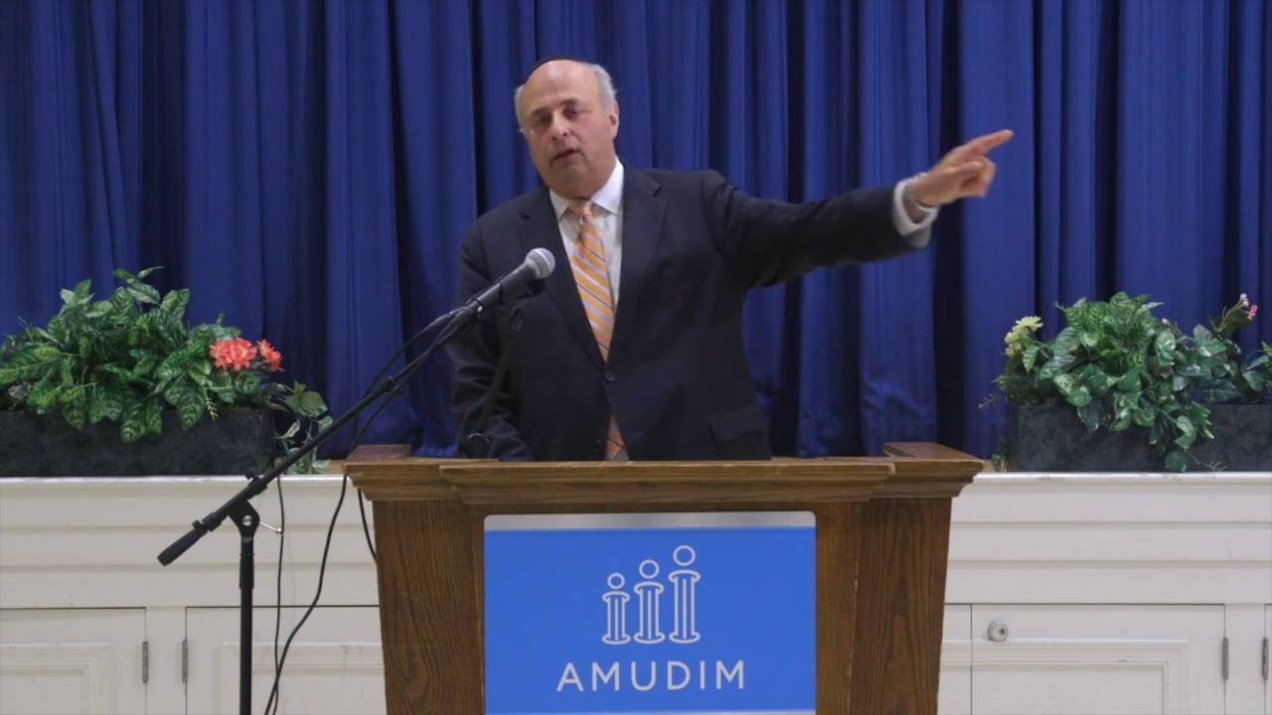
Dr. Pelcovitz is something of a standout in that group because of his renown as an advocate for survivors of child sexual abuse. Dr. Pelcovitz has spoken at countless conferences and seminars on the topic of child protection and abuse prevention education and is considered by many to be a leader in the field of abuse within the Orthodox Jewish community. He currently sits as the chair of the board of advisors for Amudim, the largest Orthodox Jewish victim services organization in the United States.

In his sentencing recommendation letter for Zauder, Dr. Pelcovitz stood on his extensive credentials and experience when he wrote, “…I spent most of my career treating the victims of child sexual abuse in the specialized clinical and research program that we has at the North Shore University Hospital, which was then part of the NYU School of Medicine. In light of this expertise and the qualities I saw in Evan when he was my student, I hope that this letter can provide a perspective that can help justice be tempered with mercy when Evan is sentenced.”

He then went on to imply without saying it that he had seen Zauder clinically following his arrest, which was not the case:

“In my interactions with Evan during and after class, what came through most, was his warmth, empathy, concern for others and genuine commitment to serve the community. In my meeting with him after his arrest he wasn’t in the least bit defensive about his actions. He expressed sincere regret and remorse, wishing that he has the strength to get professional help for his problem before they reached the disastrous proportions that brought him to your courtroom.”

In other words, Dr. Pelcovitz had no knowledge whatsoever of Zauder’s crimes while he was his student, and never treated him clinically.

Dr Pelcovitz continued, having never seen Zauder clinically, “In over thirty years of practice, I have had the opportunity to treat many individuals with issues in the area of controlling their sexuality. As you know, the prognosis for sustained change is often guarded. In the case of Evan, however, I believe that he possesses many of the ingredients that I have come to associate with sustained change and potential to be a valuable member of society…”

He then proceeded to ask the judge to give Evan Zauder the minimum possible sentence.

Setting aside the fact that this level of concern is rarely shown for victims of sexual abuse within the Orthodox Jewish community, Dr. Pelcovitz’s letter was particularly disgusting to the survivor and advocacy communities because most people would agree that someone who claims to be an advocate on behalf of survivors should not be writing sentencing recommendation letters on behalf of abusers, especially when that advocate deliberately attempts to mislead the court into believing that the basis for his opinion on the abuser is clinical rather than personal.

But what’s even more concerning about Dr. Pelcovitz is that this is far from his first questionable decision with regard to sexual abuse.

In 2011 after Agudath Israel published its halachic ruling requiring survivors of child sexual abuse to ask permission of a rabbi before reporting to the authorities, they rolled out a companion plan to implement abuse prevention measures in yeshivas. This included mandating windows in all classroom doors, advocating for cameras in classrooms, instituting basic child safety protocols, and organizing abuse prevention events for parents and teachers around the community.

One of the speakers on Agudath Israel’s circuit for this campaign was Dr David Pelcovitz. In May 2012, Dr Pelcovitz was speaking at such an event alongside Debbie Fox of Magen Yeladim, and David Mandel, CEO of Ohel. Following the event, a parent approached Dr. Pelcovitz and asked him what to do if he becomes aware of a molester. Dr Pelcovitz then admits that the panel purposely didn’t touch on the issue of reporting child sexual abusers to the authorities because they were told not to by the organizers of the event.

In a 2017 presentation for an abuse prevention event for CHANA, a Baltimore-based Orthodox Jewish community helpline for survivors of abuse, Dr Pelcovitz spoke about the importance of having frank conversations with children about their right to assert themselves in unsafe situations. He added the caveat that it should be done in a way that isn’t “chutzpahdik,” or disrespectful:

“…letting them know that there are times that if adults do things that make you a little bit uncomfortable you have a right to tell them in a way that’s not chutzpadik, but you have a right to tell them. “

This is something that flies in the face of any recognized best practice where abuse prevention education is concerned. Children, when asserting themselves in an abusive or unsafe situations, should not be burdened with the responsibility of being concerned with the feelings of the adult who is making them feel unsafe.

Last Wednesday, following the arrest of SAR associate principal Rabbi Jonathan Skolnick for production of child pornography, Dr Pelcovitz was brought in by the administration to address parents’ concerns in the wake of the arrest. Information had surfaced the day before Dr Pelcovitz’s presentation that a number of students had been contacted by Rabbi Skolnick through several of his aliases. Within the first ten minutes of his address, Dr Pelcovitz was asked about his letter of recommendation for Evan Zauder.

His response to the inquiry was defensive, dismissive of the severity of his actions, and annoyed at being asked the question at all.

He began by characterizing his plea to the court on behalf of Zauder not as an appeal for a shorter sentence, but as an appeal to the judge to “temper justice with mercy.” He describes being asked by Zauder’s attorney and therapist, whom Pelcovitz admitted to having relationships with in the past, to write the letter. Dr. Pelcovitz then went on to explain that his “working supposition, based on what I was told and based on what was released to the public at the time,” was that Zauder had been in possession of child pornography, but not that he had “actually abused.” “Had I known that Evan had actually abused,” Dr Pelcovitz said, “which is something I didn’t find out until much later, I never, ever, would have written the letter.”

It should be noted that the information was public at the time, and had not only been in the release by the Department of Justice, but had also been in several news outlets at the time, and that Dr Pelcovitz had specifically requested the minimum legal sentence in his letter, despite claiming otherwise in his presentation.

Dr Pelcovitz then finished with an aggrieved challenge to the attendees:

“There are other background reasons that go behind my writing that letter that’s extremely frustrating to me that I can’t share—and I don’t want to sound at all defensive—but basically it was a mistake, it was a big mistake, and I apologize for that mistake. Ok? We hear it? Anybody wanna yell at me or push back on me? Ok? We’re good?”

Following the presentation, several parents complained to the SAR administration about the tone-deaf irony of having someone who wrote a sentencing recommendation on behalf of a child sexual abuser convicted for luring a 14 year old to have sex with them and possession and distribution of child pornography speak to parents in the aftermath of such a similar case.

But the issue isn’t necessarily that SAR reached out to Dr. Pelcovitz as a trusted and well-known expert in the dizzying aftermath of their associate principal’s arrest. It’s the fact that he remains a trusted expert despite his very questionable history of collaborating with Agudath Israel following their psak, deliberately failing to instruct parents of their responsibility to report sexual abuse to authorities, writing a sentencing recommendation letter for a convicted pedophile, and advising parents that they should instruct their kids to not be chutzpahdik when asserting themselves in unsafe or abusive situations.

While there can be no doubt that Dr. Pelcovitz’s credentials are impressive on paper, in practice his record gives cause for concern. He is by far not the only recognized expert in the Orthodox Jewish community on child sexual abuse. However, he is one of several recognized experts who seem to have other priorities where child sexual abuse and prevention and institutional and communal concerns intersect.

Advocates on behalf of survivors of child sexual abuse must have only one concern, one priority when addressing the needs of survivors: The best interests of children and survivors. How to secure justice for them in the wake of abuse, how best to support them when they come forward, and how best to prevent them from being abused in the first place. Concerns about chutzpah, or institutional finances, or communal image have no place in an advocate’s priorities. Dr Pelcovitz’s record on this should be of great concern to any school administrator or community leader looking for a recognized expert to address parents or teachers about child sexual abuse and prevention.

Standard

Amudim is Part of the Problem

Here’s the problem with the way we’ve been conditioned to respond to things like Zvi Gluck deliberately lying to survivors about their rights under the Child Victims Act. We’ve grown so accustomed to the status quo being so incredibly terrible that we’ve lost sight of what the right thing actually looks like, and we’re therefore so much more willing to sycophantically lick the boots of the people who throw us enough crumbs to stay quiet than we are to hold them and the systems that protect abusers accountable.

To give an example. I just got off the phone with someone who called me regarding a quote I shared from Zvi Gluck in which he defended his decision to not publicly make his followers aware of their rights under the CVA, and lie about it in an op-ed he wrote shortly after it passed.

According to Zvi Gluck, director and founder of Amudim, one of the largest victim-service organizations in the Orthodox world, with an annual operating budget of $7 million, efforts not to publicize the one-year look-back provision and extended statute of limitations for civil suits were intentional, based on the organizations prerogatives.

Gluck said the organization chose not to speak out publicly because he did not want to “risk causing secondary trauma for survivors.”

“If we publicized about these new legal options and survivors chose to bring their cases back to court only for those cases to be dismissed, we could cause even more trauma for survivors,” he said.

Zvi Gluck to Hannah Dreyfus of the Jewish Week


The person I spoke to said that whatever my opinions of Zvi Gluck, didn’t I think think that what he was doing was a net positive? After all, he’s saying things no one else is saying in the community. He’s helping people no one else wants to help.

Those things are great, but here’s the issue: Zvi Gluck is part of the problem he claims he’s helping to fix.

Awareness was definitely an issue in the frum community ten years ago. To even discuss sexual abuse, to even acknowledge its existence was taboo. The people talking about it, like Nuchem Rosenberg, Shmarya Rosenberg, and Paul Mendlowitz, were considered fringe nutjobs yelling about something that people didn’t believe was a problem.

Ultimately, however, thanks to their efforts, the efforts of those who came after them, and increased general coverage of child sexual abuse in the press, the public is now aware that it exists and that it’s a problem. That’s not to say that awareness campaigns are not important. There are anyways people who remain unaware, and survivors who feel alone in their experiences who need to be reached. But the issue of awareness existing in the community has in large part been addressed. We’re aware. Now what.

When Zvi Gluck and people like him get credit for raising awareness in the community, what’s not being addressed are the systems in place in the community that actively silence survivors. It’s not because the community is unaware of sexual abuse that Yated, Hamodia, Mishpacha, Ami, and Yeshiva World don’t allow any mention of child sexual abuse in their publications. It’s because the rabbonim and community leaders who dictate what does and doesn’t get printed in those publications decided to either explicitly or implicitly forbid it.

If you’re aware of child sexual abuse, especially if you’re a survivor, and you look around you in the general world and see everyone talking about it, and then you look around in your community and see a complete moratorium on any public discussion of it, you get the message very clearly that the community does not care about you and does not want to hear or help you. That’s by design. It’s not due to a lack of awareness.

When I began leading protests for ZA’AKAH in the community, I expected a fierce backlash. I was doing something that hadn’t been done very much before, and I was being loud, rude, and in-your-face about it. We stood on street corners outside of shuls, and yeshivas, and we yelled and chanted about sexual abuse.

And the response was overwhelmingly positive.

People came over to us and offered us water. They took our fliers. They talked to us, and asked us questions. Some even waited until the end of the protests and thanked us, or asked us for help with situations they were dealing with. While there was some negative response, and even one violent incident, the response was overwhelmingly positive.

The awareness is there. The people know that sexual abuse is a prevalent problem. What they don’t have is anyone to stand up for them when they want to report sexual abuse. They don’t have anyone who will protect their jobs, their homes, their children’s educations, when they dare to come forward against their abusers and the people who enabled them.

And that’s really what they need, and they need it to be public and full-throated. They need to hear that reporting sexual abuse is the right thing to do. They need to hear that any rav who tells them otherwise is wrong. They need to hear that they’ll be supported. They need to hear from the people with the resources and communal and political capital that they will be supported if they come forward.

And Zvi Gluck could have been all of those things, but instead he chooses to protect the systems and institutions that continue to silence survivors.

That’s the real problem with giving people credit for simply saying things that no one else is saying without backing it up in action. We know, for the love of God, we know that sexual abuse is a problem. We live it. We’ve survived it. Amudim has an annual budget of 7 million dollars. It is run by a very prominent and well-respected member of the community, whose father is even more prominent and well-respected. The only excuse for such an organization to lie to its constituents about their rights under the CVA is if they’re trying to maintain the status quo. If anyone can get away with pushing the envelope, so to speak, it’s Amudim and Zvi Gluck.


And to the argument that they’re trying to change things from the inside I ask, but how many people are you hurting along the way, and how long must they wait for you to do the right thing? The community will not change until pushed, and until community leaders and rabbonim can no longer point to Amudim and use them as pretext to claim they’re taking the issue seriously, nothing will actually change. And when it eventually does in spite of them, it will come after hundreds and thousands of broken survivors who needed help but couldn’t find it.

It’s telling that the response Zvi Gluck gave the Jewish Week about why Amudim wasn’t informing survivors of their rights under the CVA was couched in concern for victims.

‘“If we publicized about these new legal options and survivors chose to bring their cases back to court only for those cases to be dismissed, we could cause even more trauma for survivors,” he said.”

Zvi Gluck to Hannah Dreyfus of The Jewish Week


Every other victims services organization like Safe Horizon, and Zero Abuse Project has to deal with similar issues. They field calls from survivors looking for help finding legal representation, and some people have viable cases, and some people don’t. Some people will win their cases and some people don’t.

The correct answer to that problem is not to lie to your constituents and pretend that their rights don’t exist for their benefit, it’s to be honest with them, inform them of the risks, and then make sure that they understand that you will be there for them and support them through whatever happens.

Survivors have been lied to for long enough. They’ve had their trust violated for long enough. They’ve been held hostage by oppressive community systems and silenced in the interest of institutional concerns for far too long. We’re all aware of it. Now what are we going to do about it?

Standard

Epstein, Wexner, and Our Communal Reckoning with Dirty Money

In the wake of the recent resurfaced allegations against alleged child sex trafficker Jeffrey Epstein, much attention has been given to the people around him who for many years enabled his well-known sexual abuse of children. Perhaps most notable among these enablers is Leslie Wexner, whose foundation has issued many scholarships to some of the Jewish community’s most influential up-and-coming leaders, and donated to many institutions across our community. When the allegations of Wexner’s complicity arose, we all knew that a reckoning was imminent, but it seems that Mechon Hadar has beaten everyone else to the punch, and not in a good way.

Above I’ve shared screenshots of an email conversation my friend Ike Brooks Fishman had with the Rosh Yeshiva of Mechon Hadar, Rabbi Ethan Tucker, regarding an email Ike sent to the Hadar community listserv. Ike had emailed the listserv to start a communal discussion about how the community would and could respond to its entanglement with Les Wexner in light of his close partnership with alleged international sex-trafficker and child rapist, Jeffrey Epstein.

It should also be noted for general context going forward that Wexner stands accused not only of being Epstein’s only public (and very wealthy) client despite almost undoubtedly knowing of Epstein’s horrific crimes, but also of allowing Epstein to sexually abuse women in his Ohio home. This was not raised in Ike’s emails, but it is relevant to the general conversation about how the Jewish community in general will have to contend in the coming months with Wexner and his various philanthropic endeavors.

Leslie Wexner is the founder and CEO of L Brands (formerly Limited Brands), which among many other things, owns Victoria’s Secret. This is notable because Epstein is accused of posing as a talent scout for Victorias Secret as early as the mid-90s, and using that as a pretext to lure models back to his hotel room for auditions, where he would sexually assault them. L Brands was allegedly made aware of this at the time and did not sever its relationship with Epstein, nor did it seem to take any steps to make Epstein stop representing himself as their employee.

He allegedly was also sent underage models to be sexually assaulted by a modelling agency used by Victoria’s Secret. Victoria’s Secret continued using that modelling agency despite allegedly being made aware of those allegations. As mentioned above, Wexner is also alleged to have done nothing after Epstein allegedly assaulted Maria Farmer at his Ohio home.

The closeness between Wexner and Epstein and his ever-growing list of accusers paints a clear picture of either active or tacit complicity on the part of Leslie Wexner in the crimes of Jeffrey Epstein.

The other thing Wexner is famous for, particularly in the Jewish community, is the philanthropic works of the Wexner Foundation, which invests in the future of Jewish leaders and institutions. One of the most sought after scholarships in the Jewish community is the Wexner Graduate Fellowship, which is awarded to 20 promising graduate students every year, and is a very prestigious line on any resume.

What makes the issue of Wexner particularly touchy for Mechon Hadar and Rabbi Ethan Tucker, is the fact that Rabbi Tucker, along with the other two founders, Rabbis Elie Kaunfer, and Shai Held are all Wexner Fellows. The Wexner Foundation website hosts a lot of content created by all three of them. The Wexner foundation has also funded several programs over the years in conjunction with Mechon Hadar. It’s unclear what the total amount of either actual or in-kind contributions Mechon Hadar has received from the Wexner Foundation, but it’s clear that there is a close friendship between the two institutions.

The Wexner Foundation for its part claims that Leslie Wexner severed his connections to Epstein 12 years ago, evidence to the contrary notwithstanding.

Which brings us back to Rabbi Tucker’s reaction to Ike’s initial email to the listserv. When the new allegations against Epstein broke, and Wexner was almost immediately implicated, there was a collective browning of many a pair of pants among the Jewish community and its institutional leadership. Wexner has donated millions over the years, given scholarship to scores of the most recognizable names in our communities, and that realization no doubt caused a panic in many of those people and institutions. Ike no doubt touched an extremely raw nerve with his first email, which is likely what caused Rabbi Tucker’s vitriolic response.

I am ashamed that you were once my student.

You should be deeply ashamed of yourself for doing this and I will do what I can to make sure that you or anyone else who engages in this sort of behavior is considered a pariah in this community until such time as you have done genuine public teshuvah for this.

Rabbi Ethan Tucker to Ike Brooks Fishman

But here’s the thing. This is not Hadar’s problem exclusively. It’s not Rabbis Held, Kaunfeld, and Tucker’s problems exclusively. This is about how we as a community are going to deal with the fact that one of our most prominent philanthropists now stands accused of at the very least enabling the rape and sexual assault of countless children. In the coming months the Jewish community at large will be grappling with questions like whether or not to scrub Wexner Fellowships from resumes, whether or not to return unspent Wexner Foundation grants, how to address the connections between the Wexner Foundation and community institutions, and whether or not the Jewish Community as a whole should turn its back entirely on Wexner, his foundation, and his money.

These conversation must be had in public. They must be had broadly among members of the affected communities. Silence is what allowed Epstein to continue committing his crimes against children. Silence is what enabled the shameful plea deal reached between Epstein attorney Jay Lefkowitz and then US Attorney Alex Acosta. Silence is what enables the abuse of children every day in our communities. Silence encourages impunity.

The faculty, student body, alumni, and communities surrounding Mechon Hadar have a difficult conversation in their collective future, but so do many other institutions and communities. Perhaps we in the broader Jewish community should all have known better. Perhaps we all turned a blind eye the first time Epstein was accused. Perhaps in the past we’ve been enticed by Wexner’s money, and the good things we believed we could do with it. But that era is over. We know too much to remain silent any longer.

I’m not going to pile on Rabbi Tucker and hold him uniquely responsible for disavowing Wexner and distancing himself from anything connected to him. That responsibility falls on all of us. What I will say is that this is a teachable moment that we shouldn’t allow to slip by unnoticed. The way Rabbi Tucker responded to Ike’s email while understandable is entirely inexcusable. The response to calls for transparency and reflection around the issue of sexual abuse can never be silence.

I wish Mechon Hadar, its leadership, its community, and all the institutions and communities within the Wexner foundation orbit much luck in the coming months as they address how best to disentangle themselves from his money and influence.

One thing is for sure. I and many others will be watching very closely.

Standard

Child Victims Act Passes NY Legislature, Agudah Still Opposed

This past Monday, the New York State Senate voted unanimously to pass the Child Victims Act, and the assembly voted 130-3. Governor Cuomo is expected to sign it into law within the coming days. The votes themselves were powerful and emotional to experience. Many senators rose to speak about why they support the legislation, and one senator and several assembly members talked about their own personal experiences as survivors of sexual abuse.

Senator Alessandra Biaggi spoke about being sexually abused when she was younger, and described how her “silence lasted for over 25 years.” Assembly member Yuh-Line Niou broke down in tears as she described in vivid detail being abused by a teacher at the age of 13. “I can still smell him,” she said. Assembly member Rodneyse Bichotte revealed that she was abused by a pastor when she was 10 years old, and Assembly member Catalina Cruz disclosed being abused by a family member.

When the results in each house were announced, everyone in the chambers erupted into applause. Many of the survivors who fought for the Child Victims Act were in attendance, and there were many teary eyes as they embraced each other, overcome by the emotions if finally seeing New York State almost unanimously acknowledge their suffering and finally bring them an opportunity for justice.

The Child Victims Act includes the following provisions:

1) Raises the criminal statute of limitations for sexual abuse to age 25 for misdemeanors, and age 28 for felonies.

2) Raises the civil statute of limitations for sexual abuse to age 55.

3) Eliminates the 90 day notice of claim requirement for civil actions related to child sexual abuse against public institutions.

4) Opens a one-year lookback window, effective 6 months after the bill is signed into law, during which any cases previously barred by the statute of limitations could be brought to civil court.

While the Catholic Church had retracted its opposition to the Child Victims Act by the time it went to the floor for a vote, Agudath Israel had not. In a statement released shortly following the passage of the bill in the senate and assembly, Agudath Israel released a statement condemning the lookback window for its potentially devastating effects on liable institutions. The statement also included a commitment by Agudath Israel to fighting the “terrible scourge” of abuse going forward. It’s worth noting that despite this statement, Agudath Israel’s official policy is still to require rabbinic permission before sexual abuse is reported to police.

While there undoubtedly may be parties who are inconvenienced by any school or institutional closures that result from lawsuits allowed under the Child Victims Act retroactive window, our primary concern must always be for the survivors of sexual abuse who were abused because of the negligence or intentional malice of these institutions. Those survivors haven’t forgotten what was done to them. The pain hasn’t faded. They not only live with the violation of their bodies and souls every day, they also live with the betrayal they experienced at the hands of people, institutions, and community leaders in whom they had placed their trust. 

That harm doesn’t go away, and neither does the liability to make reparations. In the same way institutions, despite changes in leadership or location, stand on their legacies and reputations of previous administrations for the purposes of fundraising or promotion, they must also accept responsibility for the actions of previous administrations when those actions so fundamentally damaged other people. In the same way institutional debts and bills aren’t wiped clean when administrations change, neither are institutional liabilities for enabling and covering up sexual abuse. 

These institutions owe a debt that must be paid to the parties who were made to suffer by that institution’s actions. Abuse is a particularly insidious crime in the way it not only affects individuals, but their families and communities. Not only do the victims suffer, but so do their families, as the pain of the abuse, the aftermath, the backlash, and the community ostracism radiates outward. Generations afterward feel it as parents who were abused and still suffering pass the trauma on to their children who have to witness the pain of their parents. Communities feel the pain when they are split apart in the wake of a report to authorities that pits rabbis and community leaders against survivors and their friends and families. And on the other side, the families of the abusers are also harmed by the actions of the abuser. 

And yet, the suffering of the victim demands justice, because a crime was committed, a child was violated, and for that there’s a price that neither time nor outside considerations can mitigate. So the families of the abuser suffer along with them as their loved one is charged, imprisoned, and registered as a sex offender. Constituents of institutions suffer when their institutions are forced to downsize or close. Ultimately, however, the responsibility for all of that harm, both the direct harm to the victims and the collateral damage caused to all of the otherwise innocent bystanders, lies squarely with the abusers and the people who enabled and covered up for them. 

Survivors are owed these reparations the same way the power company is owed its fees for electricity, and the water company is owed its fees for running water. Even more so because one has no moral obligation to have power or running water, but one does have a moral obligation to protect children from sexual abuse, and immediately report the abuser to authorities if, God forbid, someone does abuse a child. 

Standard